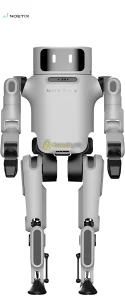
What is the Dora Noetix?
The Noetix DORA is a prototype compact humanoid robot from Shenzhen-based Noetix Robotics (China). Standing 100 cm tall and weighing 20 kg, it is designed for social interaction and assistance in homes, elder-care facilities, and educational settings. Its 26 degrees of freedom enable expressive gestures, while Nvidia Jetson Orin edge AI powers real-time visual and voice processing via three structured-light depth cameras. DORA features large language model (LLM) integration for natural speech interaction yet lacks hands or manipulators—its ‘0 fingers’ specification indicates an absence of dexterous end effectors in the first prototype. The robot is all-electric with a maximum walking speed of 3.6 km/h (1 m/s) and a payload capacity of 5 kg, targeting safe human coexistence.
Specifications
Here are the full technical specifications.
| Spec | Value |
|---|---|
| Height | 100 cm |
| Weight | 20 kg |
| Degrees of freedom | 26 |
| Battery life | Not specified |
| Max speed | 3.6 km/h |
| Payload | 5 kg |
| Price (new) | Undisclosed |
| Price (used range) | N/A |
Price & Value
New MSRP: Undisclosed
Used range: N/A
As a pre-commercial prototype, Noetix has not disclosed a price for DORA. Comparable social humanoids like SoftBank’s Pepper sold for around $20,000–$25,000 new, but DORA’s compact size and simpler actuation could position it in a lower bracket if mass-produced. Without pricing, value assessment is speculative; however, the integration of LLM speech and Nvidia edge AI suggests a significant software-focused value proposition. Total cost of ownership will depend on service contracts, battery swaps, and software licensing—none of which have been detailed. For researchers and early adopters, the cost to acquire a prototype unit may involve partnership agreements rather than a standard purchase. Until commercial pricing emerges, DORA remains an aspirational option rather than a buyable product.
Who Is It For?
Best for: - Elder-care facilities evaluating lightweight companion robots (compact, safe, and interactive) - Educational robotics labs exploring LLM-powered humanoid social interaction (26 DOF for gestures, Nvidia edge computing) - Home assistance pilot programs focused on speech-based companions (no heavy lifting capability)
Not for: - Heavy material handling (payload limited to 5 kg, no manipulators or fingers) - Outdoor or industrial environments (indoor-only operation, estimated IP rating not specified) - Buyers seeking an immediate purchase (prototype only, no commercial sales)
Alternatives & Comparison
While the Noetix DORA is still in prototyping, potential buyers evaluating compact social humanoids have a few existing platforms to compare—though none match its exact size and software integration.
| Model | Price | Available | Key Difference |
|---|---|---|---|
| SoftBank Robotics Pepper | $20,000–$25,000 (discontinued; used market) | no (discontinued) | Larger (1.2 m, 28 kg) with touchscreen and manipulator, but older software and no LLM integration |
| UBTECH Walker S | ~$100,000 (est.) | preorder | Full-sized (1.45 m, 80 kg) with manipulation, not a compact social companion |
| Fourier GR-2 | ~$120,000 (est.) | preorder | Heavy-duty research humanoid (1.75 m, 60 kg), unsuitable for home/elder care |
Verdict: For organizations needing a small, interactive humanoid right now, the discontinued Pepper remains the only proven option—but its limited availability and outdated AI make DORA an appealing future alternative. Walker S and GR-2 are overkill for simple companionship tasks. If DORA reaches production at a price below $15,000, it could dominate the compact social humanoid niche. For now, early-stage pilots should engage Noetix directly for potential prototype access.
Use Cases & Capabilities
Elderly Companionship and Monitoring
DORA’s compact stature and natural speech capabilities make it a candidate for elder-care facilities, where it can wander common areas, converse with residents, and remind them of schedules or medication. Its 5 kg payload allows carrying small items like medication blisters or a tablet for video calls. The lack of hands limits physical tasks such as opening doors, but its always-on LLM integration can provide cognitive engagement and reduce loneliness. Safety is enhanced by its all‑electric drive and intent to operate alongside people.
Home Assistance for People with Disabilities
For individuals with mobility or visual impairments, DORA could act as a voice‑controlled companion that fetches light objects, reads out notifications, and controls smart home devices through voice commands. Its compact form factor (1 m tall) allows it to navigate tighter spaces than larger humanoids. However, its inability to manipulate objects with hands would require retrofitted tool attachments for tasks like opening cabinets. Prototype demos show it moving reliably at 3.6 km/h, but real‑world obstacle avoidance among furniture remains to be validated.
Educational and Research Platform
University robotics labs can use DORA as a platform for teaching human‑robot interaction, AI, and bipedal motion planning, thanks to its accessible Nvidia Jetson compute and LLM‑based dialogue. Its relatively low weight (20 kg) and non‑hazardous all‑electric design lower safety barriers compared to heavy industrial humanoids. The 26 DOF allow researchers to experiment with expressive gestures and gaits, while the lack of hands means they can focus on software and sensing without complex manipulation hardware. Early‑stage prototype access programs could offer hands‑on experience for students.
History & Background
Noetix Robotics emerged in 2024 as a Chinese startup focused on affordable humanoid platforms. Public information is sparse, but the company unveiled multiple prototypes that year: the compact DORA for social interaction, the modular Hobbs humanoid with swappable torso sections, and the N2 mobile base for logistics. DORA was designed specifically for education, elder care, and home assistance, leveraging Nvidia Jetson Orin for on‑device AI. The robot has not yet entered serial production, and no commercial units have been sold. As of 2026, DORA remains a pre‑commercial prototype, with Noetix actively demonstrating its capabilities at technology expos and through limited partnership programs. The company’s emphasis on LLM‑integrated voice and vision suggests a software‑driven strategy, differentiating DORA from purely hardware‑centric competitors.
Buying Used — What to Check
Verify battery life Battery runtime is not specified; potential used units may have degraded batteries, and hot‑swap capability is unknown.
Confirm software support Proprietary LLM integration and Jetson SDK support may require ongoing updates—check if Software‑as‑a‑Service fees apply.
Inspect for hands/manipulators Current prototype has 0 fingers; ensure any used unit matches your need for object interaction.