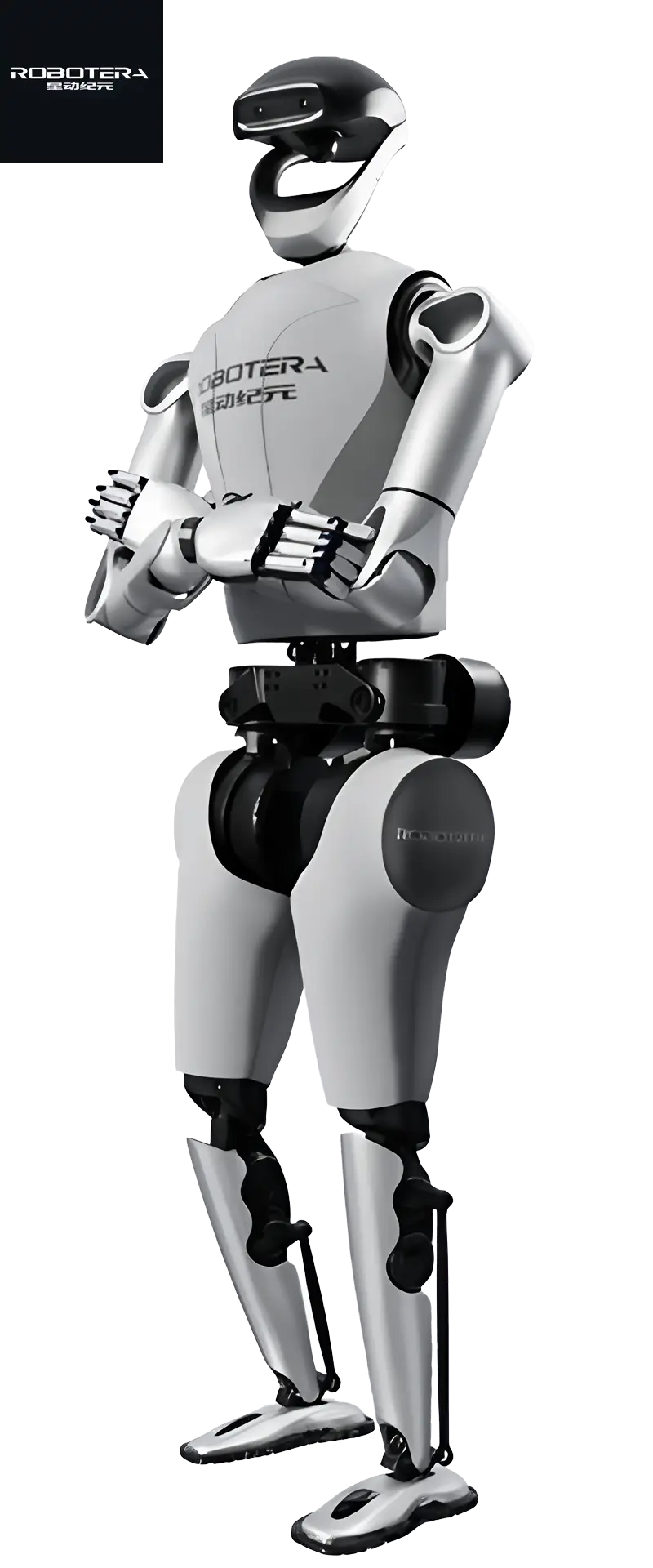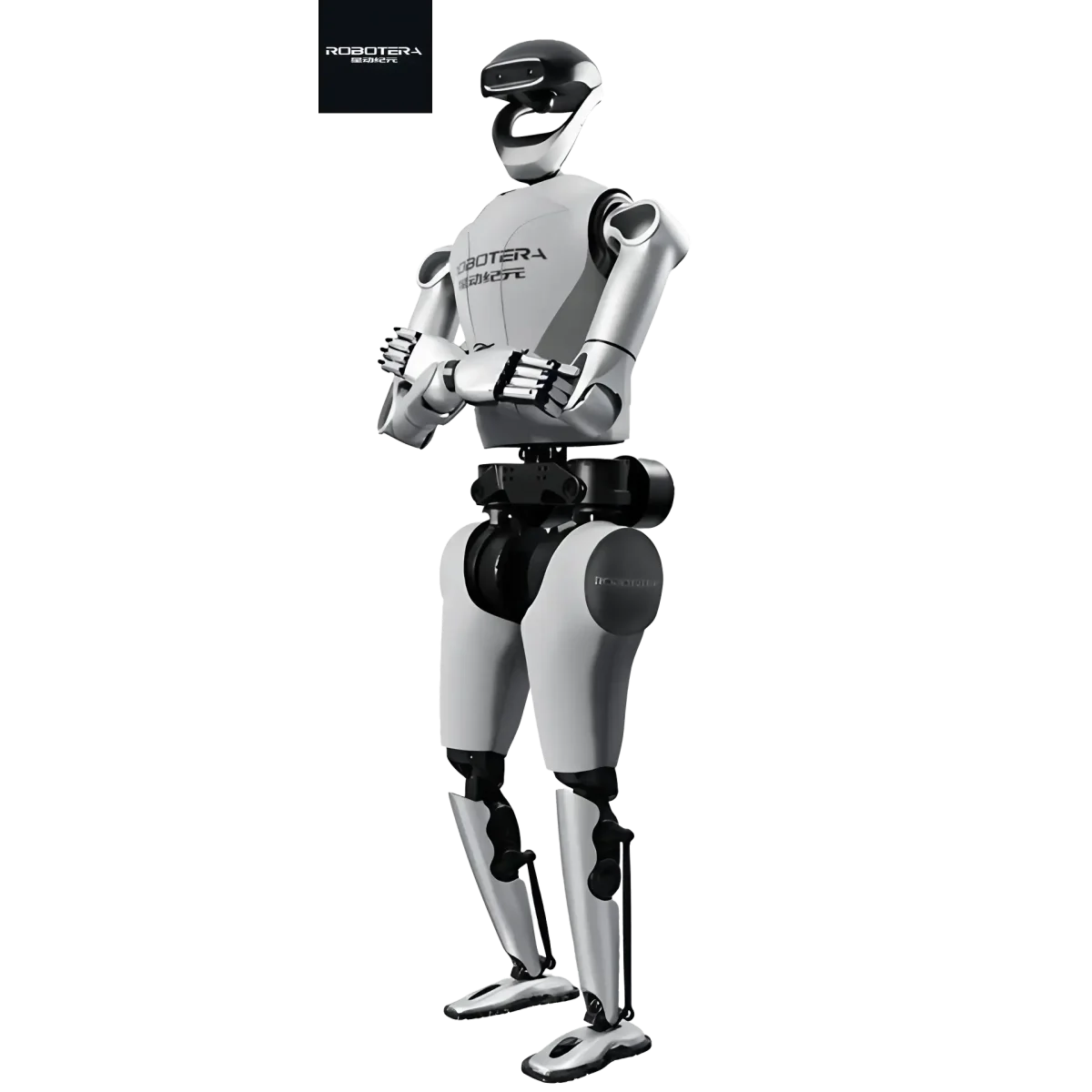
What is the Robotera L7?
The RobotEra L7 is a full-size bipedal humanoid robot developed by RobotEra, a Chinese robotics company. It is positioned as a more advanced platform than the earlier Star1, with improved dexterous manipulation capabilities. The L7 features an onboard embodied-AI computer (ERA-42) that integrates a large multimodal model for vision and language processing. It is designed for factory automation, industrial tasks, and service/research lab environments. The robot stands 171 cm tall, weighs 65 kg, and offers 55 degrees of freedom, including 12 in each hand, enabling precise manipulation. With a payload capacity of 20 kg and a top speed of 14.4 km/h, the L7 is built for dynamic, heavy-duty tasks. Currently in development, the L7 is expected to compete in the growing market of general-purpose humanoid robots.
Specifications
Here are the full technical specifications.
| Spec | Value |
|---|---|
| Height | 171 cm |
| Weight | 65 kg |
| Degrees of freedom | 55 |
| Battery life | Not specified |
| Max speed | 14.4 km/h |
| Payload | 20 kg |
| Price (new) | $120,000 |
| Price (used range) | N/A (pre-commercial) |
Price & Value
New MSRP: $120,000
Used range: N/A (pre-commercial)
At $120,000, the RobotEra L7 is priced in the mid-range for industrial humanoids, comparable to the UBTECH Walker S (~$100,000–$150,000) and Fourier GR-2 (~$150,000). While still in development, this price point positions it competitively for a 55-DOF platform with integrated AI, though real-world performance remains untested. As a pre-commercial unit, depreciation and resale values are not yet established, but early adopters may leverage first-mover advantages in custom application development. Total cost of ownership, including maintenance, training, and software integration, is unknown and could significantly increase the overall investment. Buyers should also consider the cost of custom end-effectors and programming for specific dexterous tasks. Compared to upcoming budget humanoids like Tesla Optimus, the L7 offers more immediate high-dexterity capability at a higher price, appealing to well-funded R&D teams.
Who Is It For?
Best for: - Factory automation engineers needing a high-DOF humanoid for fine manipulation tasks (55 DOF, 20 kg payload) - Research labs working on embodied AI and dexterous manipulation (integrated ERA-42 AI computer) - Industrial integration firms exploring humanoid labor for assembly lines (full-size bipedal form factor)
Not for: - Budget-constrained startups (priced at $120,000, pre-commercial) - Outdoor unstructured environments (no IP rating disclosed, unproven durability) - Applications requiring immediate deployment (not yet commercially available, development stage)
Alternatives & Comparison
The RobotEra L7 enters a competitive field of industrial humanoids from Chinese and global manufacturers. Its high DOF and integrated AI set it apart, but rivals offer proven track records or lower price points.
| Model | Price | Available | Key Difference |
|---|---|---|---|
| UBTECH Walker S | ~$100,000–$150,000 (est.) | yes | Commercially available with proven industrial deployments |
| Fourier GR-2 | ~$150,000 (est.) | preorder | Higher payload (30 kg) but lower top speed |
| Tesla Optimus Gen 2 | Undisclosed (target ~$20,000) | preorder | Radically lower target price but unproven manipulation |
Verdict: For pure dexterity and AI integration, the L7’s 55 DOF and onboard ERA-42 chip promise an edge over the Walker S and Fourier GR-2, though both competitors are more mature platforms. Tesla Optimus promises disruptive affordability but remains unproven in real-world tasks. Buyers needing a versatile manipulation robot for R&D or pilot factory lines should seriously consider the L7 once it ships, while those in immediate production may prefer the Walker S’s availability.
Use Cases & Capabilities
High-Dexterity Assembly
The L7’s 55 degrees of freedom and 12 per hand enable it to handle intricate assembly tasks such as electronics component insertion, wiring harness routing, and small-part fastening. Its 20 kg payload allows manipulation of heavier sub-assemblies, bridging the gap between lightweight collaborative arms and heavy-duty industrial robots. Integrated multimodal AI supports visual inspection and adaptive grip force control in real time. However, actual repeatability and speed have not been verified, so it is best suited for pilot production lines where flexibility is valued over cycle time. Early adopters in consumer electronics or automotive component manufacturing could program the L7 for high-mix, low-volume processes.
Research & Embodied AI Development
With the onboard ERA‑42 embodied-AI computer and vision-language model, the L7 provides a ready-made platform for cutting‑edge research in dexterous manipulation, human–robot interaction, and autonomous task planning. Researchers can leverage the 55-DOF kinematic tree to experiment with reinforcement learning for whole‑body control and fine‑motor skills. The robot’s full-size humanoid form factor makes it suitable for studies on social robotics and collaborative environments. Its unvalidated battery runtime and lack of safety certifications are manageable in controlled lab settings, where prototyping speed matters more than field-readiness. Academic labs and corporate R&D departments can use the L7 as a hardware testbed without building custom robotics from scratch.
Material Handling & Logistics
The L7’s bipedal mobility and 20 kg payload make it a candidate for warehouse pick-and‑place, kitting, and palletizing tasks. Its 14.4 km/h top speed is competitive with other logistics humanoids, potentially enabling dynamic workflows across large floor areas. Integrated vision and language understanding could allow voice-directed order picking and adaptive path planning. As a pre‑commercial unit, reliability under continuous shift conditions is unknown, and ingress protection is not disclosed, so deployment in dusty or wet environments is not recommended. Pilot programs in clean factory warehouses may demonstrate its ability to flexibly reshuffle inventory without fixed infrastructure.
Industrial Automation Retrofit
For manufacturers seeking to automate existing lines without major reengineering, the L7’s humanoid form factor can replicate human workers at stations designed for people. It can navigate standard factory floors, operate tooling intended for human hands, and adjust to layout changes through AI-based perception. The robot’s dexterous hands can manage tasks like quality inspection, machine tending, or rework that are difficult to automate with traditional robotic arms. Without a track record or certified safety ratings, it requires careful risk assessments and likely needs fencing or co‑location protocols. Integrators targeting brownfield sites may find the L7 a compelling option for incremental automation.
History & Background
RobotEra is a Chinese robotics company that first gained attention with its Star1 humanoid platform. In 2025, the company unveiled the L7 as a more capable successor, emphasizing improved dexterous manipulation and integration of the ERA‑42 embodied-AI computer. The L7 builds on the Star1’s bipedal locomotion foundation but significantly upgrades the degree-of-freedom count to 55 (including 12 per hand), enabling fine motor tasks that its predecessor could not perform. Specific details about the company’s founding year, headquarters city, and funding are not publicly disclosed, though RobotEra’s website (robotera.com) lists China as its base. The L7 has been shown in prototype form at industry events, but no official production timeline has been announced. As of 2026, the L7 remains in active development, with the company soliciting inquiries from enterprise customers via its website and responding within 48 hours. The robot is positioned to compete with other Chinese humanoid makers like UBTECH and Fourier in the growing factory automation segment.
Buying Used — What to Check
Verify payload rating 20 kg is the claimed strength; actual arm payload may differ under real-world dynamics.
Confirm software API availability Dexterous manipulation requires programmable interfaces; without them, the robot’s high DOF cannot be exploited.
Inspect build durability for industrial use Pre-commercial units may have early-stage materials or actuators that need lifespan validation before continuous operation.