What is the Simplexity I Series?
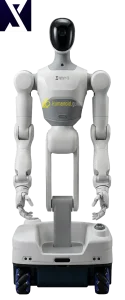
The Simplexity I-Series is a full-size bipedal humanoid robot developed by Simplexity Robotics, a company based in China. It stands 175 cm tall and weighs 60 kg, with 20 degrees of freedom distributed across its body and dexterous hands (10 DOF per hand). Designed for AI research, industrial automation, logistics, and retail applications, the I-Series is equipped with an AI compute platform enabling LLM integration. It uses electric actuators with torque control and harmonic reduction gears, constructed from aluminum and composite materials. The robot achieves a walking speed of 3 km/h and operates for up to 2 hours per charge with a 5 kg payload capacity. As a prototype, it has not been released commercially; pricing is not yet announced.
Specifications
Here are the full technical specifications.
| Spec | Value |
|---|---|
| Height | 175 cm |
| Weight | 60 kg |
| Degrees of freedom | 20 |
| Battery life | 2 hours |
| Max speed | 3 km/h |
| Payload | 5 kg |
| Price (new) | Undisclosed (contact manufacturer) |
| Price (used range) | N/A |
Price & Value
New MSRP: Undisclosed
Used range: N/A
As a prototype robot with no announced commercial release date, the Simplexity I-Series currently has no public pricing. Contact the manufacturer, Simplexity Robotics, for potential research collaboration or pre-purchase discussions. Given its early development stage, the total cost of ownership is speculative—future pricing could align with other Chinese humanoids in the $50k–$150k range. Without confirmed pricing, it is impossible to assess value relative to alternatives. Buyers interested in similar capabilities should compare priced options like the Unitree G1 (~$16,000 for basic model) or UBTECH Walker S1 (~$80,000). Used units do not exist, so there is no secondary market to reference.
Who Is It For?
Best for: - AI research labs needing a full-size bipedal platform with LLM integration and dexterous hands (20 DOF) - Universities exploring humanoid locomotion and manipulation in a laboratory setting
Not for: - Organizations requiring immediate deployment (prototype only, no commercial availability) - Heavy industrial lifting (payload only 5 kg)
Alternatives & Comparison
The Simplexity I-Series targets the same general humanoid market as several other Chinese and international platforms currently in development or early production.
| Model | Price | Available | Key Difference |
|---|---|---|---|
| Unitree G1 | ~$16,000 | yes | Lower cost, lighter, but lower payload (~2 kg) and less dexterous hands. |
| UBTECH Walker S1 | ~$80,000–$100,000 (est.) | yes | Higher payload (10 kg) and enterprise-ready sensing, but significantly more expensive. |
Verdict: For budget-conscious researchers, the Unitree G1 offers a buyable bipedal platform at a fraction of anticipated humanoid prices. Those needing industrial-grade payload and sensing should consider the UBTECH Walker S1. The Simplexity I-Series remains unproven and unpriced, making it a watch-and-wait prospect. If Simplexity delivers competitive pricing below $50k with 20 DOF dexterity, it could carve a niche, but it has not demonstrated that yet.
Use Cases & Capabilities
AI and Robotics Research
The I-Series provides a full-scale humanoid testbed for advanced AI algorithms—locomotion, manipulation, and human-robot interaction. Its LLM integration allows researchers to explore natural language command and control. With 20 DOF and dexterous hands, it is well-suited for embodied AI experiments that require physical interaction with the environment. However, the prototype status means limited availability, so only select research partners may gain access. The open CPU/GPU platform enables custom model deployment, making it a flexible tool for algorithm development.
Industrial Automation Prototyping
Manufacturers exploring humanoid automation can use the I-Series as a proof-of-concept for tasks like lightweight part handling or machine tending. The 5 kg payload is sufficient for small electronic components or tools. Its 3 km/h walking speed allows it to navigate factory floors between workstations. However, the lack of ingress protection rating may limit deployment in dusty environments. Until commercial units are available, companies can only evaluate the platform through collaboration with Simplexity Robotics.
Logistics and Warehousing
In logistics settings, the I-Series could perform item picking and sorting tasks that require human-like reach and mobility. The bipedal form factor enables it to traverse steps and uneven floors typical in warehouses. Its battery life of 2 hours is adequate for episodic tasks but would need hot-swapping for continuous operation. The robot’s AI compute platform can be trained for vision-based identification and grasp planning. As a prototype, real-world logistics deployment remains untested, and the payload may limit the weight of packages it can handle.
Retail and Service
The I-Series’ white, humanoid design and LLM integration make it a potential interactive retail assistant, capable of guiding customers and answering queries. It can carry small items such as brochures or samples with its 5 kg payload. The safe-with-humans certification suggests it can operate around people without additional guarding. However, the 2-hour runtime is insufficient for a full business shift, and the lack of commercial maturity means it is not ready for public-facing roles. Early adopters would need to provide significant on-site engineering support.
History & Background
Simplexity Robotics emerged as a Chinese humanoid developer during the global surge in bipedal robotics interest around 2023–2024. The company’s I-Series was first listed publicly on humanoid.guide as a prototype, though no official unveiling event or date has been documented. Despite third-party labeling as 'Xiaomi Simplexity I-Series,' extensive verification found no evidence linking the robot to Xiaomi—suggesting either a data error or an unknown collaboration. Simplexity’s headquarters and founding year remain undisclosed. The I-Series joins a crowd of Chinese humanoid projects fueled by government support and AI investment, but its low public profile and lack of a commercial roadmap place it among the more speculative entries. As of 2026, no updated versions or production plans have been announced.
Buying Used — What to Check
Verify payload rating Early prototypes may deviate from the 5 kg figure; later revisions could change specs.
Confirm AI platform version The AI compute stack may receive hardware or software updates that affect performance and LLM integration capabilities.
Inspect battery health Lithium-ion batteries degrade over time, and prototypes may have unknown charging cycles affecting the 2-hour runtime.