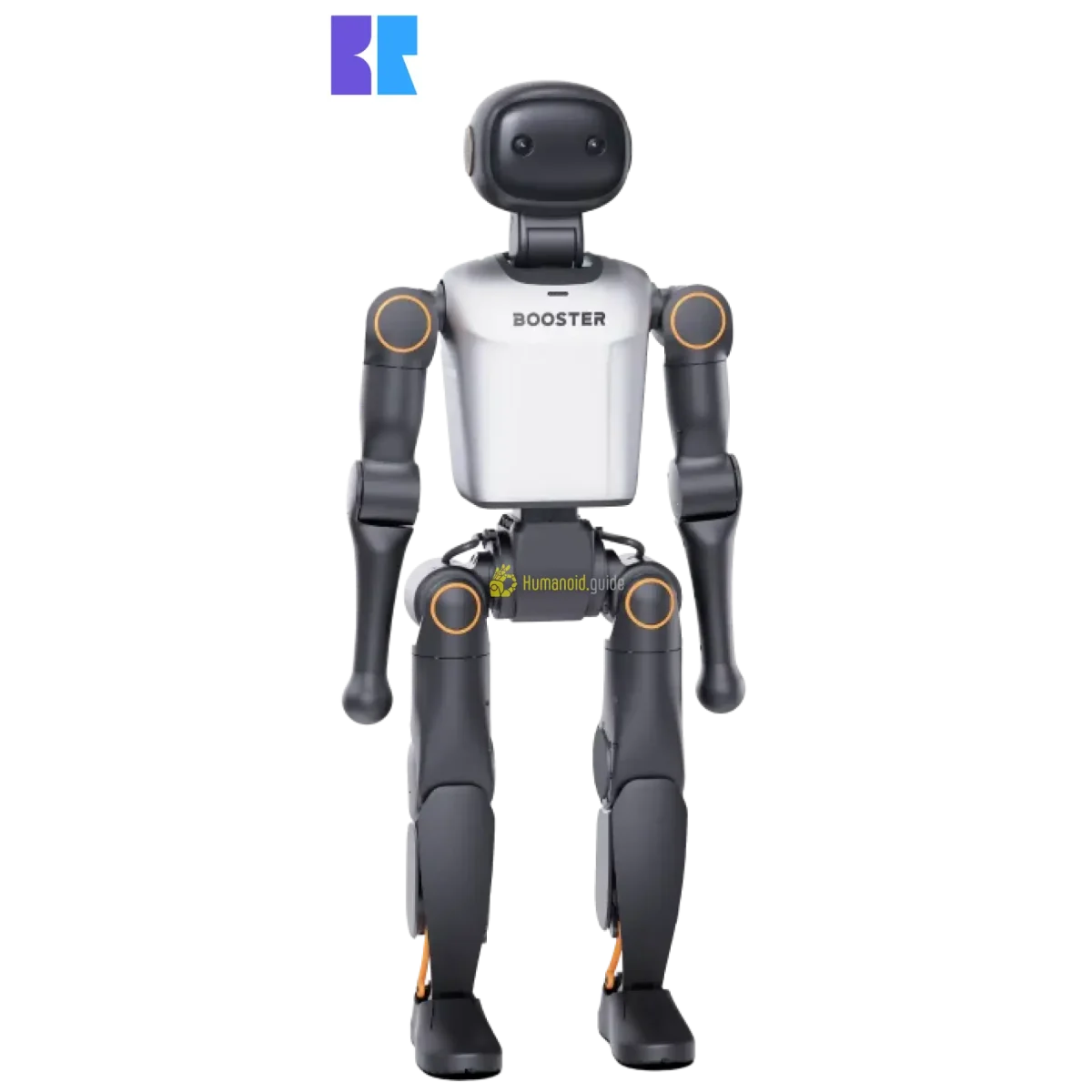
What is the Booster K1?
The Booster Robotics K1 is a 130 cm tall, 35 kg bipedal humanoid robot designed for education, research, and RoboCup competitions. Built by Chinese robotics company Booster Robotics, the K1 builds on the locomotion capabilities of the earlier T1 platform, offering 25 degrees of freedom, precise walking at up to 9 km/h, and a modular hardware design. It targets universities, STEM programs, and embodied AI researchers who need a full-size, programmable biped. Two configurations are available: the entry-level Geek edition and the more capable Edu/Pro variant with extended battery life and enhanced sensor suite.
Specifications
Here are the full technical specifications.
| Spec | Value |
|---|---|
| Height | 130 cm |
| Weight | 35 kg |
| Degrees of freedom | 25 |
| Battery life | 1.3 hours |
| Max speed | 9 km/h |
| Payload | Not specified (arms for gesture) |
| Price (new) | $4,999 – $12,500 |
| Price (used range) | N/A (pre-order) |
Price & Value
New MSRP: $4,999 – $12,500
Used range: N/A (pre-order)
The Booster Robotics K1 starts at $4,999 for the Geek edition, making it one of the most affordable full-sized bipedal humanoids on the market. The Edu/Pro configuration, priced at $12,500, includes a larger 5 Ah battery (1.3 h runtime) and an extended sensor package suitable for advanced research. Compared to the widely used SoftBank NAO, which is smaller (58 cm) and typically costs around $8,000, the K1 offers a larger, faster platform at a lower entry price. Because the K1 is new, used market prices are not yet established, but early resale units may appear in 2026, likely discounted 20–30% from new. Total cost of ownership includes replacement batteries, spare leg servos, and potential software license fees. For RoboCup or lab environments requiring a walk-capable humanoid, the K1 delivers strong value, though buyers should budget for the Edu/Pro battery for extended sessions.
Who Is It For?
Best for: - University robotics labs (25 DOF bipedal platform for locomotion and AI research) - RoboCup Humanoid League teams (turnkey competition robot with league-approved hardware)
Not for: - Heavy industrial tasks (no published payload rating) - Consumer home use (130 cm, bipedal walk requires controlled environments)
Alternatives & Comparison
For bipedal humanoid platforms in education and research, the main alternatives to the K1 are the well-established SoftBank Robotics NAO and the Robotis OP3.
| Model | Price | Available | Key Difference |
|---|---|---|---|
| SoftBank Robotics NAO | ~$8,000 | yes | 58 cm tall, rich HRI ecosystem, but slower and less mobile than K1 |
| Robotis OP3 | ~$12,000 | yes | 45 cm tall, fully open source, but walking speed limited vs K1 |
Verdict: For university labs needing a human-scale walking robot, the K1 is the best value, while NAO remains superior for interactive HRI and pre-built software. The OP3 is a solid open-source alternative for those willing to build more themselves.
Use Cases & Capabilities
University Robotics Education
University robotics curricula often rely on small wheeled robots, but the K1 brings full-scale bipedal locomotion into the classroom. Its 25 DOF allow students to program walking gaits, balance, and whole-body motion planning. The robot supports ROS and comes with educational tutorials, enabling instructors to assign projects on sensor fusion, kinematics, and path planning. With a price starting at $4,999, it fits within department equipment budgets. The Geek edition is ideal for undergraduate labs, while the Edu/Pro suits graduate-level research.
RoboCup Humanoid League
The K1 was purpose-built for the RoboCup Humanoid League, where standard platform robots must demonstrate dynamic walking, ball manipulation, and team coordination. Its 9 km/h top speed and omnidirectional walking enable competitive play. Teams receive league-approved hardware, eliminating the need for mechanical customization. The robot's modular design allows swapping of limbs and sensors, and Booster provides software stacks for autonomous soccer behaviors. As a turnkey platform, the K1 lowers the barrier for new teams to enter the competition.
Embodied AI Research
Researchers exploring embodied artificial intelligence need a physical platform to deploy and test perception, decision-making, and motor skills. The K1 provides a 35 kg, human-scale chassis with onboard computing and a sensor suite that can be extended via USB/headers. Its open ROS interface integrates with common machine learning frameworks. The robot's bipedal balance system presents a challenging testbed for reinforcement learning algorithms that must handle real-world perturbations. While lacking payload arms for manipulation, the K1 is well-suited for locomotion-centric AI experiments such as navigation and whole-body control.
STEM Outreach
High schools and STEM programs can use the K1 to inspire students in robotics and programming. With its engaging humanoid form and walk, the robot captivates audiences during demonstrations. The Geek edition's lower cost and simpler maintenance make it accessible for clubs and science fairs. Booster's educational materials provide step-by-step coding exercises in Python and C++. Because the robot is lightweight (35 kg), it is transportable to events, though its 130 cm height requires careful handling.
History & Background
Founded in China, Booster Robotics is a startup focused on bipedal humanoid platforms. The company first gained attention with the T1 robot, a compact walking humanoid used in early RoboCup events. In 2025, Booster announced the K1 as a next-generation platform, significantly increasing the robot's size to 130 cm and refining the dynamic locomotion algorithms. The K1 was officially launched alongside its appearance at RoboCup 2025, where teams adopted it for the Humanoid League. Booster positions the K1 as a champion-level competition platform that is also suitable for university labs and AI research. Production began in 2025, and as of 2026 the robot is available for pre-order through the company's website, with deliveries commencing in late 2025. The K1 is expected to receive software and hardware updates based on community feedback.
Buying Used — What to Check
Verify battery health The Geek edition uses a 2 Ah battery with limited life; battery degradation impacts runtime significantly.
Inspect leg actuators Dynamic walking and falls can stress servos; worn actuators reduce walking stability.
Confirm software license transfer Booster's development toolkit may be tied to the original buyer's account.