
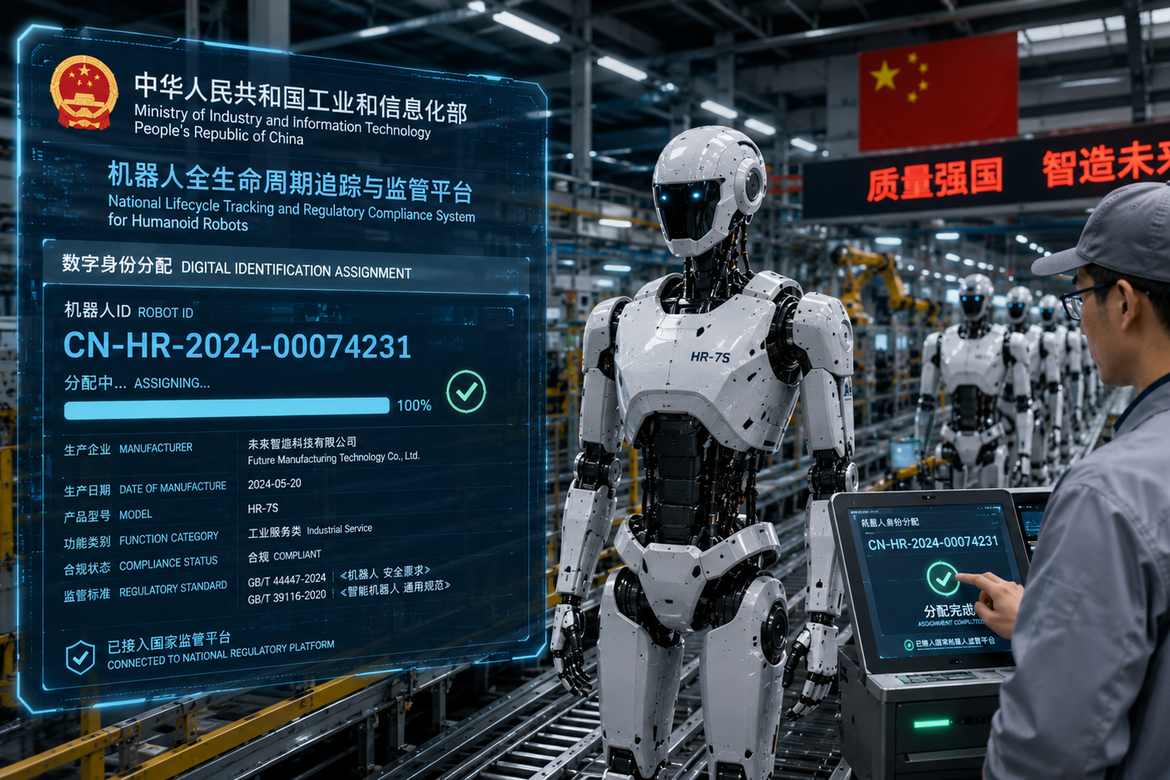
China has launched a national registry that gives every humanoid robot a unique digital ID, tracking it from factory production to eventual scrapping. The system, unveiled in Beijing and led by the Ministry of Industry and Information Technology, signals the government's growing push to supervise physical AI systems as they enter workplaces and public spaces.
- What Is the Humanoid Robot Lifecycle Platform?
- How Does the Digital ID System Work?
- Why Is China Creating a Robot Registry?
- What Does This Mean for the Global Robotics Industry?
- What Are the Potential Risks and Criticisms?
- What This Means for Buyers
What Is the Humanoid Robot Lifecycle Platform?
The platform is a centralized government system that registers every humanoid robot produced or sold in China from the moment it leaves the factory. It covers the entire lifespan — research and development, manufacturing, market access, sales, operation, and end-of-life recycling. Each robot receives a unique digital code, similar to a vehicle identification number (VIN) for cars. The Ministry of Industry and Information Technology's Standardization Technical Committee for Humanoid Robots and Embodied Intelligence oversees the platform, making it the first government-backed system of its kind worldwide.
This is not a voluntary industry initiative. It is a regulatory infrastructure built to give the state visibility into every humanoid robot operating within China's borders. The stated goals include product traceability, supply chain supervision, risk prevention, and clear accountability.

How Does the Digital ID System Work?
The system assigns each humanoid robot a unique code upon production, which remains attached through every subsequent stage. This code is tied to the robot's hardware specifications, software versions, operational history, and ownership records. When a robot is sold, transferred, or decommissioned, the registry is updated.
Key features of the system:
| Feature | Description |
|---|---|
| Unique ID | 29-character alphanumeric code assigned at factory |
| Coverage | R&D, manufacturing, sales, operation, recycling |
| Data tracked | Hardware specs, software versions, ownership, incidents |
| Oversight body | MIIT Standardization Committee for Humanoid Robots |
| Legal basis | National standards for embodied AI supervision |
The platform uses a standardized coding format that can be read by government inspection systems and, potentially, by other robots or IoT infrastructure. This creates a traceable chain from the day a robot is assembled to the day it is scrapped — a level of supervision previously reserved for vehicles, pharmaceuticals, and weapons.
Why Is China Creating a Robot Registry?
China is the world's largest manufacturer of humanoid robots, with companies like Unitree, Fourier Intelligence, and Xiaomi racing to scale. As these machines move from labs into factories, hospitals, and eventually homes, the government sees a need for safety oversight and liability tracking.
Three main drivers:
- Accident liability. If a robot injures a person or damages property, the registry identifies the owner, manufacturer, and software version — making it possible to determine responsibility.
- National security. Humanoid robots equipped with cameras, sensors, and AI could collect sensitive data. The registry helps the state track where robots are deployed and who controls them.
- Standardization. With dozens of Chinese robotics startups, the government wants to impose common technical and safety standards before the market fragments.
The platform is part of a broader Chinese strategy to become the global leader in embodied AI. By building regulatory infrastructure early, Beijing can shape how the industry evolves — both domestically and, potentially, for exports.
What Does This Mean for the Global Robotics Industry?
China's digital ID system is a first-of-its-kind regulatory move, and it could set a precedent that other countries follow. The European Union already has AI Act provisions for high-risk systems, and the U.S. has discussed robot safety frameworks. China's approach — mandatory, cradle-to-grave tracking — is significantly more prescriptive.
Implications for non-Chinese companies: - Export compliance. Foreign robot makers selling into China will likely need to integrate with the registry, adding development and compliance costs. - Data sovereignty. Operational data from Chinese robots will reside in government-controlled systems, raising concerns about IP protection and surveillance. - Market access. Robots without a valid digital ID may be barred from sale or operation in China, creating a de facto certification barrier.
Chinese robot manufacturers, by contrast, gain a home-field advantage. They already operate within the system, and their compliance can be used as a selling point for safety-conscious buyers.
What Are the Potential Risks and Criticisms?
While the platform aims to improve safety, it also raises concerns:
- Surveillance creep. Critics argue that the registry could be used to monitor robot operations in real time, including the behavior of human operators working alongside robots.
- Bottleneck for innovation. Startups may face regulatory burdens that slow down iteration cycles, especially if software updates require re-registration or re-certification.
- Export control leverage. The registry could be used to restrict where and how Chinese-made robots are used, similar to restrictions on drones.
- Interoperability gaps. If China's system is incompatible with international standards, global robot makers may need to build separate hardware or firmware for the Chinese market.
The success of the platform will depend on how transparently it is administered and whether it remains focused on safety rather than control.
What This Means for Buyers
For companies considering Chinese humanoid robots, the digital ID system adds a new layer of regulatory certainty — but also potential friction. Every robot will come with a verifiable history, which could make second-hand purchases safer and easier to audit. On the other hand, buyers may be subject to government oversight of their robot's operation, especially if they are leasing or reselling units.
Key considerations for procurement teams:
| Factor | Before Registry | After Registry |
|---|---|---|
| Traceability | Manual, unreliable | Digital, mandatory |
| Liability | Hard to assign | Owner + manufacturer tracked |
| Resale value | Uncertain | Transparent history |
| Compliance burden | None | Registration required |
| Data privacy | Buyer controls | Government visibility |
If you are evaluating Chinese humanoid robots for your facility, the registry is a double-edged sword: it adds accountability but also government oversight. For buyers outside China, it may become a factor in supplier selection if data sovereignty concerns grow. To compare available humanoid platforms and their regulatory readiness, browse humanoid robots on Botmarket.
Frequently Asked Questions
What is the humanoid robot lifecycle management platform?
It is a government-run digital registry that tracks every humanoid robot in China from production to disposal, assigning each a unique 29-character ID that records hardware, software, ownership, and operational history.
Which robots need to be registered?
The platform covers all humanoid robots — machines with a human-like form factor designed for mobility and manipulation — regardless of manufacturer or intended use. It includes units from Chinese startups like Unitree and foreign companies selling into China.
Is this system mandatory?
Yes. The platform is backed by the Ministry of Industry and Information Technology and is designed to be mandatory for all humanoid robots sold or operated in China. Non-compliant robots may face market access restrictions.
What happens if a robot's ownership changes?
The seller must update the registry with the new owner's details, similar to a vehicle title transfer. This ensures the robot's history remains continuous and traceable.
Does the platform apply to non-Chinese robots operating in China?
Foreign companies selling or deploying humanoid robots in China will likely need to comply with the registration system, including providing hardware and software data to the government.
Can the digital ID be tampered with?
The system uses standardized coding and is linked to government databases, making tampering difficult. The full technical details of the ID generation and authentication mechanisms have not been disclosed.
Conclusion
China's humanoid robot digital ID system is a watershed moment for the robotics industry. By building a cradle-to-grave registry, Beijing is laying the foundational infrastructure for how physical AI will be governed — and setting a template that other nations may soon follow. For buyers, manufacturers, and investors, understanding this regulatory shift is now essential to navigating the humanoid robot market.












Komen