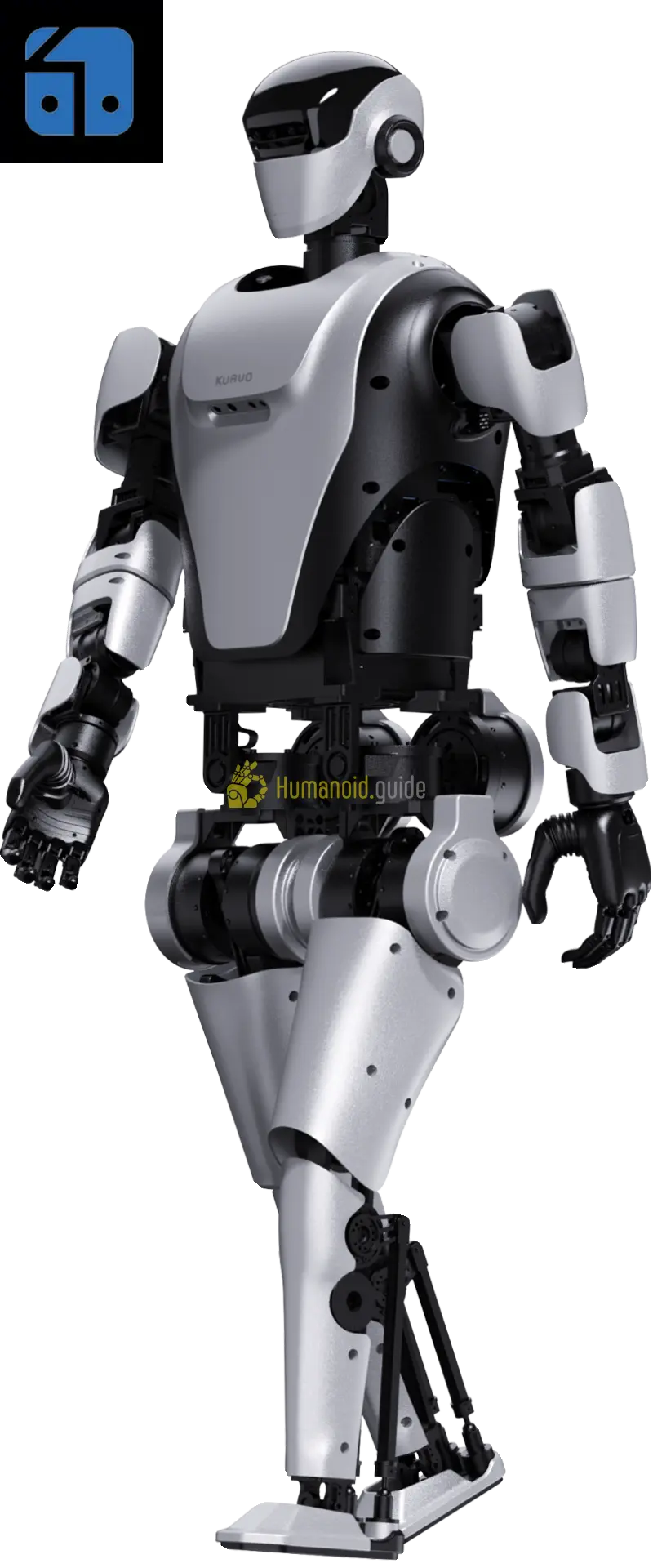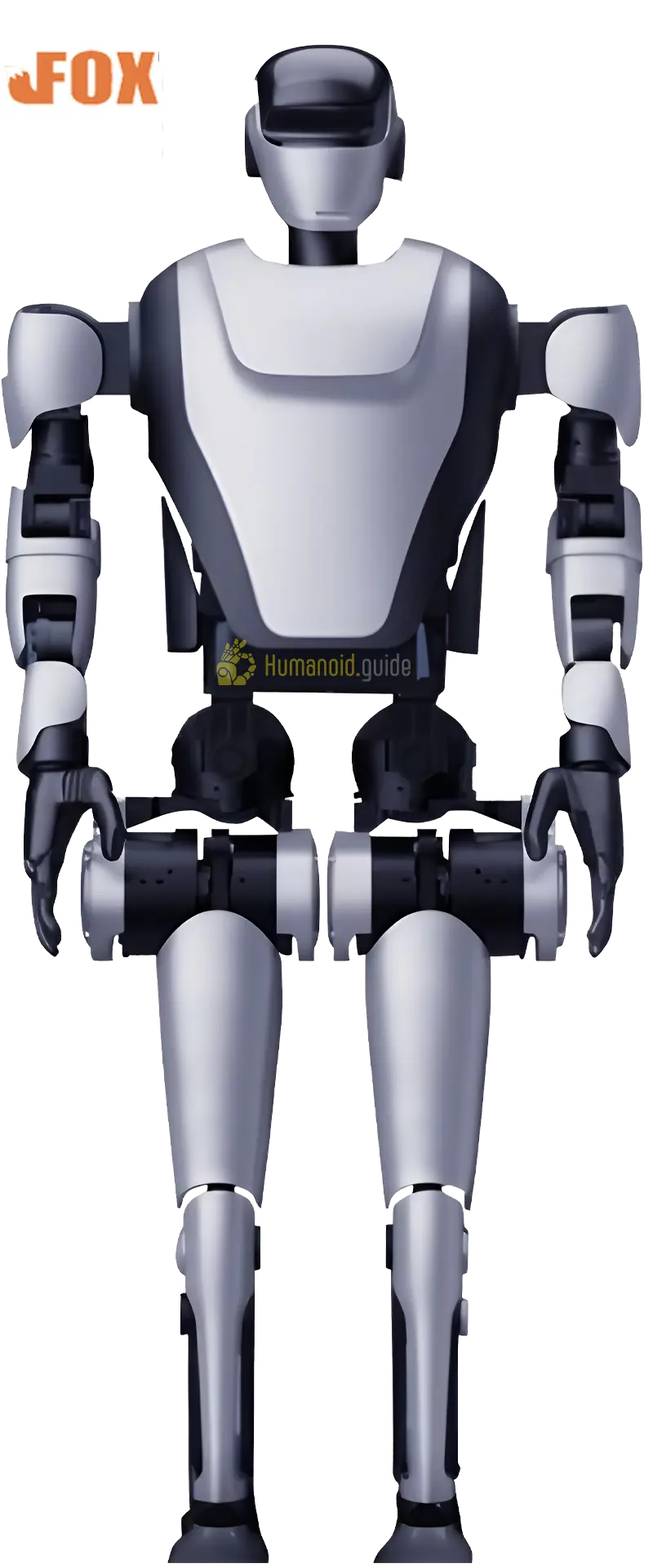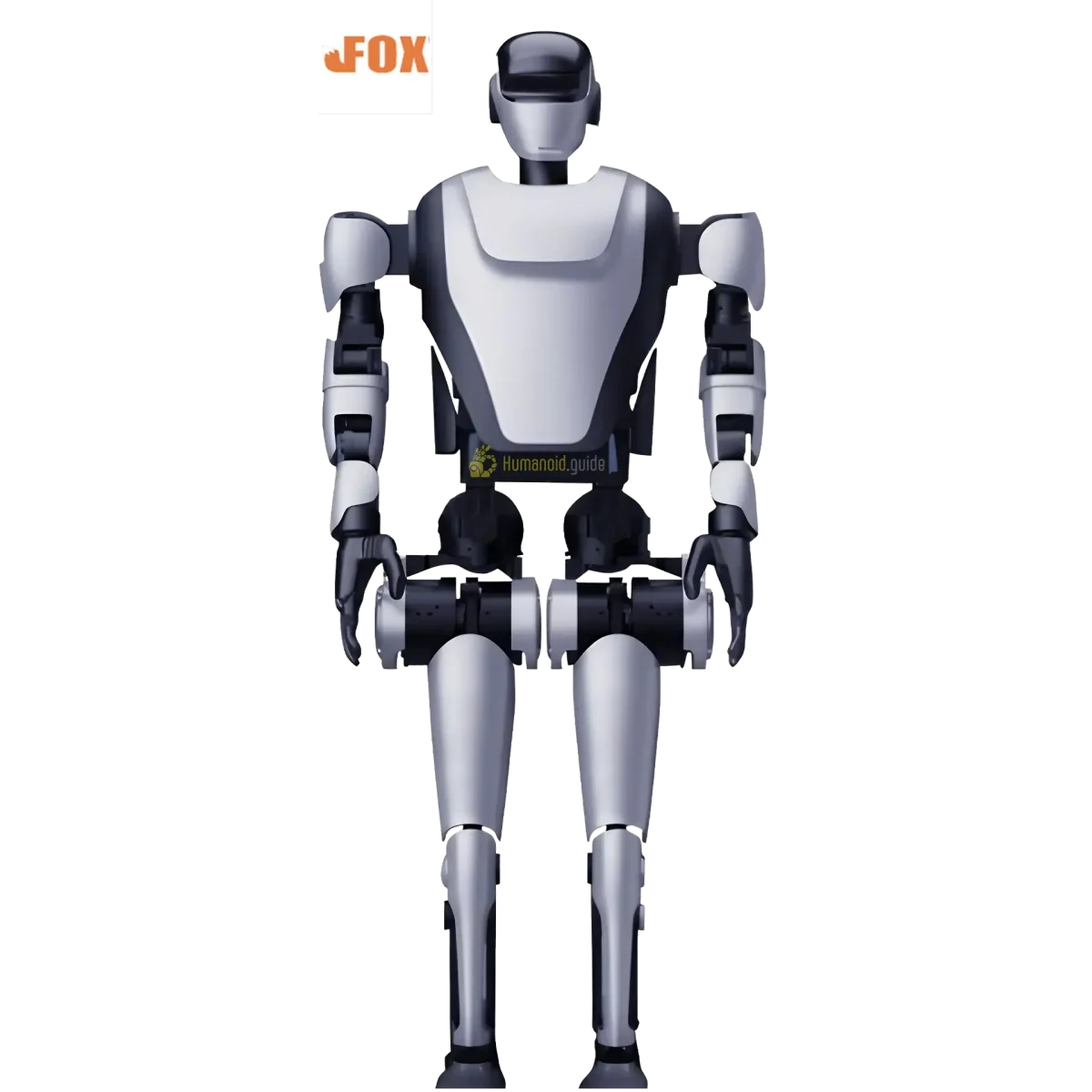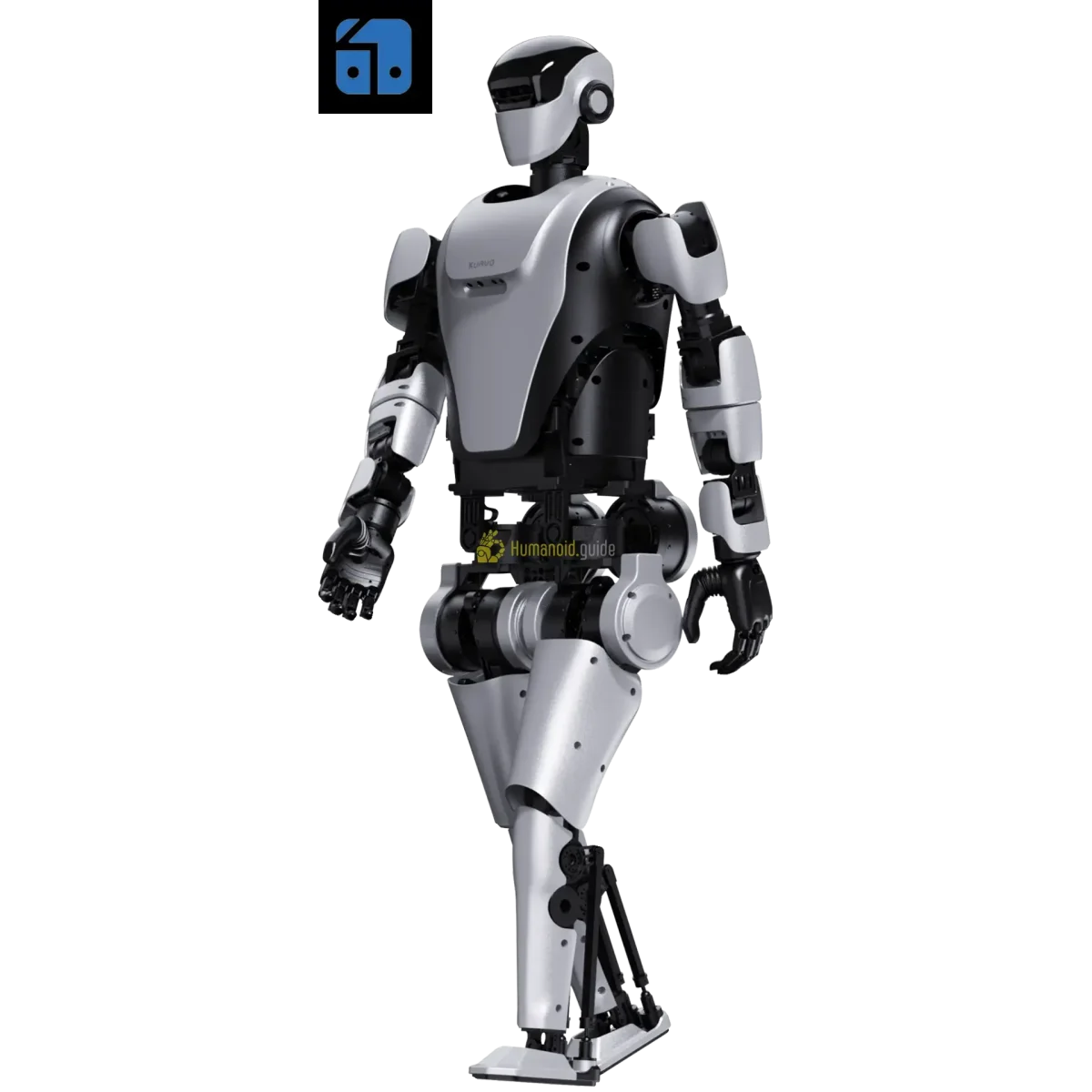
What is the Kuavo My?
The Leju Kuavo-MY is a compact humanoid robot developed by Leju Robotics, based in Shenzhen, China. Announced in 2024 for education, research, and entertainment, it stands 145 cm tall and weighs 45 kg. With 26 degrees of freedom, including underactuated five-finger hands, it can walk at up to 4.5 km/h and carry payloads of 3 kg per arm. Its custom harmonic drive actuators with torque sensors enable compliant motion, and an Intel RealSense depth camera, IMU, and foot force/torque sensors provide robust perception. The robot runs Ubuntu 20.04 with ROS 2 on an NVIDIA Jetson Orin NX, supporting Wi-Fi 6, Ethernet, and USB-C connectivity. Kuavo-MY is designed as an affordable entry point for bipedal research and human-robot interaction studies.
Specifications
Here are the full technical specifications.
| Spec | Value |
|---|---|
| Height | 145 cm |
| Weight | 45 kg |
| Degrees of freedom | 26 |
| Battery life | 2 hours |
| Max speed | 4.5 km/h |
| Payload | 3 kg |
| Price (new) | $25,000–$30,000 |
| Price (used range) | N/A (pre-order) |
Price & Value
New MSRP: $25,000–$30,000
Used range: N/A (pre-order; expected to emerge once units ship)
The Kuavo-MY’s estimated $26,500 price positions it as an affordable full-body humanoid, undercutting most research-oriented bipeds. Buyers receive integrated compute, sensors, and torque-controlled actuation, reducing the need for external hardware and lowering total cost of ownership for a lab. Compared to the cheaper $16,000 Unitree G1, the Kuavo-MY offers a larger workspace and underactuated hands but trades modularity and payload. As a pre-order product from a relatively new humanoid vendor, resale value is uncertain in the short term; early adopters may see modest depreciation if production scales. Ongoing costs include potential software support, spare batteries (est. $500–$1,000 each), and import duties for international buyers. For a turnkey ROS 2 locomotion platform, the Kuavo-MY provides compelling value, though the 2-hour battery life forces careful experiment scheduling.
Who Is It For?
Best for: - University robotics labs needing an affordable full-body biped for locomotion research (26 DOF, torque-sensing joints) - STEM educators seeking a humanoid platform to teach AI, control theory, and ROS 2 - Entertainment venues that require a programmable, interactive humanoid for choreographed performances
Not for: - Heavy industrial material handling (payload limited to 3 kg per arm) - Long-duration autonomous patrol tasks (2-hour battery without hot-swap option) - Buyers requiring out-of-the-box LLM integration (no built-in AI assistant announced)
Alternatives & Comparison
The Kuavo-MY competes directly with other affordable humanoid robots aimed at education and research, most notably the Unitree G1 and, at a higher tier, the Fourier GR-3.
| Model | Price | Available | Key Difference |
|---|---|---|---|
| Unitree G1 | $16,000 | yes | Lighter (35 kg), configurable up to 43 DOF, lower cost but smaller workspace and no underactuated hands |
| Fourier GR-3 | Undisclosed | preorder | Full-size research platform with higher payload (likely 10+ kg) and more powerful compute, but significantly more expensive |
Verdict: For research labs needing a fully programmable biped under $30k, the Kuavo-MY offers real-time torque-controlled actuation and ROS 2 support at a competitive price. The Unitree G1 remains the better choice if lower weight, swappable batteries, and extreme modularity are paramount, but it lacks the Kuavo-MY’s expressive hand dexterity. For advanced heavy manipulation, the Fourier GR-3 is superior but its cost and pre-commercial status make the Kuavo-MY a safer near-term investment.
Use Cases & Capabilities
Education
The Kuavo-MY serves as an engaging platform for teaching robotics, AI, and control theory at university and high-school levels. Its humanoid form factor helps students understand bipedal locomotion, inverse kinematics, and sensor fusion through hands-on projects. With ROS 2 and Ubuntu, educators can design coursework around real-time perception and motor control using Python or C++. The 3 kg payload restricts it to lightweight end-effectors but is sufficient for typical educational tasks like ball tossing or simple pick-and-place. Its relatively low price compared to larger research humanoids makes it accessible for departmental budgets, and its 45 kg weight allows safe operation with minimal safety guarding. The included Intel RealSense depth camera provides a ready-made sensing suite for computer vision assignments.
Research
Research labs use the Kuavo-MY for locomotion algorithm development, human-robot interaction studies, and whole-body motion planning. The torque-sensing harmonic drive actuators provide real-time feedback for compliant control experiments, while the Jetson Orin NX enables on-board deep learning inference for perception tasks. The Intel RealSense depth camera supports SLAM and object detection, though the 2-hour battery limits prolonged data collection sessions without a spare. The underactuated five-finger hands allow grasping experiments, albeit with a 3 kg payload ceiling per hand. Academic groups have explored using the robot for shared autonomy and remote teleoperation via Wi-Fi 6, and its ROS 2 architecture ensures compatibility with popular simulation tools like Gazebo.
Entertainment
In entertainment settings, the Kuavo-MY can perform choreographed dances, interactive narratives, and serve as a mascot in exhibitions. Its 4.5 km/h walking speed and stable gait make it suitable for dynamic stage performances, while torque-controlled joints enable smooth, lifelike movements. The robot’s relatively compact size and 45 kg weight allow safe operation around non-experts, but the 2-hour battery demands careful scheduling for multi-hour shows. Custom motion libraries can be programmed via ROS 2 and triggered by external commands over Ethernet, enabling integration with show control systems. Although no built-in LLM is announced, developers can pair it with cloud-based speech services for interactive audience engagement.
History & Background
Leju Robotics was founded in Shenzhen, China in 2015 and began developing humanoid robots under the Kuavo series. The company’s earlier models, including the Kuavo-5 with 40 degrees of freedom, targeted industrial assistance and AI research, showcasing advanced full-body control. In August 2024, at the World Robot Conference, Leju introduced the Kuavo-MY as a smaller, cost-reduced variant explicitly aimed at education and home use. Priced at approximately 190,000 yuan ($26,500), it retained the same torque-sensing actuator technology and ROS 2 software stack but scaled down to 26 DOF, a 145 cm frame, and a 3 kg payload. Pre-orders opened immediately, with first shipments beginning later that year. By 2026, the Kuavo-MY has reached academic labs and a few entertainment venues, with no major hardware revisions announced; Leju continues to refine its ROS 2 packages and documentation to broaden adoption.
Buying Used — What to Check
Verify battery health The 2-hour battery degrades with charge cycles; ensure it still meets your runtime needs.
Inspect actuator smoothness Harmonic drive actuators can wear; excessive backlash or noise may indicate upcoming maintenance costs.
Check ROS 2 version Running a recent Ubuntu 20.04 with updated ROS 2 packages is essential for research—old images may lack security patches.