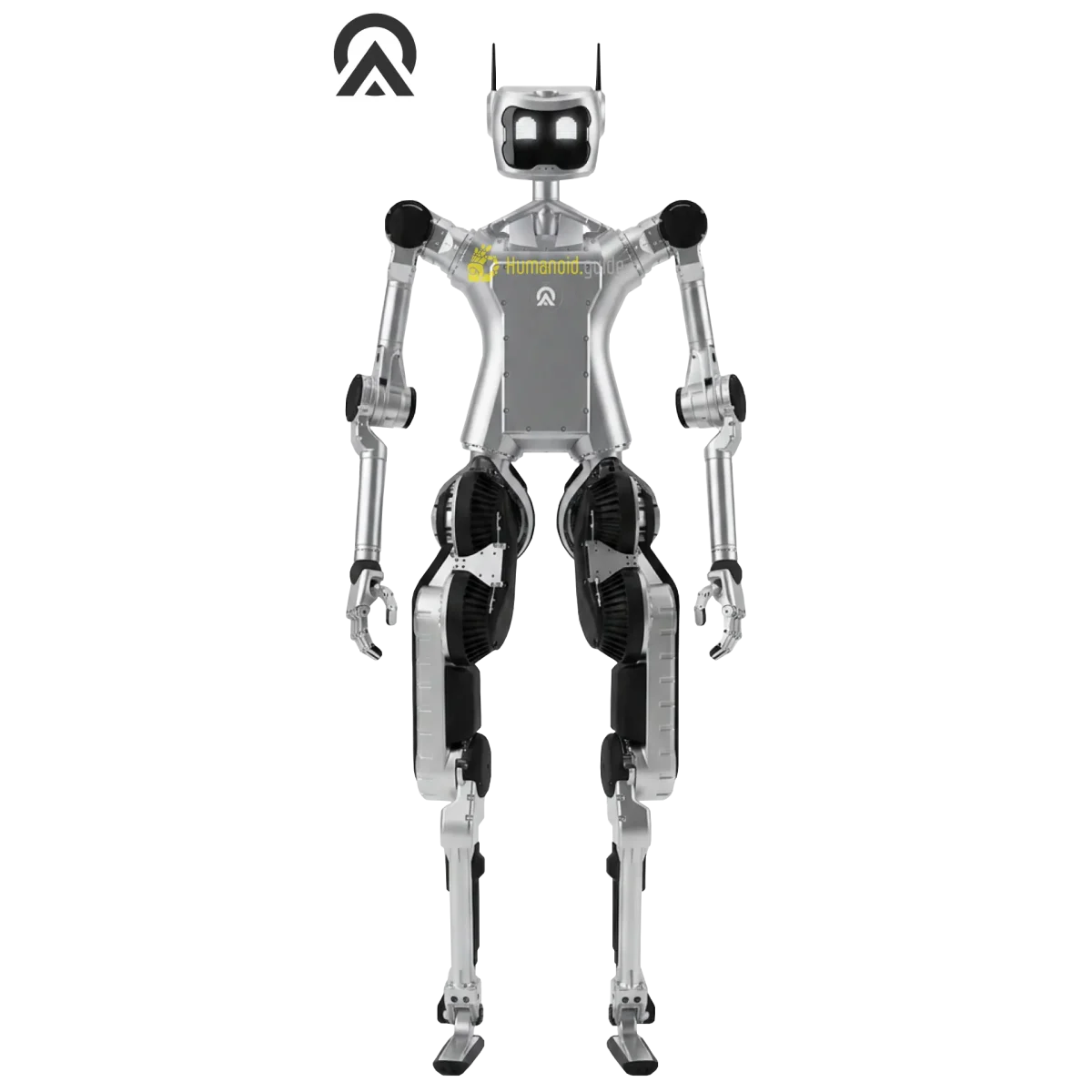
What is the Qdh?
The Apptronik QDH is a general-purpose humanoid robot designed by Apptronik, an Austin, Texas-based robotics company founded in 2016. It stands 165 cm tall and weighs 73 kg, with 14 degrees of freedom (excluding hands) powered by electric actuators and likely harmonic drives. The robot can lift a payload of up to 25 kg with its arms and walk at speeds of 3 km/h. Battery runtime is 4 hours, and it supports Ethernet and Wi-Fi for fleet management integration. It uses stereo vision cameras for perception and likely runs a ROS-based software stack, with estimated video latencies of 100–300 ms. While it has no articulated fingers, it is intended for logistics, manufacturing, and research tasks where safe human collaboration is required. As of 2026, the QDH remains a prototype with no confirmed commercial release date.
Specifications
Here are the full technical specifications.
| Spec | Value |
|---|---|
| Height | 165 cm |
| Weight | 73 kg |
| Degrees of freedom | 14 |
| Battery life | 4 hours |
| Max speed | 3 km/h |
| Payload | 25 kg |
| Price (new) | Undisclosed (contact manufacturer) |
| Price (used range) | N/A (prototype — no used market yet) |
Price & Value
New MSRP: Undisclosed (contact manufacturer)
Used range: N/A
The QDH’s price remains undisclosed as of 2026. While an early speculative estimate of $80,000 has circulated, Apptronik has not confirmed any figure, and the actual cost will depend on production scale and configurations. Compared to other pre‑commercial humanoids like Figure 02 or Tesla Optimus, which also lack public pricing, the QDH’s value will likely be determined by its payload‑to‑cost ratio and total cost of ownership once it enters production. Because the robot is a prototype, used‑market evaluation is impossible; any second‑hand unit would be extremely rare and lack warranty support. Organizations considering the QDH should factor in integration costs for end‑effectors and possible fleet software licenses. As the market matures, depreciation for humanoids is uncertain but may follow trends seen in industrial robots if they achieve repeatable reliability.
Who Is It For?
Best for: - Research labs exploring humanoid locomotion and manipulation (14 DOF provides a meaningful platform for motion planning experiments without the complexity of a fully actuated hand) - Logistics and warehouse pilots interested in evaluating humanoid form factors for light to medium lifting (25 kg payload, 3 km/h walking speed, and safe physical interaction design)
Not for: - High-dexterity tasks requiring articulated fingers (the QDH currently has zero hand DOF, making it unsuitable for fine manipulation) - Heavy industrial material handling exceeding 25 kg arm payload (the robot is sized for lightweight goods) - Immediate deployment in production environments (the robot is a prototype with no stated production timeline or service level guarantees)
Alternatives & Comparison
The Apptronik QDH enters a crowded field of prototype humanoids targeting logistics and manufacturing, with key rivals including the Tesla Optimus, Figure 02, and 1X NEO. All are pre‑commercial and have not yet demonstrated scalable deployment.
| Model | Price | Available | Key Difference |
|---|---|---|---|
| Tesla Optimus (Gen 2) | Undisclosed | no | Tesla’s Optimus has articulated hands and relies on Tesla’s AI stack, but production timeline is also uncertain. |
| Figure 02 | Undisclosed | no | Figure 02 focuses on general-purpose dexterity with human-like hands and integrated AI, targeting complex manipulation tasks. |
| 1X NEO | Undisclosed | no | NEO emphasizes safe, soft-shell design and consumer-facing deployment, while Apptronik targets industrial logistics. |
Verdict: For early adopter pilot programs in logistics, the QDH’s simpler design and the company’s exoskeleton heritage may translate to faster iteration and lower upfront integration complexity. However, if your research demands advanced dexterous manipulation, the Figure 02’s hands are a decisive advantage. Tesla’s Optimus benefits from a massive AI ecosystem but lacks a clear logistics focus. Ultimately, no robot has proven market fit, so the QDH is a solid bet for those who want a pragmatic, task‑specific humanoid rather than a generalist.
Use Cases & Capabilities
Manufacturing material transport
The Apptronik QDH can autonomously transport components between workstations in factories, handling payloads up to 25 kg. With a walking speed of 3 km/h, it keeps pace with human workers without needing safety cages. Its 4‑hour battery life allows it to work for a full shift segment, and hot‑swappable batteries could extend uptime. The robot’s lack of articulated fingers means it requires custom trays or grippers for carrying tasks. Connectivity via Wi‑Fi or Ethernet enables real‑time job dispatching through a warehouse management system. This use case could reduce reliance on forklifts and conveyors, but the prototype status means any deployment would need heavy customization.
Research platform for locomotion
University labs can use the QDH to study bipedal walking, balance, and whole‑body control algorithms. The 14‑DOF chassis provides enough complexity for meaningful research without the cost or maintenance burden of 50+ DOF robots. Its stereo vision system supplies depth data for autonomous navigation experiments. The estimated 100–300 ms glass‑to‑action latency is adequate for real‑time control loops. Because the arms lack hands, manipulation research is limited to payload‑grasping with custom end‑effectors. The ROS‑based software stack makes it easy to integrate with common research tools like Gazebo and MoveIt.
Logistics co‑packing
In e‑commerce warehouses, the QDH could assist in picking and packing lightweight items into boxes. It can lift up to 25 kg, making it suitable for handling cases of consumer goods. Its human‑like reach and safe interaction design allow it to work alongside human packers without physical barriers. The robot’s connectivity supports direct integration with existing fulfillment software. However, without articulated fingers, it would need specialized grippers for different product shapes. As a prototype, the QDH is not yet validated for 24/7 operation, which limits its use in high‑throughput environments.
History & Background
Apptronik was founded in 2016 as a spin‑out from the Human Centered Robotics Lab at the University of Texas at Austin. The company’s early work centered on exoskeletons like the Astra suit for military and industrial ergonomics. In the late 2010s, Apptronik shifted focus to humanoid robots, revealing prototypes such as ARCA and Draco that demonstrated bipedal walking and manipulation. The QDH was announced as a next‑generation platform tailored for real‑world work environments, prioritizing safety and scalability. It debuted with a slimmed‑down design compared to earlier models, featuring updated electric actuators and a more modular architecture. As of 2026, the QDH is still in the prototype phase, with Apptronik engaging in pilot programs with select partners to refine the platform. No official launch date has been published, and the company has not disclosed details about manufacturing scale or supply chain.
Buying Used — What to Check
Verify payload rating Payload limits may differ between arms and total body; confirm 25 kg is the arm payload for your application.
Inspect battery health Since battery runtime is critical for industrial shifts, used units may have degraded batteries that no longer hold a 4-hour charge.
Confirm software stack Ensure the robot runs a compatible ROS version and that any custom software licenses transfer with the hardware.