

When Unitree Robotics offers two quadrupeds priced from $1,600 to over $180,000, the first question isn’t “which is better?” — it’s “which task are you solving?” This article compares the Unitree Go2 and the Unitree B2 across every dimension that matters: price, payload, battery, autonomy, software, and real‑world endurance. By the end you’ll know exactly which machine fits your lab, worksite, or production line.
Unitree Go2 vs Unitree B2: Specs Compared
| Specification | Unitree Go2 | Unitree B2 |
|---|---|---|
| Price (base) | $1,600 | $100,000 |
| Price (max config) | $22,500 | $180,000 |
| Weight | 15 kg | 60 kg |
| Height | 40 cm | 109.8 cm |
| Payload (walking) | 5 kg | 40 kg |
| Max speed | 9 km/h | 21.6 km/h |
| Battery life | 1.5 h | 5 h |
| Degrees of freedom | 12 | 26 |
| IP rating | Not officially rated | IP67 |
| Onboard compute | Jetson Orin NX (Pro/EDU models) | Industrial‑grade CPU/GPU (manufacturer‑disclosed) |
| Sensors | Stereo depth, optional 4D LiDAR; ultrasonic | Multi‑line LiDAR, depth cameras, thermal module (configurable) |
| ROS2 support | Yes (official SDK) | Yes (official SDK) |
| Autonomy stack | Autowalk, SLAM, GPT‑powered voice (EDU) | Industrial SLAM, fleet‑management integration |
| Availability | In stock, worldwide resellers | Factory‑direct, enterprise qualification |
| Warranty | 1 year (standard) | Custom enterprise SLA |
Table 1 – Key specs as published by Unitree Robotics. The B2 officially launched in early 2026; Go2 has been shipping since mid‑2023.
Unitree Go2: The 15 kg Lightweight Quadruped for All‑Terrain Research
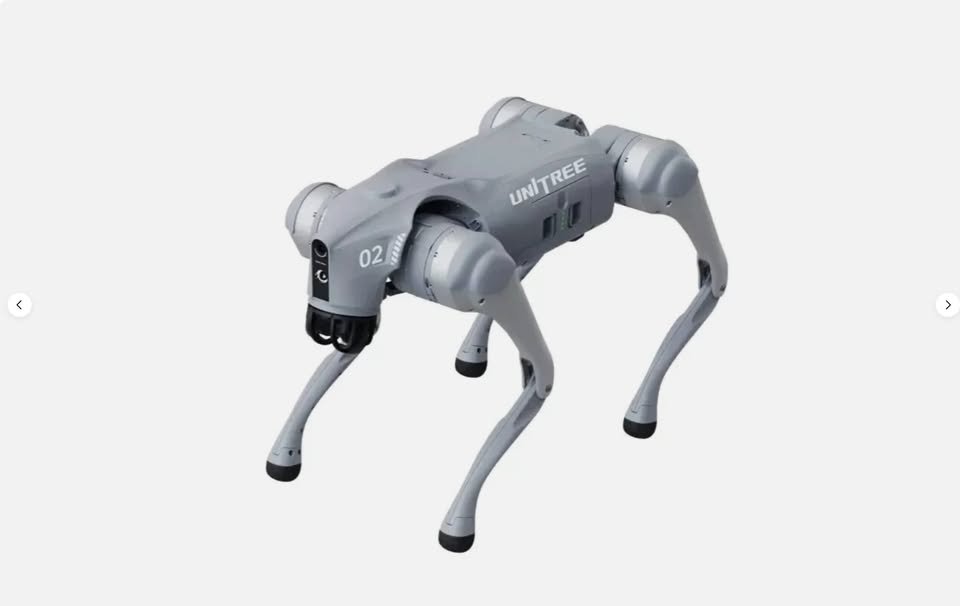
Launched in 2023, the Unitree Go2 is the direct successor to the popular Go1 and quickly became a staple in academic robotics labs, maker communities, and light industrial inspection. With a starting price of $1,600 (Go2 Air), it is the most accessible quadruped in the market. The top‑spec Go2 EDU ($22,500) adds 4D LiDAR, a Jetson Orin NX compute module, and a GPT‑powered voice‑interaction engine that allows natural‑language commands. All models share a 15 kg chassis, 12 degrees of freedom, and a 5 kg payload capacity, enough for cameras, environmental sensors, or a small manipulator arm.
- Launch year: 2023
- Manufacturer: Unitree Robotics, Hangzhou, China
- Target market: Education, research, STEM outreach, light industrial inspection, entertainment
- Core specs: 12 DOF, 9 km/h top speed, 1.5 h battery, 15 kg mass
- Price range: $1,600 (Air) → $22,500 (EDU)
More details are available on the Unitree Go2 product page.
Unitree B2: The 60 kg Heavy‑Duty Industrial Quadruped for Harsh Environments

The Unitree B2 was announced in 2026 and represents a step change in quadruped capability. It is a 60 kg machine designed from the ground up for enterprise industrial inspection, remote asset monitoring, and search‑and‑rescue operations. The B2 carries a 40 kg walking payload — enough for dedicated sensor payloads, manipulators, or logistics modules — and reaches 21.6 km/h, more than twice the Go2’s top speed. Its IP67 rating means it can operate in dust, heavy rain, and temporary submersion, while the 5‑hour battery extends uninterrupted inspection routes. Pricing starts at $100,000 and scales to $180,000 for fully‑configured models; purchase is factory‑direct only after an enterprise qualification process.
- Launch year: 2026
- Manufacturer: Unitree Robotics, Hangzhou, China
- Target market: Oil & gas, power utilities, mining, heavy infrastructure, public safety
- Core specs: 26 DOF, 40 kg payload, 21.6 km/h, 5 h battery, IP67
- Price range: $100,000–$180,000
See the full Unitree B2 profile for up‑to‑date configuration details.
Price & Configurations
The single most dramatic difference is cost. The Go2’s entry price of $1,600 is 62× cheaper than the B2’s base of $100,000, and even the fully‑loaded Go2 EDU is 4.4× cheaper than the least‑expensive B2. This price gap reflects fundamentally different manufacturing scales, component quality, and intended business models.
- Unitree Go2 Air ($1,600): Basic platform without LiDAR, suitable for walking‑algorithm development and STEM teaching.
- Unitree Go2 Pro ($2,800): Adds 4‑unit microphone array and better depth cameras.
- Unitree Go2 EDU ($22,500): Jetson Orin NX, 4D LiDAR, GPT‑voice; the same chassis as research labs worldwide.
- Unitree B2 ($100,000): Baseline industrial package with multi‑line LiDAR, IP67, 40 kg payload.
- Unitree B2 Max ($180,000): Expanded sensor suite, thermal camera, edge compute upgrade, and enterprise SLA.
Winner: For any budget‑constrained application, the Go2 wins by an enormous margin. However, the B2 is the only option for payloads over 5 kg or all‑weather industrial use.
Performance & Specs
Payload
The Go2’s 5 kg payload is sufficient for a light camera, environmental sensor, or small gripper. The B2’s 40 kg payload opens possibilities for industrial NDT probes, gas detectors, heavy manipulators, or first‑responder cargo.
Winner: B2 — 8× the payload for truly industrial sensor payloads.
Speed
The Go2 moves at a brisk walking pace of 9 km/h (≈ human jog). The B2 can sprint at 21.6 km/h, covering a 10 km inspection loop faster than any other commercial quadruped.
Winner: B2 for speed‑critical perimeter patrol or large‑site inspection.
Battery and Runtime
Go2’s 1.5 h runtime is typical for a lightweight research platform. The B2’s 5 h runtime allows full‑shift autonomous operation without a battery swap. A Go2 can be extended with hot‑swap batteries (sold separately), but it cannot match the B2’s single‑charge endurance.
Winner: B2 for long‑duration missions; Go2 is adequate for classroom and lab sessions.
Degrees of Freedom (DOF)
12 DOF on the Go2 enables dynamic walking, stair climbing, and back‑flips. The B2’s 26 DOF includes articulated neck joints and additional leg flexion for stability on steep gradients and uneven terrain. The extra DOFs are tailored to industrial locomotion, not acrobatics.
Winner: B2 for complex unstructured terrain; Go2 retains agility for research showpieces.
Software & SDK Ecosystem
Both robots use Unitree’s unified SDK with support for C++, Python, and ROS2. The Go2’s larger user base has spawned a rich open‑source ecosystem — dozens of GitHub repositories cover SLAM integration, reinforcement learning pipelines, and even ROS‑to‑web dashboards. The Go2 EDU’s GPT‑powered voice interaction is unique to the platform and simplifies human‑robot communication for demos and education.
The B2 runs the same SDK core but is delivered with a hardened fleet‑management layer, intended for integration with SCADA systems and centralized inspection dashboards. Unitree provides direct enterprise support and custom software development for large B2 deployments.
Winner: Go2 wins on community, open‑source maturity, and ease of prototyping. B2 wins for mission‑critical enterprise integration.
Autonomy & Sensors
The Go2 (Pro and EDU) relies on stereo depth cameras and an optional 4D LiDAR, combined with Unitree’s Autowalk and SLAM. It can autonomously navigate predefined paths, avoid obstacles, and return to a charging dock. The EDU’s 4D LiDAR adds solid‑state scanning for enhanced mapping.
The B2 is equipped out‑of‑the‑box with multi‑line LiDAR, depth cameras, and optional thermal modules. Its autonomy stack is tuned for industrial‑grade SLAM over kilometer‑scale inspection routes, often in GPS‑denied environments. Real‑time 3D mapping and automatic anomaly detection are standard deliverables.
Winner: B2 — superior sensor suite and industrial autonomy for unstaffed inspection at scale.
Build Quality & Durability
The Go2’s plastic‑alloy chassis is robust for a lab environment but carries no official IP rating; it is not designed for sustained rain, dust, or extreme temperatures. The B2’s IP67 certification means it is fully dust‑tight and can withstand temporary immersion in water. Its larger leg actuators and metal‑composite body can handle repeated shocks, loose gravel, and chemical exposure typical of oil & gas or heavy industry sites.
Winner: B2 — purpose‑built for harsh, continuous outdoor operation.
Price & Total Cost of Ownership
A $1,600 Go2 Air incurs almost no operational cost beyond electricity and occasional servo maintenance. Even a Go2 EDU, with its Jetson module, carries a negligible software cost because the SDK and ROS2 stack are open.
The B2’s $100k–$180k purchase price is only part of the picture. A three‑year ownership typically adds:
- Annual software & fleet‑management license (est. $15k–$25k/year)
- Spare leg modules and actuators (one actuator rebuild ≈ $3,500)
- Enterprise‑grade support contract
- Optional on‑site training and integration
A fully‑configured B2 Max with three‑year support can exceed $250,000 TCO. Conversely, it can replace human inspection crews in hazardous areas, yielding a return on investment within 12–18 months in typical oil & gas deployments.
Bottom line: The Go2 is a capital‑expense‑light platform; the B2 is a heavy‑CAPEX but high‑ROI industrial asset. Choose the former if budget is the primary constraint; choose the latter if the inspection ROI justifies the spend.
See pricing details for Unitree Go2 | Request Unitree B2 enterprise quote
Which Should You Buy? Unitree Go2 vs Unitree B2 by Use Case
Choose the Unitree Go2 if you: - Are a university lab, STEM program, or maker space with a sub‑$25k budget. - Need a platform for walking‑algorithm research, reinforcement learning, or multi‑robot swarms. - Plan light inspection tasks in indoor or fair‑weather conditions. - Value a huge open‑source community and easy‑to‑use SDK.
Choose the Unitree B2 if you: - Require payloads over 5 kg for NDT sensors, gas monitors, or heavy grippers. - Need all‑weather, IP67‑rated operation in dust, rain, or snow. - Operate in oil & gas, mining, power generation, or large‑scale infrastructure. - Demand 5‑hour autonomous mission endurance and fleet‑management integration.
Choose neither if you: - Need a humanoid form‑factor for flexible manual stations — consider a cobot or humanoid robot. - Have a mid‑range budget (~$30k–$80k) and need light industrial IP protection — there is currently no direct intermediate model from Unitree.
Real‑World Deployments & Track Record
The Unitree Go2 has been in the wild since 2023, logging thousands of hours across research institutions, tech companies, and hobbyist groups worldwide. It is a regular sight at robotics competitions and university labs; its relative simplicity has also made it a favorite for teaching ROS2 and SLAM.
The Unitree B2 entered production in early 2026, so long‑term deployment data is still accumulating. Early adopters in oil & gas and power utilities are running pilot programs for remote flare‑stack inspection and substation monitoring. Unitree has not yet published aggregate operating hours or named customers. As with any new industrial platform, real‑world reliability figures will emerge over the next 12–18 months.
Takeaway: The Go2’s track record is proven; the B2’s is nascent but promising given its industrial design envelope.
SDK, Software & Developer Ecosystem
Both robots share Unitree’s C++/Python SDK and offer full ROS2 Humble support out of the box. The Go2’s community is one of the largest in legged robotics: popular repositories include Go2‑specific Gazebo/Ignition simulation models, Isaac Sim integrations, and even web‑based teleoperation interfaces. The Go2 EDU’s GPT‑voice module — powered by a language model — enables spoken commands and simple scene‑aware dialogue, which educators and researchers use to demonstrate human‑robot interaction without heavy coding.
The B2 inherits the same SDK but is typically provisioned with Unitree’s industrial software stack, including advanced collision avoidance, multi‑robot orchestration, and API hooks for SCADA integration. Developers can still access the low‑level API, but the primary workflow is through enterprise‑facing tools.
Winner: Go2 for open‑source richness and rapid prototyping; B2 for industrial‑grade, supported deployment pipelines.
Support, Warranty & Availability
- Go2: Purchasable directly from Unitree’s online store and through international resellers. Standard warranty is 1 year with optional extensions. Spare parts and battery packs are readily available. Community forums and GitHub provide informal peer support.
- B2: Sold only factory‑direct via Unitree’s enterprise sales process. Warranty is custom‑negotiated and typically includes an annual service‑level agreement (SLA) with guaranteed response times. Spare parts are provided through enterprise support contracts; availability of individual components to non‑contract holders is limited.
댓글