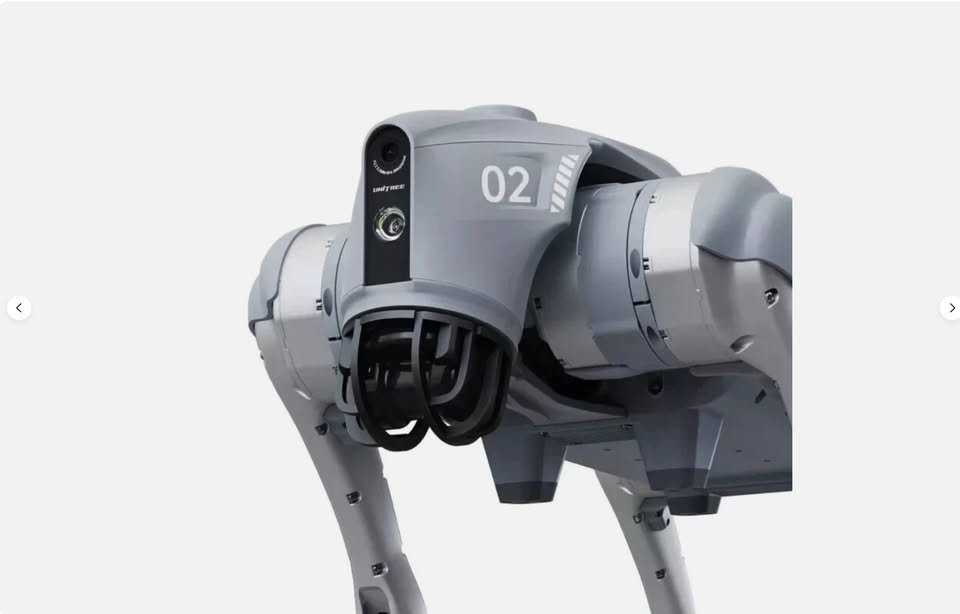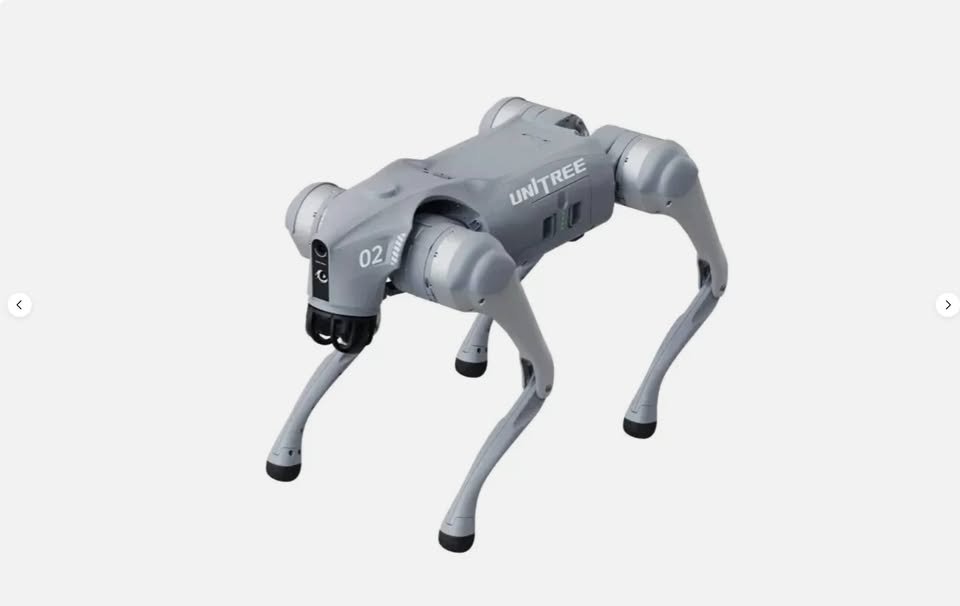
What is the Go2?
The Unitree Go2 is an advanced quadruped robot designed by Unitree Robotics, headquartered in Hangzhou, China. It builds on the company’s experience with legged locomotion and is marketed as an affordable, reinforcement-learning-driven robotic dog. Modular hardware and optional 4D LiDAR, depth cameras, and GPT-powered voice interaction make it suitable for research, education, light inspection, and entertainment. With a 15 kg body, 5 kg payload, and top speed of 9 km/h, it competes directly with Boston Dynamics Spot at a fraction of the cost.
Specifications
Here are the full technical specifications.
| Spec | Value |
|---|---|
| Height | 40 cm |
| Weight | 15 kg |
| Degrees of freedom | 12 |
| Battery life | 1.5 hours |
| Max speed | 9 km/h |
| Payload | 5 kg |
| Price (new) | $1,600–$22,500 |
| Price (used range) | ~$1,200–$18,000 (est.) |
Price & Value
New MSRP: $1,600–$22,500
Used range: ~$1,200–$18,000 (est.)
The Go2’s aggressive pricing undercuts Boston Dynamics Spot by 97% at the base level. With $1,600 for the Air model, it is the cheapest research-grade quadruped on the market. The Pro and X models add 4D LiDAR and greater compute at midrange prices ($2,500–$3,500), while EDU variants ($7,500–$22,500) provide high-performance computing for advanced workloads. Depreciation is moderate; early models hold value well due to strong demand in education. Total cost of ownership remains low because batteries and repairs are affordable compared to industrial quads. For the price of one Spot, a lab can equip an entire fleet of Go2 robots.
Who Is It For?
Best for: - University robotics labs (affordable platform for locomotion research) - STEM educators (low‑cost entry to legged robots) - Light inspection tasks (5 kg payload for small sensors)
Not for: - Heavy industrial payloads (5 kg max, insufficient for heavy tools) - Outdoor operations in rain (no IP rating, not waterproof) - Long‑duration autonomous patrol (1.5 h battery limits continuous operation)
Alternatives & Comparison
The Go2 competes in the affordable quadruped segment, but a few direct rivals exist.
| Model | Price | Available | Key Difference |
|---|---|---|---|
| Boston Dynamics Spot | $74,500 | yes | Industrial IP54, 14 kg payload, but 46× more expensive |
| Xiaomi CyberDog 2 | ~$1,600 (est.) | yes | Smaller, 3 kg payload, open‑source but limited compute and no LiDAR option |
| Deep Robotics Lite3 | ~$3,000 (est.) | yes | Similar payload and price, but lacks GPT integration and 4D LiDAR |
Verdict: For budget‑conscious labs and educators, the Go2 is unbeatable: you can buy a dozen for the price of one Spot. CyberDog 2 matches on price but lacks the compute and LiDAR options of the Go2 Pro and EDU. Spot remains the only choice for industrial jobs requiring IP54 and 14 kg payload, but for research and light inspection, the Go2 offers 90% of the capability at 3% of the cost.
Use Cases & Capabilities
Robot Research
The Go2’s reinforcement‑learning‑based locomotion and open‑source extensibility make it an ideal platform for gait optimization, autonomous navigation, and human‑robot interaction studies. Its 12‑DOF aluminum alloy joints provide compliant movement at a fraction of the cost of larger quadrupeds. Researchers can upgrade to EDU models with up to 100 TOPS for on‑board AI workloads. The robot’s standard sensor suite (cameras, ultrasonics, foot force) allows mapping and SLAM experiments without additional hardware.
STEM Education
Priced from $1,600, the Go2 Air gives schools and coding camps a fully‑functional legged robot for teaching programming, control theory, and robotics fundamentals. The GPT‑powered voice module keeps students engaged, while the ROS‑compatible SDK supports curriculum from block coding to graduate‑level projects. Durable aluminum frame and plastic body survive repeated crashes during student demos. Multiple configurations let programs scale from introductory labs to advanced autonomous systems courses.
Outdoor Mapping
With a maximum speed of 9 km/h and a 30° climbing grade, the Go2 Pro and X can traverse rough terrain while scanning with an optional 4D LiDAR and depth camera. This makes it useful for digitizing construction sites, archaeological digs, or forest trails. The 1.5‑hour battery limits mapping area per charge, but swappable batteries alleviate downtime. Without an IP rating, however, operation must be paused during rain or heavy dust, restricting always‑on field use.
Security Patrol
The Go2 can follow predefined patrol routes, streaming video and detecting anomalies through onboard cameras and ultrasonic sensors. Its small footprint and quiet electric motors allow it to operate indoors without disturbing occupants. The high‑end EDU+ config adds 100 TOPS of compute for real‑time threat detection. Low cost means multiple units can cover larger facilities, though the lack of waterproofing prevents outdoor night patrols in harsh weather.
Entertainment
Unitree’s GPT integration lets the Go2 respond to voice commands with expressive head motions and pre‑programmed tricks. Enthusiasts use it as a high‑tech companion at events or trade shows, where its dynamic gait and compact size draw attention. The robot’s ability to crouch (20 cm tall) and walk on uneven floors adds a lifelike quality. While not as rugged as a Spot, its lower price makes it accessible for hobbyist tinkering and custom modifications.
History & Background
Unitree Robotics was founded in 2016 in Hangzhou, China, quickly gaining recognition with its A1 and B1 quadrupeds. The Go2, announced in July 2023, marked a generational leap by introducing reinforcement‑learning‑based locomotion and GPT‑powered voice interaction. Built on the earlier Go1, the Go2 series expanded into Air, Pro, X, EDU, and EDU+ configurations, each adding sensors (4D LiDAR, depth cameras) and more onboard compute (up to 100 TOPS). Within its first year, Unitree shipped thousands of units to universities, research labs, and hobbyists worldwide. As of 2026, the Go2 remains in active production, regularly updated via firmware, and has become one of the most widely adopted affordable quadrupeds on the market.
Buying Used — What to Check
Verify battery health Battery capacity degrades over time; a worn pack may only deliver 1 hour instead of 1.5.
Inspect joint motors Aluminum alloy motors can develop play after heavy use; ensure smooth motion without grinding noises.
Confirm sensor functionality If buying a Pro or EDU model, test LiDAR, depth camera, and ultrasonic sensors for accurate data output.