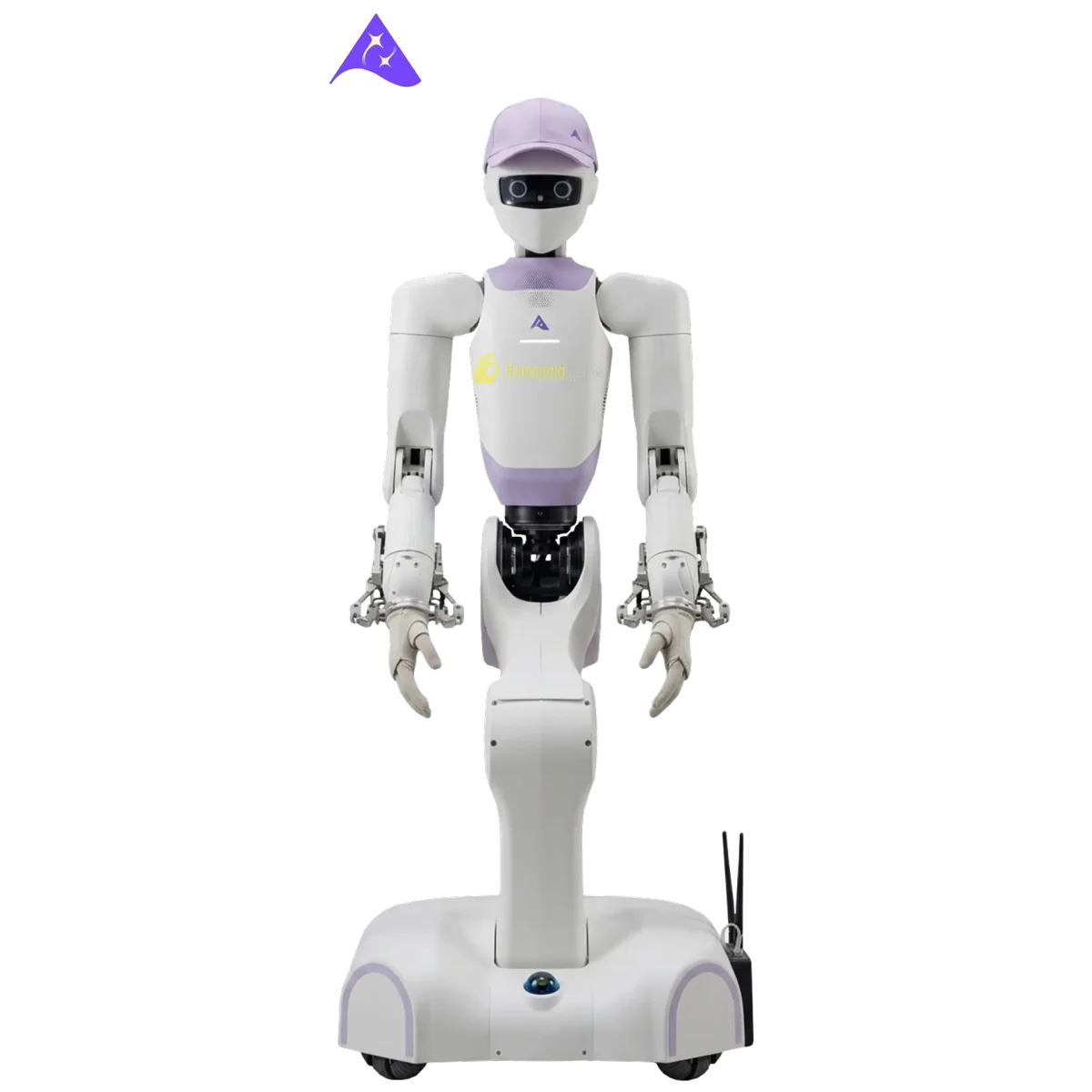
What is the Astribot T1?
The Astribot T1 is a humanoid upper-torso robot built by Astribot, a robotics company founded in 2022 and headquartered in Shenzhen, China. Designed primarily for bimanual manipulation tasks, the T1 features a 155 cm tall aluminum alloy frame with polymer covers, weighing 66 kg. It boasts 23 degrees of freedom and high-performance cable-driven actuators that enable fast, precise arm movements up to 5 km/h. Its dual five-fingered hands provide dexterous gripping, and it runs for up to 6 hours on a charge. The T1 is targeted at commercial service, education, research, and light industrial settings, offering safe human interaction for indoor use.
Specifications
Here are the full technical specifications.
| Spec | Value |
|---|---|
| Height | 155 cm |
| Weight | 66 kg |
| Degrees of freedom | 23 |
| Battery life | 6 hours |
| Max speed | 5 km/h |
| Payload | 10 kg |
| Price (new) | Undisclosed |
| Price (used range) | N/A |
Price & Value
New MSRP: Undisclosed
Used range: N/A
The Astribot T1 is a prototype, and official pricing has not been announced. Media estimates have suggested a possible $22,000 range, but Astribot has not confirmed this. Without a formal product launch, no standard pricing or warranty terms exist. Comparisons to similar bimanual platforms are difficult, but a production-ready competitor like the Unitree H1 starts at $90,000. If the T1 eventually reaches the market at a price around $20,000–$30,000, it would be very cost-competitive; however, buyers should treat it as a research asset with uncertain long-term support.
Who Is It For?
Best for: - University robotics labs researching bimanual manipulation algorithms (23 DOF with cable-driven dexterity) - Light industrial R&D teams prototyping assembly lines where a stationary, safe cobot is needed - Educators demonstrating humanoid movement and AI integration in a controlled indoor setting
Not for: - Heavy industrial lifting (payload limited to 10 kg per arm) - Outdoor or rough-terrain use (low IP rating, no legs, indoor-only) - 24/7 production environments (battery life of 6 hours requires recharging, no hot-swap capability confirmed)
Alternatives & Comparison
The Astribot T1 occupies a niche as a prototype bimanual torso. It competes conceptually with full humanoid and mobile manipulator robots that are already on the market.
| Model | Price | Available | Key Difference |
|---|---|---|---|
| Unitree H1 | $90,000 | yes | Full humanoid with legs, higher payload, more dexterous hands |
| Fourier GR-1 | Undisclosed | preorder | Medical/rehab focus, different form factor, legs included |
| Tesla Optimus | Undisclosed | no | Proprietary AI, massive manufacturing scale, full-size humanoid |
| Agility Digit | Undisclosed | enterprise-only | Dynamic legged locomotion, warehouse package handling focus |
Verdict: For budget-conscious research labs exploring bimanual manipulation, the T1’s rumored low price could be a game-changer, but until it ships the Unitree H1 remains the most capable and actually available humanoid platform. The T1’s stationary design limits its versatility compared to legged competitors, but its focus on upper-body dexterity may suit assembly and service tasks better.
Use Cases & Capabilities
Bimanual Assembly
The T1 excels in dual-arm coordination tasks like threading components, fastening screws, or assembling small electronic devices. Its 23 DOF and cable-driven actuators allow fluid, human-like motions, while force/torque sensors provide fine control. The 10 kg payload per arm is sufficient for many light assembly workloads, and its 5 km/h arm speed keeps pace with typical manual workrates. Integration with ROS2 facilitates custom automation scripts for varied production runs.
Research and Education
As a pre-commercial platform, the T1 is a compelling tool for academic groups studying bimanual manipulation, imitation learning, or human-robot interaction. Its RGB-D cameras and ROS2 compatibility enable rapid experimentation. The 6-hour battery supports full-day lab sessions, and the cable-driven design gives researchers a look at alternative actuation philosophies. Safe human collaboration is assured by the robot’s indoor-rated, low-speed design.
Logistics Pick-and-Place
In warehouse settings, the T1 can be mounted at a fixed station to sort items, palletize goods, or feed conveyors. A 66 kg weight makes it relocatable without heavy rigging, and its Ethernet/Wi‑Fi connectivity allows integration into existing warehouse management systems. The dexterous five-fingered hands can handle a variety of object shapes, though the lack of autonomous mobility limits its operational footprint to a fixed cell.
Domestic Service Assistance
The T1’s safe interaction design and moderate size make it a candidate for home service tasks like tidying, fetching objects, or simple kitchen help. A 6‑hour runtime is enough for several hours of chores, and the cable-driven arms operate quietly. However, as a prototype, reliability and robustness in unpredictable home environments remain unproven, and the robot lacks onboard legs for room‑to‑room navigation.
History & Background
Astribot was established in 2022 in Shenzhen, China, with a focus on dexterous humanoid robots. The company emerged from stealth in early 2024 with a viral video of its S1 robot performing rapid, precise manipulation at 10 m/s tip speed. The T1 model was introduced later that year as a smaller, torso-only variant optimized for stationary bimanual tasks. By 2026, the T1 remains a pre‑commercial prototype, with Astribot refining the design through limited partner trials. The company has not yet announced mass production or a definitive release date, though the buzz around its arm speed continues to generate interest.
Buying Used — What to Check
Verify payload rating Prototype robots may have exaggerated specs; actual payload per arm should be confirmed with Astribot before purchase.
Check battery health Lithium-ion cells degrade even in low-use prototypes; ensure the unit still delivers the claimed 4–6 hour runtime.
Inspect cable tension Cable-driven systems can lose tension over time, affecting precision and requiring specialist recalibration.