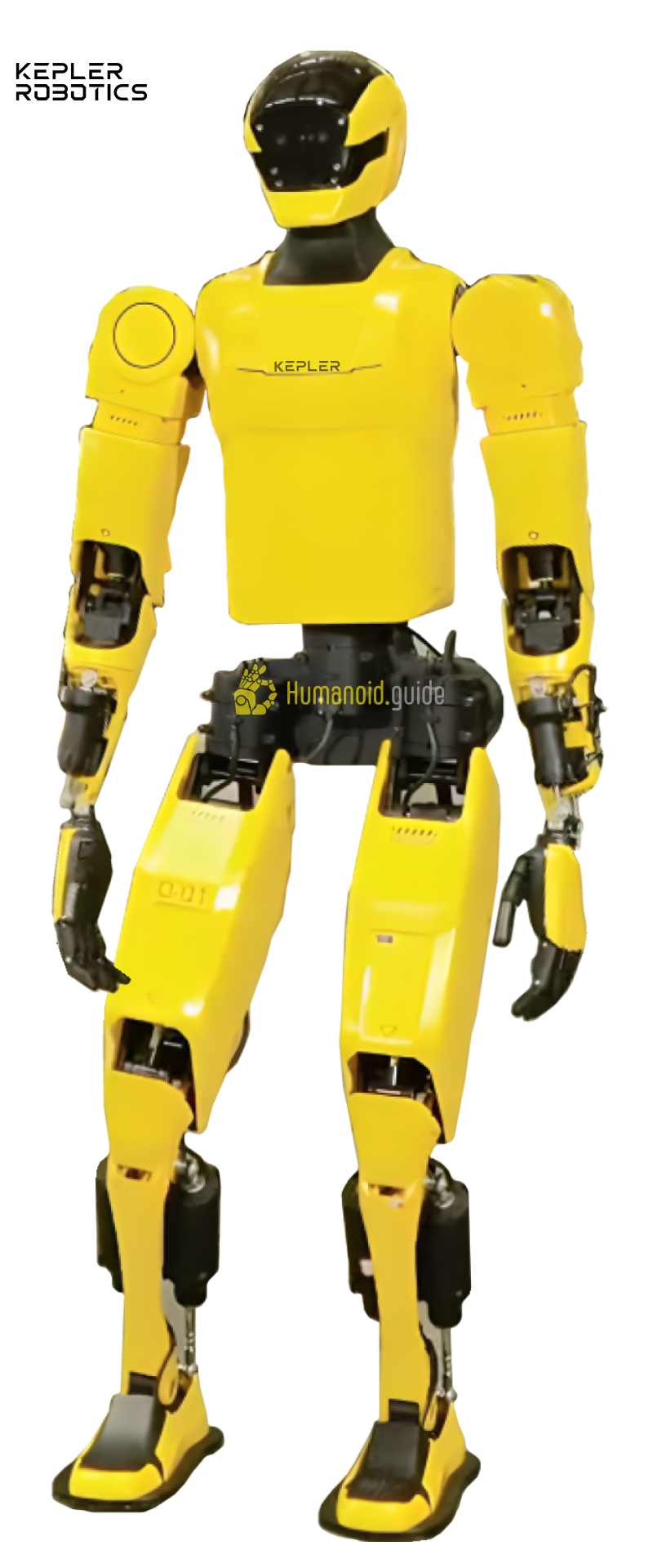
What is the Kepler K2 Bumblebee?
The Kepler Forerunner K2 Bumblebee is a special-edition humanoid robot from Kepler Exploration Robot Co., headquartered in Shanghai, China. As a variant of the Forerunner K2 platform, it features a distinctive yellow-and-black color scheme inspired by bumblebees and is reportedly equipped with additional sensors beyond the standard K2. Standing 178 cm tall and weighing 85 kg, the robot is designed for research, education, and AI laboratory environments. It offers 28 degrees of freedom across its body, a 2-hour battery life, and a maximum walking speed of 5 km/h. The Bumblebee edition remains at the pre-commercial prototype stage, with pre-orders being taken for early adopters and developers.
Specifications
Here are the full technical specifications.
| Spec | Value |
|---|---|
| Height | 178 cm |
| Weight | 85 kg |
| Degrees of freedom | 28 |
| Battery life | 2 hours |
| Max speed | 5 km/h |
| Payload | Not specified |
| Price (new) | $30 (pre-order deposit, full price undisclosed) |
| Price (used range) | N/A |
Price & Value
New MSRP: $30 (pre-order deposit; full retail price undisclosed)
Used range: N/A
The listed $30 price on third-party storefronts is almost certainly a pre-order deposit, not the full purchase price of the robot. Kepler has not publicly disclosed the final MSRP for the Forerunner K2 Bumblebee, making cost comparisons difficult. Until the official figures are released, the K2 Bumblebee's value proposition for buyers is uncertain. Given the pre-commercial nature of the platform, early adopters may face additional expenses for software, support, and optional modules. Prospective buyers should budget for a total cost likely competitive with other research humanoids, though exact amounts remain speculative.
Who Is It For?
Best for: - University robotics labs seeking a pre-production humanoid platform for perception and manipulation research (28 DOF allows full-body motion studies) - AI companies developing embodied intelligence with a physical testbed (supports external LLM API integration for vision-language-action experiments) - Research groups focusing on sensor fusion and autonomous navigation (extra sensor suite on Bumblebee edition enhances data collection)
Not for: - Industrial production lines (payload rating is unspecified, limiting heavy object manipulation) - Outdoor deployment in harsh environments (no IP rating confirmed, protection against dust/moisture unknown) - Organizations requiring immediate, plug-and-play commercial solutions (the robot is still a prototype with limited support ecosystem)
Alternatives & Comparison
The K2 Bumblebee enters a rapidly evolving market of general-purpose humanoids, where it competes with better-known platforms like Tesla Optimus, Unitree G1, and Fourier GR-3. As a special-edition pre-commercial robot, it differentiates through its sensor loadout and color scheme, but currently lacks the commercial maturity of some alternatives.
| Model | Price | Available | Key Difference |
|---|---|---|---|
| Unitree G1 | Undisclosed | preorder | Smaller form factor; likely lower cost but fewer known specs as of early 2026 |
| Fourier GR-3 | Undisclosed | preorder | Full-size humanoid with focus on dynamic locomotion and manipulation; potentially more refined hardware |
| Tesla Optimus | Undisclosed | no | Industry benchmark with massive AI integration and ongoing trials in Tesla factories; not commercially available |
Verdict: For researchers who value an open sensor platform and are willing to co-develop the robot alongside the manufacturer, the K2 Bumblebee offers a unique pre-release testing ground. However, buyers needing proven reliability and standard payload capabilities should wait for either the finalized Forerunner K2 specs or turn to more mature platforms from Unitree or Fourier once those become commercially available.
Use Cases & Capabilities
Academic Research in Humanoid Locomotion & Manipulation
The K2 Bumblebee provides an advanced 28-DOF testbed for universities exploring bipedal walking, balance, and object interaction. Its 2-hour battery allows for extended lab sessions without frequent recharging. The extra sensors support multi-modal data capture during experiments, enabling novel approaches in reinforcement learning for whole-body control. While the lack of a published arm payload rating may restrict heavy-grasping studies, lighter tasks like precision pick-and-place are feasible. Additionally, the robot’s Linux-based control OS eases integration with ROS-based research pipelines.
AI Embodiment and LLM Integration
Designed for the emerging field of embodied intelligence, the K2 Bumblebee can be paired with external large language models through its API, facilitating real-world command execution. Its hardware includes an embedded ARM CPU and small onboard GPU, sufficient for running perception stacks. The 1080p camera and Bluetooth/Wi‑Fi connectivity allow seamless streaming of visual data to cloud-based AI services. Developers can test vision-language-action models in a physical robot with a glass-to-action latency of 250–450 ms, making it a viable platform for iterative AI training cycles.
Education and Workforce Training
Although still in pre-order phase, the K2 Bumblebee can prepare students for future humanoid robot operation and maintenance. Its anthropomorphic design and human-safe interaction features make it suitable for classroom demonstrations of robotics principles. The distinctive Bumblebee styling can engage younger learners in STEM subjects. Educational institutions may leverage the robot to teach programming, sensor integration, and mechatronics, though the absence of a commercial support network could pose challenges for sustained educational use without dedicated lab staff.
Sensor Fusion and Perception Research
The Bumblebee edition’s additional sensors—whose exact types remain undisclosed—open avenues for multi-modal perception studies. Researchers can experiment with time-synchronized data from cameras, LiDAR, and proprioceptive sensors to improve humanoid situational awareness. The robot’s aluminum and composite structure provides a stable platform for mounting extra experimental hardware. Low-level access to motor controllers and gear data enables torque sensing and advanced control algorithm development, making it a valuable asset for labs specializing in intelligent robotics.
History & Background
Kepler Exploration Robot Co., based in Shanghai, China, emerged as a player in the humanoid robotics market with the unveiling of its Forerunner series. The company introduced the Forerunner K1, designed for “unmatched power,” before announcing the Forerunner K2, which touted an impressive 1-hour charge for 8-hour endurance. In 2025, Kepler released the K2 Bumblebee, a special-edition variant distinguished by its yellow-and-black colorway and expanded sensor suite, targeting research and AI labs. The robot remains in pre-production, with no known large-scale deployments as of 2026. The company has emphasized integration into manufacturing processes, but the Bumblebee appears more lab-focused. No ownership changes or major acquisitions have been reported.
Buying Used — What to Check
Verify full price and purchase terms The $30 pre-order deposit does not reflect the robot’s final cost; confirm the total price including any mandatory support packages.
Confirm sensor and hardware specs The Bumblebee edition is advertised as having extra sensors, but their models and capabilities are not publicly documented — ensure they match your project needs.
Check production status and serial number As a limited-edition prototype, later units may differ from early ones; a provenance check helps avoid non-functional engineering samples.