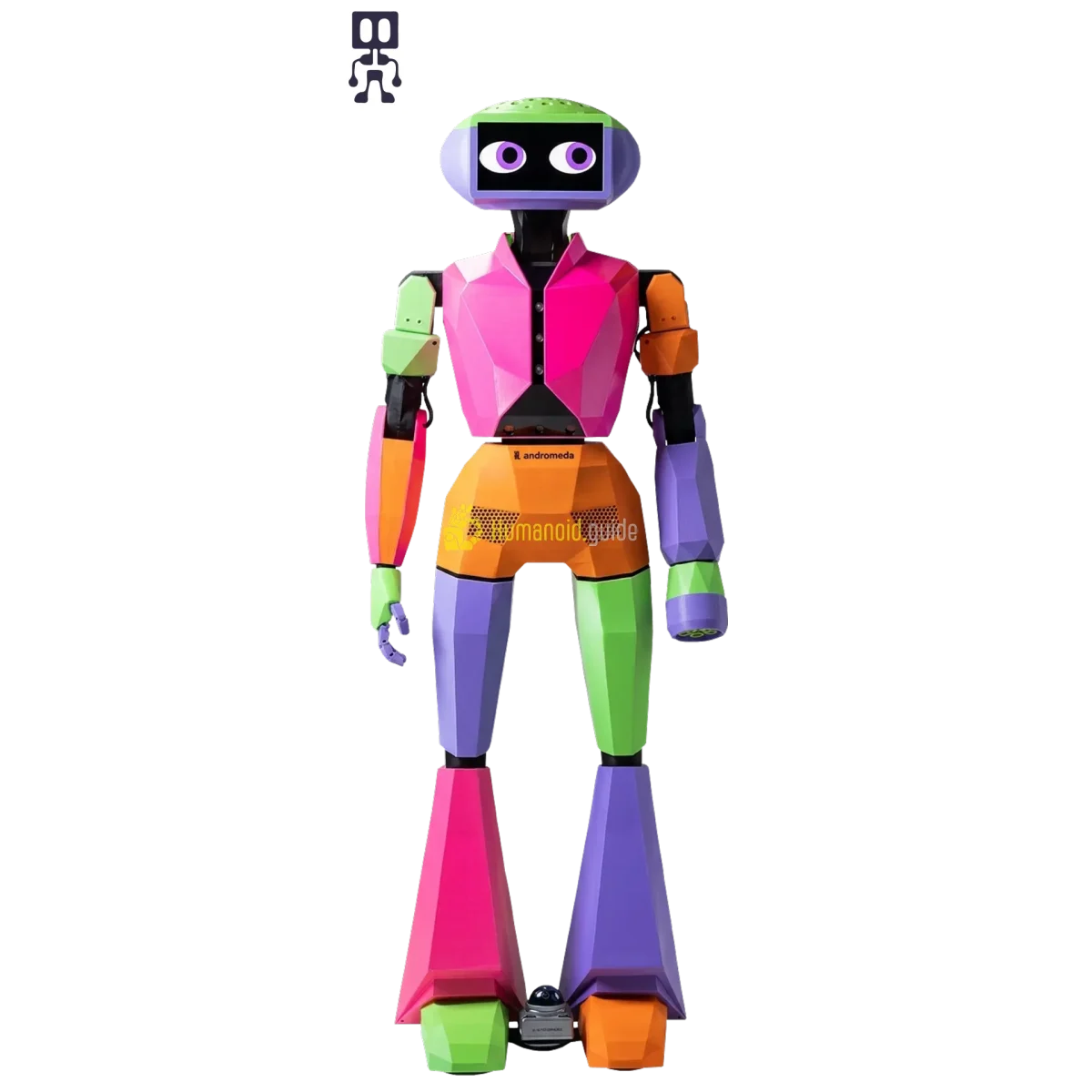
What is the Abi Andromeda?
The Abi is a social humanoid from Andromeda Robotics (Melbourne, Australia), standing 120 cm and weighing 50 kg. Designed for aged care and hospitality, it uses an expressive LED/LCD face display, conversational AI, and 12-degree-of-freedom motion for companionship, patient engagement, and therapy support. It communicates through voice and gesture, integrating cameras, microphones, and touch sensors. Abi targets facility operators—not individual consumers—and was developed with the goal of reducing loneliness in elderly populations. Andromeda Robotics, founded in 2022, deploys Abi to care facilities via pilot programs and enterprise sales, having raised $23M in Series A funding to scale production to 100 units per month.
Specifications
Here are the full technical specifications.
| Spec | Value |
|---|---|
| Height | 120 cm |
| Weight | 50 kg |
| Degrees of freedom | 12 |
| Battery life | 2 hours |
| Max speed | 3 km/h |
| Payload | 4 kg (arm) |
| Price (new) | Undisclosed |
| Price (used range) | N/A (no secondary market) |
Price & Value
New MSRP: Undisclosed (contact manufacturer)
Used range: N/A (no secondary market)
Andromeda Robotics does not publicly list pricing for Abi; prospective enterprise customers must inquire directly. Given the robot’s focus on facility deployment, it likely operates on a lease or service-subscription model rather than a simple hardware purchase, which lowers upfront capital but increases total cost over time. In the context of social humanoids, Pepper sits around $20,000, while Misty II is about $3,000, but Abi’s purpose-built design for aged care may command a premium for its conversational AI and expressive hardware. With a planned production ramp to 100 units per month, economies of scale could eventually reduce per-unit cost, though initial deployments are expected to be modest. Used units are currently unavailable as the robot is still in limited pilots; a secondary market may emerge only after several years of fleet turnover. Organisations evaluating Abi should factor in software licences, staff training, integration with existing care systems, and potential customisation costs, as these will significantly influence the total cost of ownership beyond the robot itself.
Who Is It For?
Best for: - Aged-care facilities seeking a semi-autonomous social companion for residents - Hospitals and rehabilitation centres aiming to improve patient engagement and reduce staff burden - Hospitality businesses wanting interactive lobby greeters or concierge robots
Not for: - Individual consumers (only sold to enterprises) - Industrial or heavy logistics tasks (no significant payload capacity) - Outdoor or high-dust environments (indoor only, likely IP20 rating)
Alternatives & Comparison
Abi competes in the social humanoid space with a few established platforms, though its focus on emotional interaction and enterprise deployment distinguishes it from developer-oriented or consumer robots.
| Model | Price | Available | Key Difference |
|---|---|---|---|
| SoftBank Robotics Pepper | $20,000 | yes | Wider commercial deployment and more advanced emotion recognition; larger installed base. |
| Misty Robotics Misty II | $3,000 | yes | Smaller, modular developer platform lacking aged-care specificity or expressive face. |
| UBTECH Lynx | $800 | yes | Affordable educational humanoid with Alexa, not built for enterprise care environments. |
Verdict: For facilities seeking a dedicated social companion with a large physical presence, expressive face, and healthcare-specific conversational AI, Abi is the most purpose-built option—assuming budget and pilot availability allow. Pepper remains a safer, more established choice with a proven track record in care settings globally, while Misty II and Lynx are simply not designed for aged-care or hospitality deployments. If immediate deployment and reliability are critical, Pepper wins; if you can partner with a startup and influence future features, Abi offers a compelling roadmap.
Use Cases & Capabilities
Companionship for elderly residents
In aged-care homes, Abi acts as a conversational partner, remembering residents’ names and preferences and telling stories or playing music. Its expressive face and gentle gestures create a non-threatening presence, reducing feelings of isolation and loneliness. Staff can schedule regular check-ins, and Abi can alert nurses if a resident appears distressed through its cameras and audio analysis. The robot’s integration with large language models allows natural, open-ended dialogue that adapts to the individual, helping bridge social gaps between visits from family members. Because it can navigate autonomously at a safe speed, it can move between common areas and private rooms to maintain consistent engagement.
Social interaction in paediatric wards
In hospital paediatric units, Abi engages children with games, storytelling, and interactive quizzes, distracting them during long treatments or waiting periods. It can move autonomously between beds—at a limited 3 km/h—and display cheerful, animated faces. Touch sensors on its hands and torso allow lightweight, safe interaction, encouraging hesitant children to engage. Nurses can control or monitor sessions via a tablet interface, and the robot’s microphone array picks up children’s responses even in a moderately noisy ward. This use case leverages Abi’s mobility and emotional expressiveness to reduce anxiety and improve the overall patient experience.
Patient engagement during rehabilitation
During rehabilitation sessions, Abi can lead light physical exercises by demonstrating arm movements and giving verbal encouragement. It tracks participant compliance via its cameras and offers personalised feedback, turning repetitive exercises into a more enjoyable activity. For older adults, the robot guides seated exercises, helping maintain range of motion and muscle tone without risk of overexertion. Its 2-hour battery runtime suits a typical therapy session, though needing a recharge between groups might limit throughput in larger facilities. Therapists can later review aggregated data to adjust care plans, adding a layer of objective measurement to traditional rehab.
Therapy support for anxiety and non-verbal clients
Psychologists and occupational therapists can use Abi as a non-judgmental medium to facilitate sessions with anxious or non-verbal clients. The robot’s consistent, predictable behaviour helps build trust, and its expressive face can mirror or model emotions without the complexities of human facial expressions. It can run cognitive assessments or memory games, logging results for clinician review, and its touch sensors allow clients to interact physically in a safe, controlled way. As Abi’s voice, appearance, and persona are customisable per deployment, it can adapt to individual patient needs—from gentle encouragement to more energetic motivation—making it a flexible tool in mental health settings.
History & Background
Andromeda Robotics was founded in 2022 by a team with backgrounds in robotics and healthcare, headquartered in Melbourne, Australia. The Abi robot was unveiled in early 2023, initially trialled in select aged-care homes in Victoria. A successful $23 million Series A round in 2024 financed manufacturing scale-up, with a stated goal of producing 100 units per month by late 2025. By 2026, Abi has participated in several pilot programmes across Australia and the Asia-Pacific region, deployed in aged-care, hospital, and hotel lobbies. The company has not yet announced a consumer version; all sales remain enterprise-focused. Software updates have continuously improved its LLM-driven conversation and personality, and the team is exploring additional applications in education and hospitality sectors.
Buying Used — What to Check
Verify unit condition and service history Early production units may have reliability issues; a full maintenance log helps assess remaining lifespan.
Confirm software licence transferability Abi’s value heavily depends on its conversational AI and support; ensure licences can be transferred and that Andromeda Robotics will provide updates to a second owner.
Check connectivity and IT compatibility Abi likely requires cloud connectivity for LLM features; confirm that your facility’s Wi-Fi and firewall policies allow the robot to operate without restrictions.