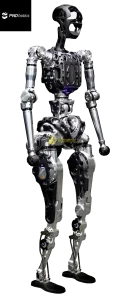
What is the Adam?
The ADAM is a full-size humanoid robot developed by Richtech Robotics, headquartered in Las Vegas, Nevada, USA. Designed for hospitality, retail, and service environments, ADAM features advanced bipedal locomotion, 50 degrees of freedom, and a suite of sensors including cameras, LiDAR, and ultrasonic for autonomous navigation and interaction. With a height of 1.73 m and weight of 95.2 kg, it presents a human-like presence suitable for customer greeting, food service, and information delivery. Its modular design and NVIDIA Jetson compute platform support custom application development, though the platform remains in limited enterprise deployment as of 2026.
Specifications
Here are the full technical specifications.
| Spec | Value |
|---|---|
| Height | 173 cm (1730 mm) |
| Weight | 95.2 kg |
| Degrees of freedom | 50 |
| Battery life | 8 hours |
| Max speed | 6 km/h |
| Payload | 5 kg (standing payload) |
| Price (new) | Undisclosed (contact manufacturer) |
| Price (used range) | N/A (enterprise sales only) |
Price & Value
New MSRP: Undisclosed (contact manufacturer)
Used range: N/A
Richtech Robotics does not publicly disclose ADAM’s price; all sales go through direct enterprise contracts. Industry sources place the unit cost at approximately $120,000, making it one of the more affordable full-size bipedal humanoids compared to competitors like the UBTECH Walker X (est. >$200,000) and Fourier GR-2 (~$150,000). However, that price likely covers only the hardware, with additional costs for integration, training, and maintenance that can significantly impact total cost of ownership. The robot’s limited deployment history makes depreciation rates unpredictable. Used units are rare, but as more enterprises pilot the platform, a secondary market could emerge, though Richtech’s transfer policies are unknown. For organizations evaluating ADAM, a thorough ROI analysis against cheaper stationary alternatives like Ameca or digital signage is essential before committing to a six-figure purchase.
Who Is It For?
Best for: - Hotels and retail chains seeking a humanoid host for customer interaction (173 cm height and 50 DOF enable expressive greeting and guidance) - Restaurants and cafes aiming to automate food delivery and bussing tasks (with standing payload of 5 kg and bipedal mobility)
Not for: - Manufacturers needing heavy industrial payloads (arm payload unspecified, limited to light manipulation) - Budget-constrained organizations (price undisclosed, but estimated six figures; lower-cost alternatives like telepresence robots exist)
Alternatives & Comparison
ADAM competes against other bipedal and upper-body humanoids aimed at customer-facing service roles. The table below compares it with established and emerging alternatives.
| Model | Price | Available | Key Difference |
|---|---|---|---|
| UBTECH Walker X | Undisclosed (~$200,000 est.) | preorder | Fully bipedal, advanced manipulation with hands, more established in enterprise settings. |
| Fourier GR-2 | ~$150,000 (est.) | preorder | Higher torque density, explicit industrial payload ratings, currently in early adopter programs. |
| Engineered Arts Ameca | $133,000 | yes | Expressive human-like face and upper body; no legs, sold as a platform for AI interaction. |
Verdict: For businesses that require full bipedal mobility and a human-like presence, ADAM offers a lower entry price than the Walker X and GR-2, but with less proven reliability and limited arm functionality. Ameca, while wheeled, provides a more polished and commercially mature platform for stationary interaction. ADAM is best suited for early adopters willing to collaborate with Richtech on custom deployments, while risk-averse buyers should consider Ameca or wait for ADAM to demonstrate wider field success.
Use Cases & Capabilities
Hotel Lobby Ambassador
ADAM greets guests, provides directions, and interacts with visitors in high-end hotel lobbies. Its 1.73 m height makes it visually commanding, and its 50 DOF allow for natural gestures and head movements. The robot can integrate with the hotel’s property management system to offer personalized recommendations. However, its 6 km/h walking speed is moderate, and arm dexterity is limited to standing tasks like handing out brochures, not complex manual work.
Restaurant Food Runner
In casual dining or fast-casual settings, ADAM transports food trays from the kitchen to tables using its standing payload of 5 kg. The robot navigates autonomously using LiDAR and cameras, avoiding dynamic obstacles like children or chairs. Its bipedal locomotion allows it to traverse steps if needed, though current implementations are typically on flat floors. Service staff can trigger table numbers via a tablet, and ADAM’s speech system announces the order before handing over items.
Retail Store Guide
ADAM patrols the store floor, answering product queries through a built-in voice assistant and directing customers to the right aisle. Its camera array can identify customer demographics for targeted promotions, though Richtech emphasizes privacy-compliant processing. The robot’s charging dock allows it to work shifts of up to 8 hours, after which it autonomously returns to recharge. Lack of arm manipulation means it cannot retrieve or physically display products.
Trade Show Host
At exhibitions and corporate events, ADAM draws crowds with its humanoid appearance and interactive demos. It can deliver pre-programmed presentations, guide visitors to booths, and even pose for photos. The robot’s modular software platform lets exhibitors upload custom content and scripts. While ADAM’s presence generates buzz, its reliance on stable floor surfaces and the need for an operator for complex interactions limit spontaneous engagement.
History & Background
Richtech Robotics was founded in 2016 in Las Vegas, Nevada, originally focusing on service robots for food delivery and indoor transport. The ADAM humanoid was first revealed at CES in January 2022, with a prototype completed in 2021. The robot is designed as a bipedal interactive platform for hospitality and retail, running on Ubuntu with ROS and NVIDIA Jetson compute. As of 2026, ADAM remains in limited enterprise deployment; no second-generation model has been publicly announced. Richtech has partnered with select hospitality chains for pilot programs, but the robot has not yet achieved mass production. The company’s approach is low-key, prioritizing practical B2B solutions over consumer-facing hype, contrasting with high-profile projects like Tesla Optimus or Boston Dynamics Atlas. ADAM’s development continues with incremental updates to its sensor and navigation stack, but detailed technical milestones are not widely disclosed.
Buying Used — What to Check
Verify payload rating ADAM’s official standing payload is 5 kg, but no arm-specific load rating is published; confirm real-world capabilities before assigning tasks.
Inspect battery health The 8‑hour runtime can degrade over charge cycles; request a battery cycle count report from the seller.
Confirm software licensing transfer The robot runs proprietary software; ensure Richtech permits license reassignment and that update support continues for second owners.