What is the Aei Alice?
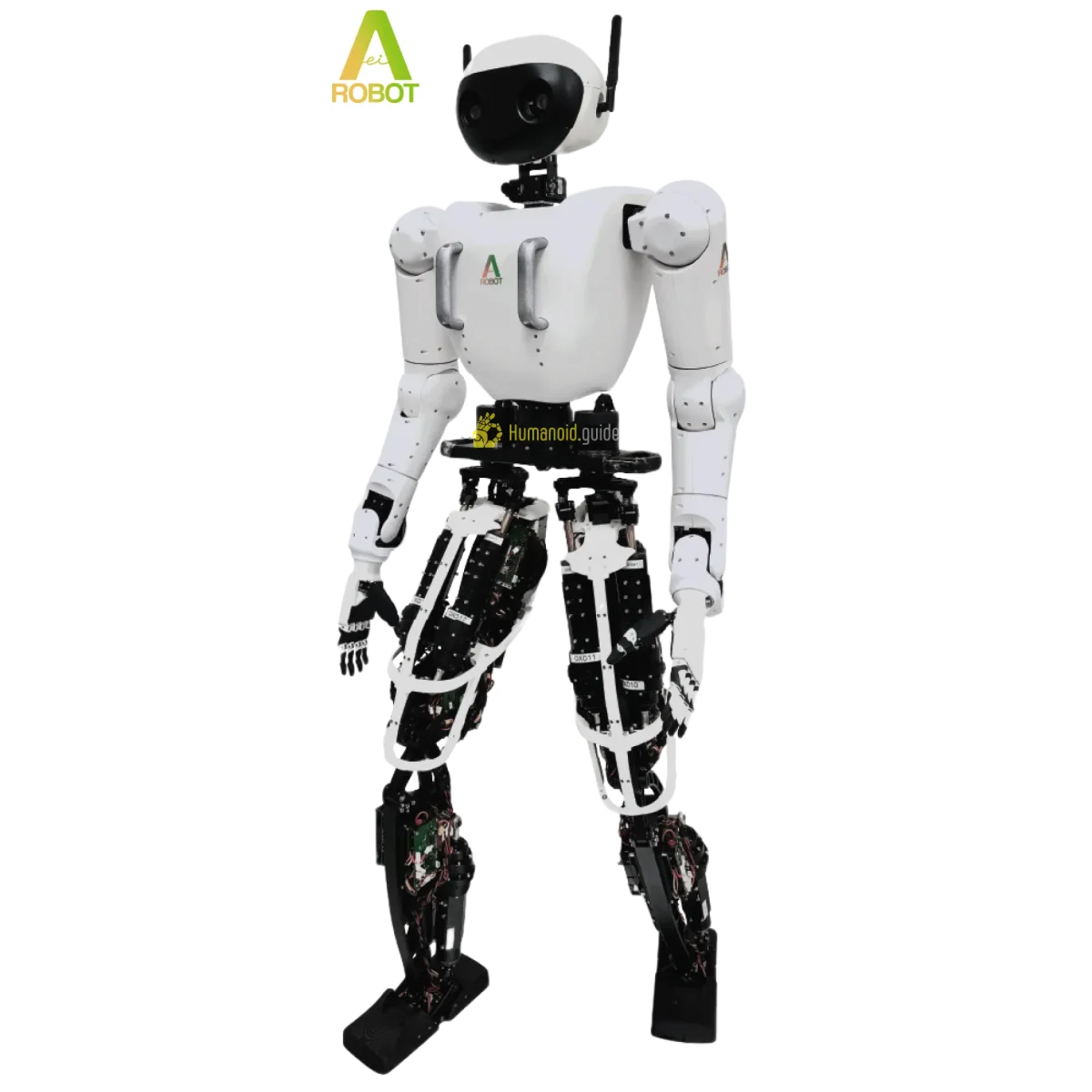
The AEI Alice is a bipedal humanoid research platform developed by AEI Robot, a Chinese robotics company based in Shenzhen. Focused on physical human-robot interaction, it features 31 degrees of freedom (7 per hand) and compliant joint actuators powered by Harmonic Drive gear technology and brushless motors. Standing 157 cm tall and weighing 50 kg, Alice carries a payload of 10 kg and walks at up to 2 km/h. Compute is handled by an NVIDIA Jetson Orin-class system running Linux with ROS2. It is still in the prototype phase, targeted at academia, AI labs, and demonstration environments. The platform supports cloud-based LLM integration (via OpenAI, Alibaba Qwen, etc.) and offers Ethernet/Wi‑Fi connectivity. A wheeled mobile-manipulator variant, Alice M1, also exists but remains experimental.
Specifications
Here are the full technical specifications.
| Spec | Value |
|---|---|
| Height | 157 cm |
| Weight | 50 kg |
| Degrees of freedom | 31 |
| Battery life | 1.5 hours |
| Max speed | 3 km/h |
| Payload | 10 kg |
| Price (new) | $45,000 (listed, pre-commercial) |
| Price (used range) | N/A (no used market yet) |
Price & Value
New MSRP: $45,000
Used range: N/A
At a listed price of $45,000, the AEI Alice would be one of the most affordable full-scale bipedal humanoid research platforms if brought to market. Compared with the Unitree H1 (approx. $90,000) or Fourier GR-1 (approx. $150,000), its value proposition lies in high dexterity (31 DOF) and open ROS2 architecture at roughly half the cost. However, the robot is still a prototype, so final pricing and availability remain uncertain. The lack of a production track record means depreciation and used-market pricing are impossible to estimate; early adopters should budget for potential hardware updates and limited manufacturer support. Total cost of ownership will also depend on spare parts, battery replacements, and eventual integration with AI cloud services.
Who Is It For?
Best for: - University robotics labs focusing on dexterous manipulation and bipedal locomotion research (31 DOF enables complex hand-arm coordination studies)
Not for: - Field deployment or industrial automation (IP20 rating, no certifications, prototype-only status)
Alternatives & Comparison
For research-grade humanoid bipeds, the AEI Alice competes against a handful of established and emerging platforms. Below is how it stacks up against key alternatives that a lab might evaluate.
| Model | Price | Available | Key Difference |
|---|---|---|---|
| Unitree H1 | ~$90,000 (est.) | yes | Production-ready with 2‑hour battery life and proven walking, but only 19 DOF. |
| Fourier GR‑1 | ~$150,000 (est.) | preorder | Full-size humanoid with strong sensing and manipulation, but double the cost. |
| UBTECH Walker S | Undisclosed | enterprise-only | Industrial‑grade with 20 DOF and outdoor capability, but no public pricing. |
Verdict: If maximum manipulation dexterity at the lowest possible entry cost is the priority, the Alice looks compelling on paper—31 DOF in a 50 kg package is rare. However, the Unitree H1 is a safer bet for labs that need a reliable, immediately available biped with strong locomotion performance and a growing user community. The Fourier GR‑1 offers a middle ground but at a significantly higher price. Until the Alice exits the prototype stage, the H1 remains the practical recommendation.
Use Cases & Capabilities
Academic Robotics Research
The Alice is purpose-built for university labs investigating whole-body control and dexterous manipulation. With 31 DOF, including 7-DOF hands, researchers can implement advanced grasping algorithms and test compliant joint behaviors. The open ROS2 stack and access to cloud LLMs enable rapid prototyping of cognitive architectures. Its moderate weight (50 kg) and IP20 rating make it suitable for structured indoor lab environments. The platform’s emphasis on physical human-robot interaction also supports studies on safety and collaboration.
AI and LLM Integration Testing
Alice’s NVIDIA Jetson Orin‑class compute and cloud API support make it an ideal testbed for embodied AI. Developers can deploy large language models (OpenAI, Alibaba Qwen, Baidu) to control the robot’s actions and responses. The 250–450 ms glass-to-action latency allows real-time decision‑making experiments. The platform can be used to validate vision‑language‑action models for manipulation and navigation tasks. Because it is ROS2‑based, integrating custom AI modules is straightforward, accelerating human‑robot dialogue research.
Demonstrations and Public Engagement
With its white, approachable design and compliant actuators, Alice is well‑suited for technology exhibitions and educational demos. The robot can safely interact with visitors thanks to its built‑in human‑safe operating modes. Its ability to integrate with cloud LLMs enables interactive conversations and gesture‑based communication. The 1080p RGB+depth camera provides sensor data for immersive demos. Although walking speed is only 2 km/h, it is sufficient for controlled stage presentations.
Locomotion and Balance Algorithm Development
Researchers can use Alice to test bipedal locomotion controllers on a lightweight, compliant platform. The 2 km/h walking speed and 3 km/h max speed give a realistic envelope for push‑recovery and gait transition experiments. The 31 DOF allow testing of full‑body coordination strategies beyond simple point‑foot walking. Because the robot is still a prototype, the community can freely modify control software and integrate new sensors. The aluminum‑plastic composite frame reduces cost but demands careful tuning to avoid excessive wear.
History & Background
AEI Robot, a robotics startup likely based in Shenzhen, China, introduced the Alice bipedal humanoid as a research platform in 2025. The company’s goal was to offer an affordable, open‑architecture humanoid for universities and AI developers. The first prototypes featured compliant Harmonic‑Drive actuators and a 31‑DOF kinematic design, with a focus on safe physical human‑robot interaction. In parallel, AEI also developed a wheeled variant, the Alice M1, which mounts a 7‑DOF humanoid upper body on a mobile base for logistics research. As of 2026, the Alice remains in the prototype phase with no commercial units sold. The company continues to refine the platform based on feedback from early‑access partners, though no official release date has been announced. The robot has not yet undergone any major generational update or ownership change.
Buying Used — What to Check
Verify actuator wear Harmonic Drive gears can degrade with high cycles; ask for hours of use data if a unit ever becomes available.
Test battery health The 1.5‑hour runtime is critical for uninterrupted experiments; a worn battery may last under an hour.
Confirm ROS2 version and cloud API support Older prototypes may run outdated software; compatibility with current LLM APIs may require updates.