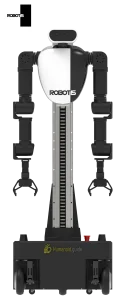
What is the Ai Worker Robotis?
The ROBOTIS AI Worker is a prototype full-size humanoid robot developed by ROBOTIS Co., Ltd., a South Korean robotics company founded in 1999 and headquartered in Seoul. Targeted at logistics, manufacturing, and AI research, the AI Worker stands 162 cm tall, weighs 90 kg, and features 25 degrees of freedom, including 7-DOF hands. It is built on ROBOTIS’s own DYNAMIXEL servo actuators and DYNAMIXEL DRIVE (DYD) gear technology, with compute from an NVIDIA Jetson AGX Orin. Running Linux and ROS 2, it supports LLM integration via ACT, GR00T, and PI frameworks. First demonstrated in 2024, the AI Worker remains in pre-commercial development, with no pricing or general availability announced.
Specifications
Here are the full technical specifications.
| Spec | Value |
|---|---|
| Height | 162 cm |
| Weight | 90 kg |
| Degrees of freedom | 25 |
| Battery life | 4 hours |
| Max speed | 5.4 km/h |
| Payload | 6 kg |
| Price (new) | Undisclosed (contact manufacturer) |
| Price (used range) | N/A — pre-commercial |
Price & Value
New MSRP: Undisclosed (contact manufacturer)
Used range: N/A — pre-commercial
The ROBOTIS AI Worker has no official price, as it remains a pre-commercial prototype. Competing full-size humanoids for research (e.g., Unitree H1 at $90,000, Fourier GR-1 at $150,000) suggest a potential range of $100,000–$200,000 if it reaches market. ROBOTIS benefits from vertical integration (DYNAMIXEL servos) that could yield a lower price than competitors reliant on third-party actuators. However, the AI Worker’s limited payload (6 kg) and 4-hour battery may position it below heavy-duty industrial options. Buyers should anticipate a steep early-adopter premium and limited resale value until production units ship. Total cost of ownership will depend heavily on software licensing and integration support, which ROBOTIS has not detailed.
Who Is It For?
Best for: - University robotics labs developing AI-based manipulation research (25 DOF, full body, open ROS 2 platform) - Industrial R&D teams exploring humanoid deployment in logistics (built-in NVIDIA AGX Orin, DYNAMIXEL reliability) - Companies prototyping human-robot interaction systems (LLM integration support)
Not for: - Heavy industrial lifting (6 kg payload insufficient for most manufacturing tasks) - Outdoor autonomous navigation (no IP rating, likely indoor-only) - Buyers needing immediate delivery (still in development)
Alternatives & Comparison
The AI Worker enters a crowded field of full-size humanoid prototypes. It competes primarily with other research-focused platforms like Unitree H1 and Fourier GR-1, as well as corporate moonshots like Tesla Optimus.
| Model | Price | Available | Key Difference |
|---|---|---|---|
| Unitree H1 | ~$90,000 | yes | Higher payload (30 kg) and 5.4 km/h speed, but no dexterous hands (just grippers) |
| Fourier GR-1 | ~$150,000 | preorder | 44 DOF, 10 kg payload, built-in AI, but heavier and costlier |
| Tesla Optimus Gen 2 | Undisclosed | no | End-to-end AI, scalable manufacturing, but no public specs or availability |
Verdict: For robotics labs that value open-source software and actuator integration, the AI Worker’s DYNAMIXEL ecosystem and ROS 2 compatibility make it a standout — if it ships at a reasonable price. Buyers needing immediate deployment should choose the Unitree H1, which is shipping now with higher payload, though lacking dexterous hands. Those wanting cutting-edge AI integration might wait for Optimus, but that path is uncertain.
Use Cases & Capabilities
AI and Embodied Intelligence Research
The AI Worker provides a full-body humanoid platform with 25 DOF and NVIDIA Jetson AGX Orin compute, ideal for training foundation models like GR00T. Its ROS 2 and Linux environment, combined with DYNAMIXEL servos, allow precise low-level control for imitation learning and reinforcement learning experiments. Researchers can test mobile manipulation in a human-scale form factor without building custom hardware. The open software stack supports ACT and PI integration, enabling rapid algorithm development. However, limited runtime and payload constrain prolonged experiments.
Human-Robot Interaction Studies
With 7-DOF hands and a natural human-like height, the AI Worker is suited for HRI research in service and social robotics. Its expressive hand movements and full-body mobility enable studies on non-verbal communication and collaborative tasks. The Jetson Orin’s GPU can handle real-time gesture recognition and speech processing. Still, the lack of a camera specification suggests users may need to add external sensors for vision-based social cues.
Light Industrial Logistics Trials
The AI Worker’s 6 kg payload and 5.4 km/h speed allow it to transport small parts in controlled indoor environments. Its DYNAMIXEL actuators offer reliability, and the Wi-Fi connectivity supports fleet coordination. However, the absence of IP rating and limited payload exclude it from heavy-duty factory floors. It could serve as a testbed for humanoid-assisted kitting or assembly line tending.
Education and STEM Outreach
While heavier and more expensive than smaller educational robots, the AI Worker could be used by universities to teach advanced humanoid robotics. Its use of standardized DYNAMIXEL servos (common in academic labs) and ROS 2 lowers the learning curve. Multiple degrees of freedom across the body provide a full kinematics curriculum, from bipedal locomotion to dual-arm coordination. However, its size and weight require proper safety protocols and dedicated lab space.
History & Background
ROBOTIS was founded in 1999 in Seoul, South Korea, and became known for the DYNAMIXEL smart servo line used worldwide in research and hobby robotics. The company previously released the robotic manipulator series (OpenManipulator) and the K0 small humanoid for education. The AI Worker was first revealed in 2024 as a full-size humanoid prototype integrating ROBOTIS's DYNAMIXEL DRIVE gear technology and NVIDIA Jetson AGX Orin. It is part of the company's expansion into general-purpose humanoids for industry and service. As of 2026, the robot remains in development, with no firm release date, though it has been demonstrated at exhibitions like CES and robotics conferences. No commercial orders have been accepted.
Buying Used — What to Check
Verify actuator condition DYNAMIXEL servos have a known wear cycle; used prototypes may have high runtime hours.
Confirm software support ROBOTIS may not yet offer public SDKs or warranty transfers for pre-production units.
Check for design revisions Early prototypes may have mechanical or electrical issues fixed in later builds.