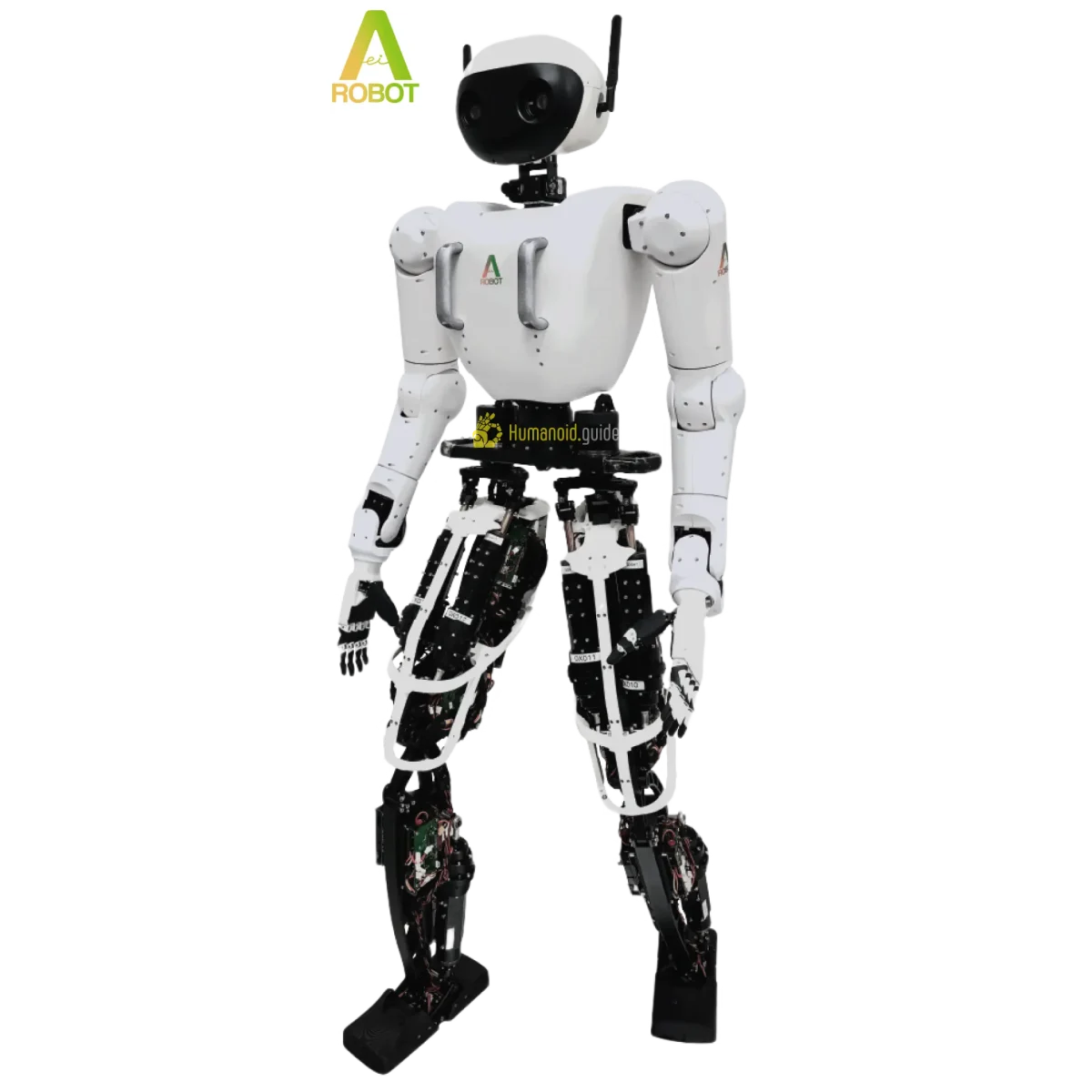
What is the Alice Aeirobat?
The AeiROBOT Alice M1 is a wheeled semi-humanoid robot designed for industrial applications in construction, manufacturing, and shipbuilding. Developed by South Korea's AeiROBOT, the platform combines a 7-DOF upper torso and two 5-fingered hands (12 DOF per hand) mounted on a wheeled base, offering 31 total degrees of freedom. It stands between 130 and 180 cm, weighs 97 kg, and moves at up to 3 km/h. The M1 runs on an NVIDIA AGX Orin system, supports ROS 2 and LLM integration, and targets pick-and-place, assembly, and inspection workflows. Unlike the walking Alice prototype, the M1 is a wheeled, commercially deployed unit.
Specifications
Here are the full technical specifications.
| Spec | Value |
|---|---|
| Height | 130–180 cm |
| Weight | 97 kg |
| Degrees of freedom | 31 |
| Battery life | 1.5–2 hours |
| Max speed | 3 km/h |
| Payload | Not specified |
| Price (new) | Undisclosed |
| Price (used range) | N/A |
Price & Value
New MSRP: Undisclosed
Used range: N/A
The AeiROBOT Alice M1 carries an undisclosed price, reflecting its enterprise B2B sales model. Without a public MSRP, cost estimates are not available, but comparable industrial humanoid platforms with 31 DOF and NVIDIA Orin compute often range from $100,000 to $200,000. Its value proposition is strong for targeted tasks in construction and shipbuilding where wheeled mobility suffices and force-sensitive manipulation is prioritized. Depreciation may be steep once second-generation models arrive, but the current lack of a used market makes residual value uncertain. Total cost of ownership includes integration fees, software licensing, and potential battery replacement costs, none of which are publicly quantified. As AeiROBOT scales production and competitors like Sanctuary AI release wheeled semi-humanoids, pricing pressure could eventually emerge, but for now the Alice M1 remains a high-investment, specialized tool.
Who Is It For?
Best for: - Construction and shipbuilding firms needing a mobile manipulator for indoor assembly (wheeled base eliminates walking complexity) - Manufacturing plants seeking a force-sensitive humanoid torso for pick-and-place and inspection tasks (31 DOF, LLM integration) - Industrial R&D labs evaluating dexterous manipulation with a humanoid form factor without the challenge of bipedal locomotion
Not for: - Outdoor unstructured sites (IP20 rating, wheeled base limited to smooth surfaces) - Operations requiring heavy lifting above 10 kg per arm (no published payload, likely limited to light objects) - Walking humanoid research (the M1 lacks legs; the original Alice prototype remains a separate, non-commercial platform)
Alternatives & Comparison
The AeiROBOT Alice M1 competes against other wheeled semi-humanoids and a few bipedal industrial robots, but its niche is clear: force-sensitive manipulation on wheels at a potentially lower cost than full walking platforms.
| Model | Price | Available | Key Difference |
|---|---|---|---|
| Sanctuary AI Phoenix | Undisclosed (est. $200,000+) | pre-order | Advanced cognitive architecture for dynamic tasks, but less proven in heavy industry than the Alice M1 |
| UBTECH Walker S | ~$150,000 (est.) | yes | Bipedal walking expands terrain, but higher cost, complexity, and battery drain vs. wheeled Alice M1 |
Verdict: For manufacturing and shipbuilding floors where wheels suffice, the Alice M1 offers the most practical, low-maintenance humanoid torso today. Sanctuary AI Phoenix offers greater AI flexibility but is still scaling, while UBTECH Walker S’s legs are overkill for most indoor industrial tasks. If your priority is dexterous, force-sensitive work in a controlled environment, AeiROBOT’s wheeled platform is the safer, cost-effective bet until payload and pricing are fully transparent.
Use Cases & Capabilities
Shipbuilding Interior Assembly
In shipyards, the Alice M1 navigates flat decks to assist with interior outfitting—installing panels, routing cables, or tightening fixtures. Its adjustable height (130–180 cm) allows it to reach both low and overhead positions without scaffolding. The 12-DOF hands handle sensitive cabling without damage, while the NVIDIA Orin brain processes assembly instructions via LLM-guided workflows. As a wheeled platform, it avoids the stability risks of a walking robot on a swaying vessel. However, its IP20 rating confines it to dry, interior zones, not exposed deck environments.
Manufacturing Quality Inspection
Factories deploy Alice M1 for automated quality checks along production lines. The 1080p stereo depth camera and force-sensitive grippers allow it to visually inspect and gently manipulate products—detecting scratches, measuring gaps, or verifying torque. ROS 2 integration enables quick programming for different SKUs, and the 1.5–2 hour battery covers a typical shift segment before hot-swap replacement. The wheeled base moves at 3 km/h, matching conveyor speeds. Limitation: no published payload means it cannot lift heavy components for under-side inspection, limiting its role to light visual and tactile checks.
Construction Site Logistics
On multi-story construction sites with smooth floors, the Alice M1 can autonomously transport tools, deliver materials, or perform simple pick-and-place of light fixtures. Its compact footprint (130 cm minimum height) fits through standard doorways, and the wheeled locomotion ensures reliable navigation around obstacles without the need for complex leg balancing. The robot’s LLM integration lets site managers issue voice commands for ad-hoc tasks. However, the lack of outdoor ruggedness and unknown payload severely restrict it to indoor finishing phases, not structural heavy-lift tasks.
Research & Development (LLM Integration Testing)
University and corporate labs use the Alice M1 as a physical platform for testing large language model interfaces in a manipulation context. Its ROS 2 and NVIDIA AGX Orin stack support cloud API calls to models like OpenAI or Alibaba Qwen, enabling conversational task planning. Researchers can study human-robot interaction with a full torso and dexterous hands at a relatively low entry cost compared to a walking humanoid. The known latency of 250–450 ms glass-to-action provides a reliable benchmark. Drawback: limited documentation and enterprise-only sales channels may complicate procurement for academic grants.
History & Background
AeiROBOT (AEI Robot) emerged as South Korea’s first humanoid robotics company to receive Regulatory Sandbox approval for factory demonstrations. The company first revealed a walking humanoid prototype named Alice, which stood 157 cm tall, weighed 50 kg, and could walk at 2 km/h. This bipedal research platform was developed to explore force-sensitive joint actuation and human-robot physical interaction. In 2024–2025, AeiROBOT shifted focus to the Alice M1, a wheeled variant designed for immediate industrial deployment. The M1 was first built in 2025 and features a modular torso with adjustable height (130–180 cm), a 7-DOF arm with harmonic drives, and 5-fingered hands. This pivot from legs to wheels reflected the practical demands of shipbuilding and construction environments where flat floors are the norm. As of 2026, the M1 is in active industrial pilots, while the original Alice remains a research platform with no commercial release.
Buying Used — What to Check
Verify operational hours and battery cycle count Industrial pilot units may have logged hundreds of hours, and the 1.5–2 h battery may be near end-of-life, requiring replacement.
Confirm software license transferability Enterprise deployments often have locked ROS 2 and LLM integration stacks that may not transfer to a new owner.
Inspect wheel tread and base stability Wheeled platforms used on gritty construction or shipyard floors can develop uneven wear, affecting navigation accuracy.