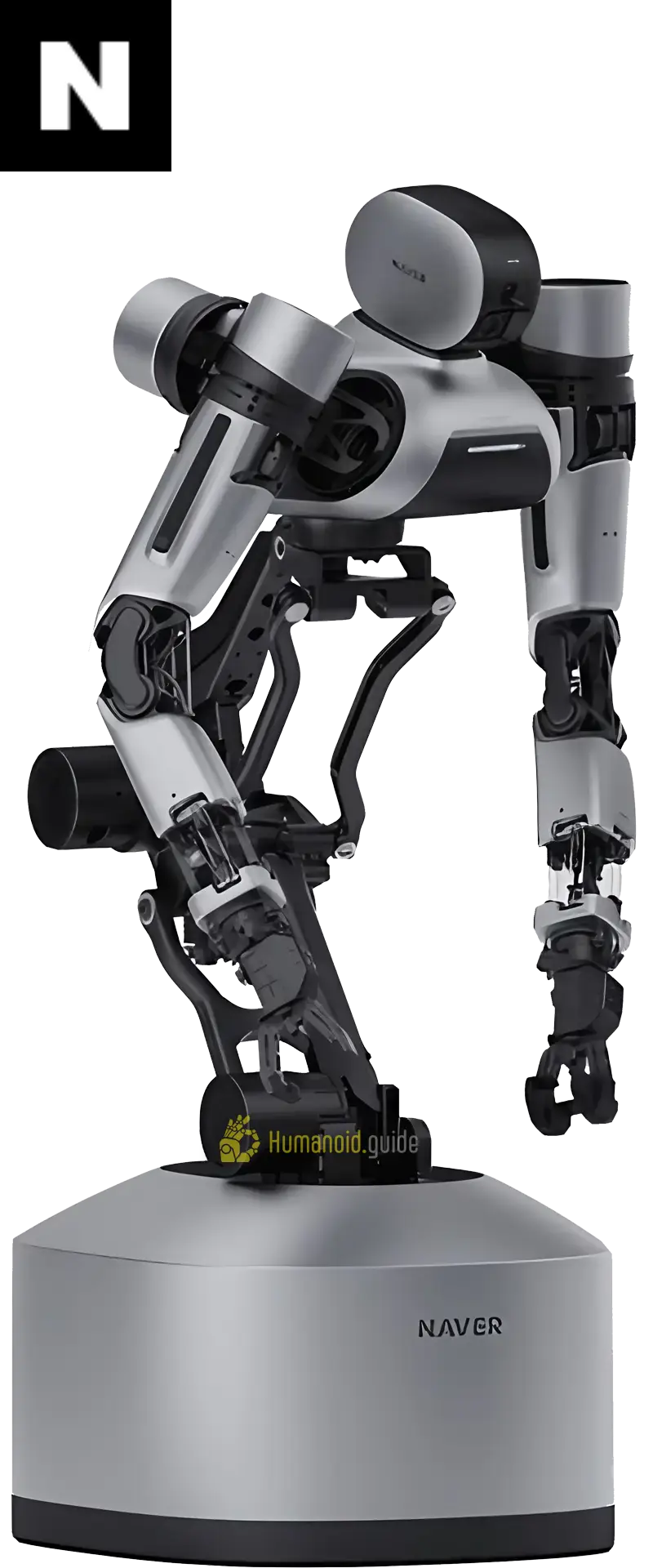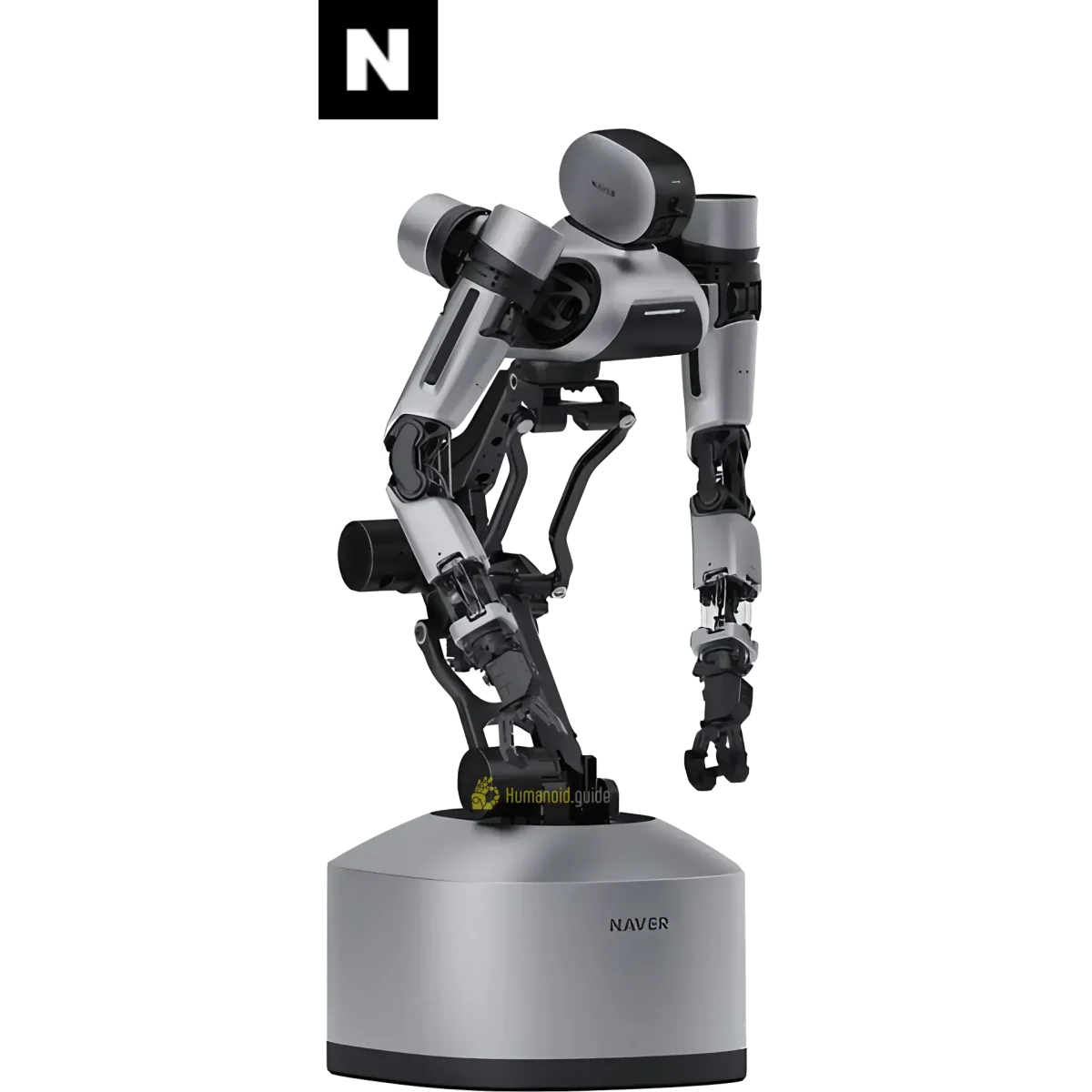
What is the Ambidex?
The AMBIDEX, developed by Naver Labs (Seoul, South Korea), is a dual-arm humanoid robot designed for precise bimanual manipulation tasks. Standing 186 cm tall and weighing 22 kg, it features 47 degrees of freedom across its body, with 7 DOF per arm for human-like dexterity. Each arm delivers a 3 kg payload capacity and incorporates joint torque sensors and wrist force/torque sensing. Powered by an 8-hour battery, the robot operates at speeds up to 3.6 km/h, making it suitable for tasks like bartending, food preparation, and service interactions. Originally introduced in 2018 and released in 2019, AMBIDEX has been deployed in hospitality and research settings, emphasizing safe human-robot collaboration.
Specifications
Here are the full technical specifications.
| Spec | Value |
|---|---|
| Height | 186 cm |
| Weight | 22 kg |
| Degrees of freedom | 47 |
| Battery life | 8 hours |
| Max speed | 3.6 km/h |
| Payload | 3 kg (per arm) |
| Price (new) | Undisclosed (contact manufacturer) |
| Price (used range) | N/A (limited secondary market) |
Price & Value
New MSRP: Undisclosed (contact manufacturer)
Used range: N/A (no established used market)
Naver Labs has not publicly disclosed pricing for AMBIDEX, but industry estimates place it in the $30,000–$50,000 range based on comparable dual-arm cobots like the ABB YuMi ($40,000) and FANUC CRX-10iA/L ($35,000). This positions AMBIDEX as a cost-competitive option for research labs and hospitality businesses seeking dual-arm manipulation without the overhead of industrial integration. Without an official MSRP, buyers should negotiate directly with the manufacturer or authorized distributors; used units are rare, so total cost of ownership (TCO) must factor in proprietary software licensing and training. Compared to single-arm cobots, the AMBIDEX offers 14 axes of simultaneous motion, but its 3 kg arm payload limits it to lightweight tasks. For organizations requiring redundancy, the robot’s 8-hour battery allows continuous operation with periodic charging. Given the low market visibility, pricing transparency may improve as Naver Labs expands distribution.
Who Is It For?
Best for: - Hospitality businesses seeking an automated bartender or food service assistant - Research labs focused on dual-arm manipulation and force control - Small-scale food preparation lines requiring bimanual dexterity
Not for: - Heavy industrial tasks requiring payload over 3 kg per arm - Outdoor or high-IP environments (IP40 only) - Budget-constrained buyers needing a fully supported ecosystem with local service
Alternatives & Comparison
For dual-arm collaboration, AMBIDEX competes with established cobots like the ABB YuMi. Single-arm cobots like the FANUC CRX-10iA/L offer higher payloads but lack bimanual capabilities.
| Model | Price | Available | Key Difference |
|---|---|---|---|
| ABB YuMi | $40,000 | yes | Lower per-arm payload (0.5 kg) but fully integrated vision and ABB ecosystem |
| FANUC CRX-10iA/L | $35,000 | yes | Single-arm with 10 kg payload, extensive industry adoption, no bimanual tasks |
Verdict: For tasks requiring precise dual-arm coordination like bartending or assembly, the AMBIDEX offers higher per-arm payload than the YuMi, making it more versatile for lightweight object handling. However, the lack of a mature software ecosystem and limited parts support may deter industrial buyers compared to ABB or FANUC. The single-arm FANUC CRX is a better fit for heavy-duty applications, while the YuMi remains the safer choice for integrated automation systems.
Use Cases & Capabilities
Service and Hospitality
The AMBIDEX excels in interactive service roles such as bartending, where its dual 7-DOF arms can mix drinks, pour precise amounts, and handle glassware safely. Its force/torque sensors enable gentle manipulation, reducing risk of breakage, while the 8-hour battery supports a full shift of operation. At events or in kiosk setups, the robot's tablet-sized footprint and 22 kg weight allow easy placement in customer-facing areas. However, limited payload means it cannot handle heavy kegs or large containers. With proper ambient lighting and controlled environments, the AMBIDEX provides a novel customer experience that can attract crowds.
Food Preparation
In commercial kitchens, AMBIDEX can assist with repetitive bimanual tasks like assembling sandwiches, plating dishes, or sorting ingredients. Its high repeatability (0.1 mm) ensures consistent quality, while the integrated torque sensing prevents crushing delicate food items. The robot's IP40 rating means it should be kept away from direct water sprays, limiting use cases around washing stations. Naver Labs has demonstrated the robot handling utensils and cooking tools in research settings, suggesting potential for automated meal production. Compliance with food safety standards would require additional sanitization protocols, but the hardware is inherently compatible with dry food handling.
Research and Education
University labs favor AMBIDEX for dual-arm manipulation research due to its 14 axes of motion and ROS compatibility, which simplifies integration with academic software. The built-in joint torque sensors and wrist force/torque sensors provide rich data for motion planning and human-robot interaction studies. Its Linux-based embedded controller allows customization, though the proprietary nature of some components may limit full open-source exploration. At 22 kg, the robot is relatively lightweight for a dual-arm platform, facilitating transport between research setups. Several Korean universities have published work using AMBIDEX for teleoperation and AI-driven manipulation, validating its utility as a research testbed.
History & Background
The AMBIDEX project originated within NAVER LABS, the R&D arm of South Korean internet giant Naver Corporation, founded in 2017 (NAVER LABS itself was established earlier). The robot was first revealed in 2018, with a commercial release in 2019, targeting service and research applications. Unlike many humanoid robots, AMBIDEX is a stationary dual-arm manipulator, not a bipedal walker, reflecting Naver’s focus on bimanual dexterity. The development emphasized harmonic drives with integrated torque sensors for force control, enabling delicate tasks like pouring drinks or handling food. In 2022, an updated version (or iteration) was highlighted by MERA Robotics as the "AMBIDEX" research platform. While the robot has achieved CE certification, its software ecosystem remains proprietary, leveraging Linux and ROS. To date, AMBIDEX has seen limited commercial deployment, primarily in Korean hospitality and university labs. As of 2026, Naver Labs continues to support the platform with no announced discontinuation.
Buying Used — What to Check
Verify payload rating Payload is critical for intended tasks; any degradation or misrepresentation could render the robot unsuitable.
Check software licensing Proprietary ecosystem may incur additional costs; ensure licenses transfer with the unit.
Request battery condition Battery life degrades over time; an 8-hour rating may have diminished in used units.