What is the Ams?
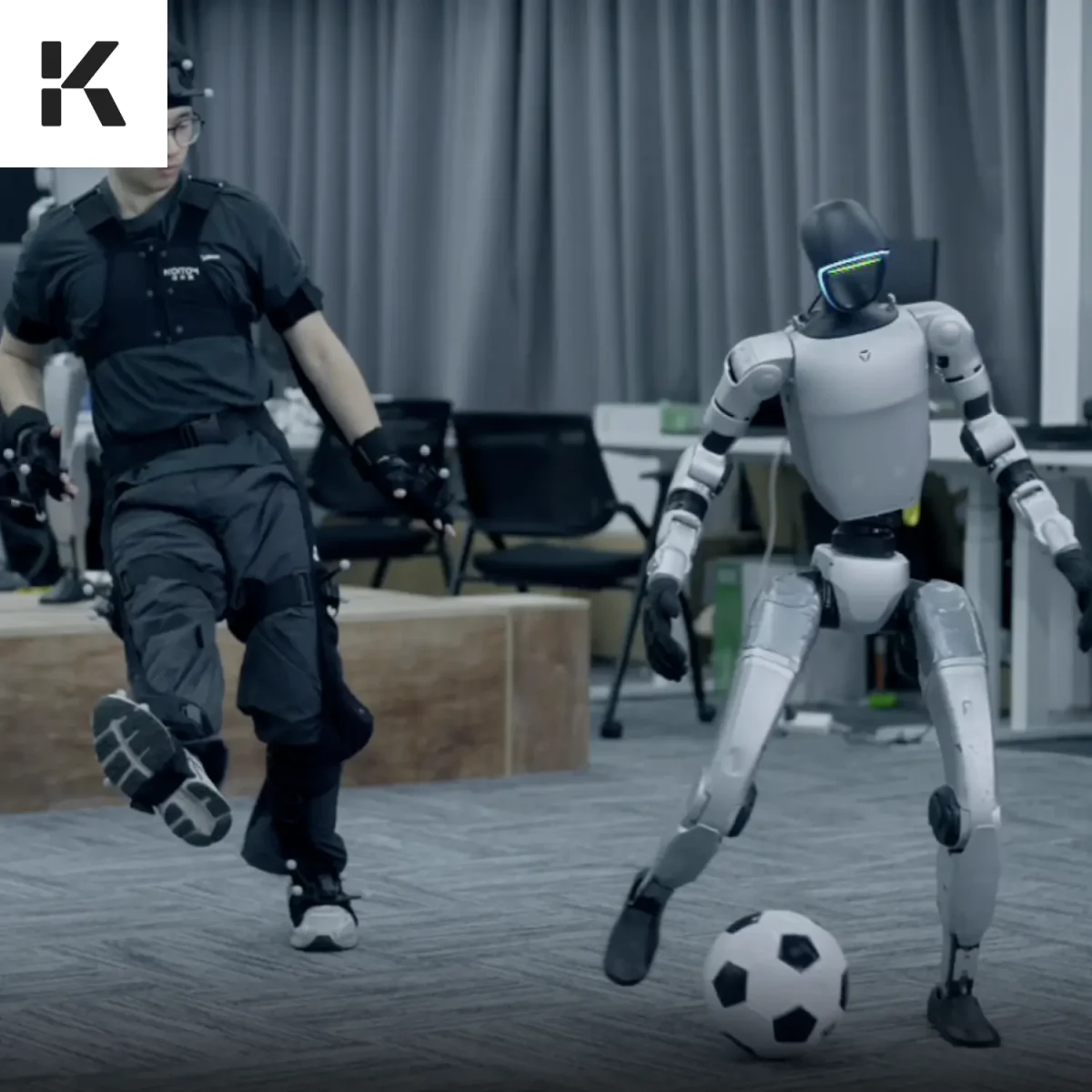
The AMS Humanoid Training System is a whole-body motion learning and control platform developed by Kinetix AI, a Chinese AGI and robotics company focused on giving humanoid robots 'ultra-human-like' capabilities. Unlike a physical robot, AMS is a software stack that ingests human pose data from RGB/video feeds and synthetic simulation to train humanoid robots for dynamic, stable tasks—walking, running, manipulation—through hybrid learning methods. It supports real-time teleoperation, allowing operators to puppeteer a remote humanoid instantly. The system generalizes to unseen motions, making it a rapid prototyping tool for humanoid manufacturers and AI labs. Deployment spans both simulation (Isaac Gym, MuJoCo) and physical humanoid robots, with compatibility across diverse morphologies.
Specifications
Here are the full technical specifications.
| Spec | Value |
|---|---|
| Height | Not applicable (software) |
| Weight | Not applicable |
| Degrees of freedom | 0 (software platform; controls arbitrary DOF) |
| Battery life | N/A (operates via host robot) |
| Max speed | N/A |
| Payload | N/A |
| Price (new) | Undisclosed (contact Kinetix AI) |
| Price (used range) | N/A (no aftermarket) |
Price & Value
New MSRP: Undisclosed (contact manufacturer)
Used range: N/A
Kinetix AI has not disclosed public pricing for the AMS Humanoid Training System; as an enterprise software platform likely sold as a multi-year license or subscription, costs can vary based on deployment scale, simulation node count, and support tier. Compared to building a comparable in-house pipeline from scratch—which easily exceeds $500,000 in engineering time and GPU compute—AMS offers an accelerated path to capable whole-body control, potentially saving years of development for a humanoid startup. However, total cost of ownership must account for required motion capture hardware (e.g., ~$50,000 Vicon systems), compute infrastructure, and ongoing license fees. Because the platform is specialized for humanoid training, resale value is negligible and a used market has not yet formed; buyers should view it as a capex investment tied to product timelines. For well-funded R&D groups, the value proposition hinges on time-to-demonstration, while bootstrapped labs may find open-source alternatives like MuJoCo with custom controllers more cost-effective.
Who Is It For?
Best for: - Humanoid robotics startups developing dynamic locomotion and teleoperation (rapid prototyping with hybrid sim-real training) - AI research labs studying whole-body reinforcement learning and sim-to-real transfer (generalizes to unseen motions) - Industrial automation integrators needing remote teleoperation of humanoid robots in unstructured environments (live control via pose estimation)
Not for: - Toy or educational robot projects (platform targets full-size humanoids with complex dynamics; overkill for simple robots) - Fully autonomous deployment without any teleoperation (AMS core capability blends human demonstration; not a pure autonomous navigation stack)
Alternatives & Comparison
The AMS competes with other teleoperation and simulation-based training tools, but its unified whole-body motion learning and real-time control sets it apart.
| Model | Price | Available | Key Difference |
|---|---|---|---|
| Shadow Teleoperation System | Undisclosed (enterprise quote) | yes | Excels at dexterous hand teleoperation but lacks whole-body locomotion training; mainly for manipulation. |
| NVIDIA Isaac Sim + RL Gym | Free (with GPU hardware) | yes | Powerful simulation but no built-in teleoperation or robot-agnostic pose estimation; requires custom integration. |
| PAL Robotics Teleoperation Kit | ~$25,000 (est.) | yes | Hardware-centric teleop suit for a specific robot family; not a trainable AI pipeline. |
Verdict: For humanoid developers who need a complete, robot-agnostic training pipeline that combines simulation, real-world data, and live teleoperation, AMS is the strongest productized solution. Shadow Teleoperation wins for hand-centric tasks, and Isaac Sim is better if you have a deep RL team and want full control. Choose AMS when time-to-deployment and whole-body motion quality matter most.
Use Cases & Capabilities
Humanoid Locomotion R&D
AMS accelerates the development of bipedal walking, running, and stair-climbing by enabling rapid policy training in simulation then transferring to physical robots. Researchers can capture human motion with a simple RGB camera, feed the pose into AMS, and generate thousands of synthetic variations, drastically reducing the need for expensive motion capture sessions. The hybrid training method helps robots generalize to unseen terrains and recover from perturbations, a capability that usually takes months to hard-code. Early adopters report cutting the sim-to-real gap in half compared to pure RL approaches.
Teleoperated Hazardous Environment Inspection
With real-time control support, AMS allows operators to remotely pilot a humanoid robot via body pose, ideal for inspecting chemical plants, nuclear sites, or disaster areas. The system’s high adaptability means the same training can control robots with different link lengths and weights, enabling fleet management of heterogeneous humanoids. Live human pose estimation from standard video feeds ensures intuitive control without cumbersome suits. Because AMS continuously learns from each teleoperation session, robot performance improves over time, making routine inspection tasks safer and more efficient.
Industrial Humanoid Deployment for Logistics
Warehouses and factories testing humanoid robots for picking, packing, and palletizing can use AMS to teach whole-body coordination—bending, reaching, lifting—while maintaining balance. The platform’s ability to synthesize training data reduces the physical trial-and-error damage that plagues early humanoid pilots. Integrators can fine-tune policies for specific environments by combining real teleop demonstrations with domain randomization in simulation. As of 2026, several OEMs have demonstrated AMS-trained humanoids stacking boxes at speeds competitive with fixed automation, though long-term reliability data is still emerging.
History & Background
Kinetix AI was founded in the early 2020s as a Chinese startup aiming to create 'AGI for Robotic Superintelligence.' The company’s public mission centers on developing ultra-human-like robots with emergent intelligence, motion, and even 'feeling.' The AMS Humanoid Training System was introduced around 2024–2025 as a core enabler for humanoid OEMs to quickly teach complex behaviors without hand-coding thousands of trajectories. Initially deployed in research partnerships with major Chinese humanoid manufacturers, AMS became broadly available in production by mid-2025, with a reported user base spanning over a dozen humanoid companies worldwide. No generational hardware revisions apply as it is purely software; updates are delivered via cloud-based model training and on-premise runtime patches. In 2026, Kinetix AI continues to refine the platform’s sim-to-real fidelity, aiming to achieve fully autonomous locomotion without teleoperation guidance by 2027.
Buying Used — What to Check
Verify software license transferability AMS is a licensed platform; second-hand purchases may be invalid without vendor approval, leaving the buyer without updates or support.
Confirm compatibility with your target humanoid hardware Some versions are optimized for specific robot models (e.g., joints, sensor layout), and used licenses may be tied to a specific OEM’s hardware configuration.
Inspect motion capture gear and compute system included Used packages may lack essential cameras, capture suits, or GPU servers, which can add $50,000+ to total cost.