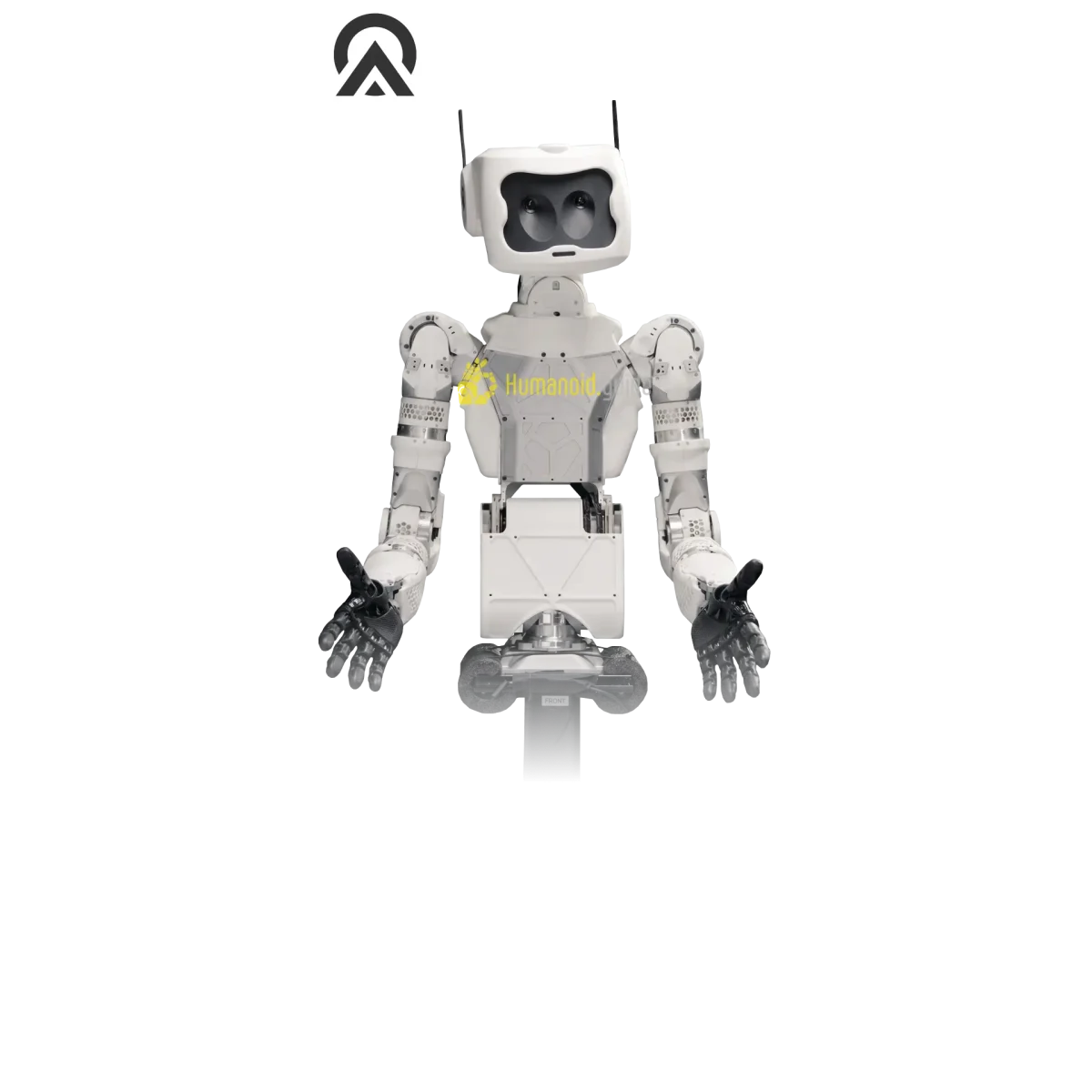
What is the Apptronik Astra?
The Apptronik Astra is a modular, stationary upper-body humanoid robot developed by Apptronik in Austin, Texas (founded 2016). It features a torso, dual 5-fingered hands, and 24 total degrees of freedom (12 in the hands alone). Designed for research and interactive service, Astra has a 10 kg payload, a 4‑hour battery, and a system height of 175 cm. An NVIDIA Jetson‑class edge AI and stereo vision suit enable perception‑driven manipulation. The robot is built on a ROS‑based architecture with optional LLM integration. Its stationary base can be mounted on a cart or AMR, though it has no locomotion of its own. Astra targets laboratories exploring bimanual manipulation, human‑robot interaction, and industrial lab automation — a focused alternative to full‑body humanoids.
Specifications
Here are the full technical specifications.
| Spec | Value |
|---|---|
| Height | 175 cm |
| Weight | 25 kg |
| Degrees of freedom | 24 |
| Battery life | 4 hours |
| Max speed | 0 km/h |
| Payload | 10 kg |
| Price (new) | $45,000 |
| Price (used range) | N/A |
Price & Value
New MSRP: $45,000
Used range: N/A
The Astra is listed at $45,000, a price positioned for university labs and R&D departments. This figure is likely an enterprise list price — true street prices may vary once the robot enters commercial production. Compared with a full‑upper‑body research platform like Pollen Robotics Reachy ($20,000), Astra demands a premium for its higher‑strength actuators and AI‑ready compute. There is no used market yet; the robot remains a prototype, so depreciation cannot be estimated. Total cost of ownership will include the price of a mounting base (fixed stand or AMR) and possibly additional compute or sensor modules. For a dual‑arm manipulation research platform with 10 kg payload, the Astra’s pricing is in line with industrial‑grade systems like the Nextage, though the Astra’s AI focus and ROS ecosystem lower integration costs.
Who Is It For?
Best for: - University robotics labs studying bimanual manipulation and AI‑driven task learning (24 DOF with 12 in hands enables dexterous manipulation experiments). - Industrial R&D teams testing humanoid upper‑body automation for kitting, assembly, or lab environments (10 kg payload, safe human interaction, stationary base).
Not for: - Autonomous mobile service applications (max speed 0 km/h, no legs — cannot navigate). - Heavy‑lift industrial tasks (payload limited to 10 kg, insufficient for many factory jobs).
Alternatives & Comparison
In the niche of stationary dual‑arm research humanoids, Astra competes with Pollen Robotics’ Reachy (lower cost, more expressive) and Kawada’s Nextage (industrial heritage). All three are upper‑body manipulators, but their ecosystems and price points differ sharply.
| Model | Price | Available | Key Difference |
|---|---|---|---|
| Reachy by Pollen Robotics | $20,000 | yes | Lightweight research platform with expressive head, 7 DOF per arm, and a larger sensor suite for HRI studies. |
| Nextage by Kawada Industries | Undisclosed | enterprise-only | Industrial‑grade dual‑arm robot with a proven track record in assembly lines, but closed‑loop control and less AI flexibility. |
Verdict: For academic labs seeking a fully‑fledged humanoid torso with easy‑to‑program ROS and a modern AI stack, Reachy’s lower price and extensive documentation make it the safer bet. Nextage wins for factory‑floor integration where repeatability and heavy‑duty hardware are paramount. Astra, still a prototype, promises a compelling blend of strength and AI‑readiness, but until it ships commercially, its real‑world value remains unproven.
Use Cases & Capabilities
Research & Development (Bimanual Manipulation)
The Astra’s 24‑degree‑of‑freedom architecture — split evenly between the arms and 5‑fingered hands — makes it a prime platform for studying dexterous manipulation. Researchers can implement reinforcement learning or imitation learning algorithms on a real‑world robot with HD stereo vision and NVIDIA edge AI. The stationary nature simplifies safety and setup, and ROS‑based control allows custom motion planners. Labs exploring shared autonomy, tool usage, or multi‑modal sensing benefit from the 10 kg payload, which can hold heavier objects than most research arms. The modular design also lets teams swap hands or mount the robot on different bases for varied experiments.
Industrial Lab Automation
In an R&D lab or pilot production line, the Astra can perform pick‑and‑place, kitting, and light assembly tasks. Its 10‑kg payload and reach suit handling of small components or sub‑assemblies. The robot is built with aluminum and composites, and its actuators (harmonic drive/planetary gears) provide precision and repeatability. Because the Astra is safe for human interaction (rated) and stationary, it can be placed directly next to human workers without fencing. Integrating the robot with a mobile cart creates a flexible cell that can be wheeled between workstations, though it has no autonomous navigation.
Interactive Service Prototyping
For use cases like front‑of‑house reception, museum demos, or retail kiosks, the Astra’s humanoid upper body creates an engaging, approachable presence. The dual 5‑fingered hands enable expressive gestures, and the stereo camera can be used for face detection and simple object handovers. With an optional external AI stack, it can integrate a large language model for natural conversation. The robot’s 175‑cm system height (when mounted) matches human eye level, and its stationary base simplifies installation in public spaces. As a prototype, Astra is best suited for controlled trials rather than 24/7 unattended operation.
Teleoperation & Dexterous Control Research
The Astra’s 12 hand degrees of freedom and full upper‑body arm workspace make it an ideal platform for teleoperation studies. Researchers can map a human operator’s hand and arm motions directly to the robot using gloves or exoskeletons, exploring latency, transparency, and shared autonomy. The estimated 100–300 ms glass‑to‑action latency (from perception to physical response) is suitable for supervised tasks. Universities have used similar systems to study remote maintenance of hazardous materials or tele‑nursing scenarios. Astra’s ROS backbone allows easy integration with standard teleoperation software stacks.
History & Background
Apptronik was founded in 2016 in Austin, Texas, by Luis Sentis and a team from the Human Centered Robotics Lab at UT Austin. The company originally developed a lower‑body exoskeleton before pivoting to full‑body humanoids; it is best known for Apollo, the general‑purpose humanoid unveiled in 2023. In 2024, Apptronik introduced the Astra, a modular upper‑body cousin designed specifically for research and interactive service. Unlike Apollo’s mobile legs, Astra is stationary, trading locomotion for a lower cost and simpler mechanical design. It incorporates many of the same actuator and hand technologies from the Apollo program, packaged in a compact, cart‑mountable chassis. As of 2026, the Astra remains a prototype with a listed price of $45,000, serving as a technology demonstrator for Apptronik’s approach to AI‑driven manipulation.
Buying Used — What to Check
Verify production status and lead time Astra is a prototype; production units may not ship for months after order, and specs could change.
Check mounting compatibility The robot is designed to attach to a stand or cart; ensure any used unit includes the correct mounting plate and all fasteners.
Inspect all 12 hand DOF The 5‑fingered hands have many small actuators; a pre‑production unit may have reliability issues or need calibration.