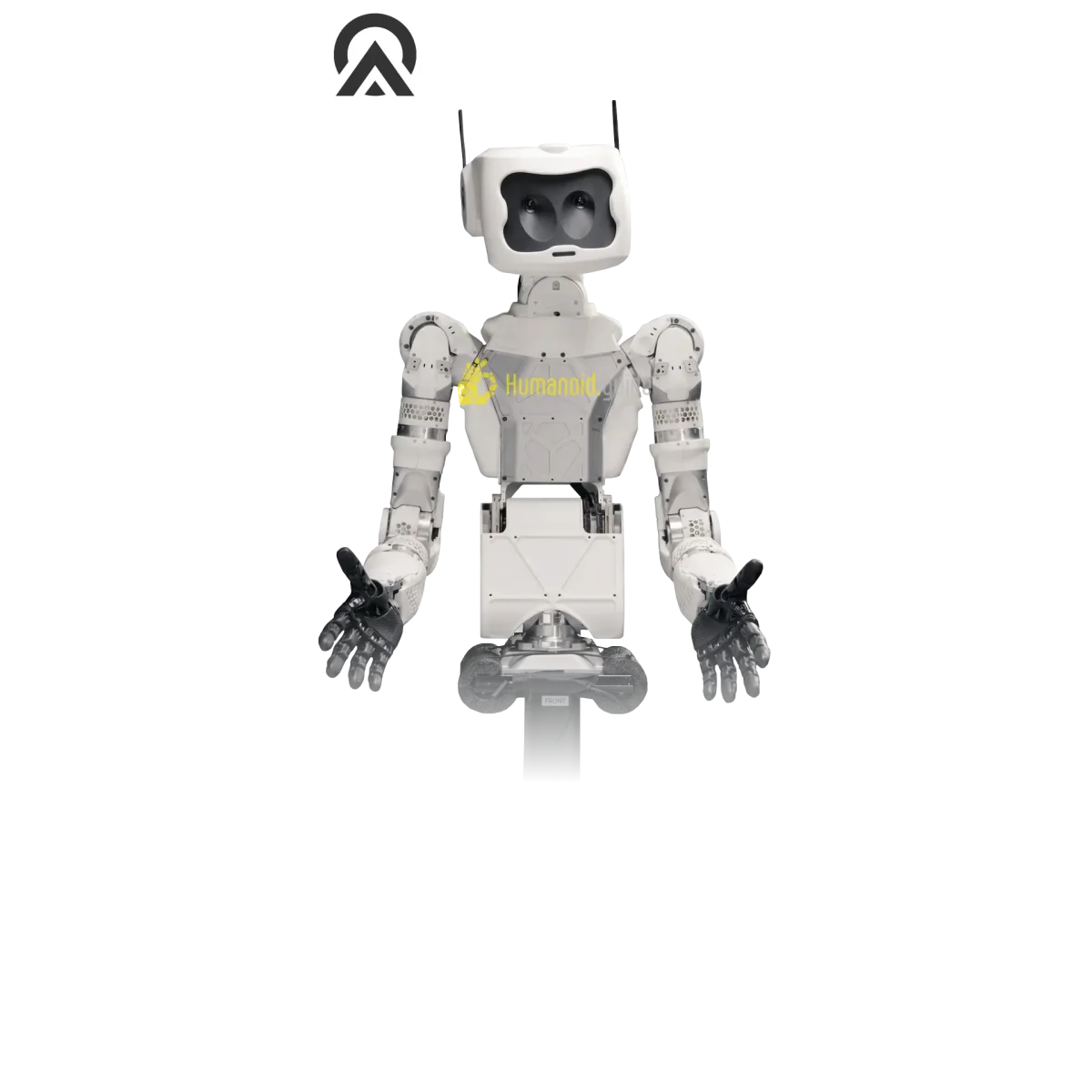
What is the Astra?
The Apptronik Astra is an upper-body-only humanoid robot from Apptronik (Austin, Texas, USA). Unlike the company’s full-body Apollo humanoid, Astra is a modular torso-plus-arms platform meant to be installed on autonomous mobile robots, fixed workstations, or carts. It features 24 degrees of freedom (12 per hand), dexterous five-finger grippers, and a payload capacity of 10 kg. With a 2‑hour battery runtime and an upper‑body height up to 140 cm, Astra targets interactive service, light manufacturing, and research environments. Apptronik engineered it as a flexible development tool for human‑robot collaboration, assembly trials, and logistics testing. The robot remains a prototype and has no commercial release date or public pricing.
Specifications
Here are the full technical specifications.
| Spec | Value |
|---|---|
| Height | 140 cm (upper body) |
| Weight | 25 kg |
| Degrees of freedom | 24 (12 per hand) |
| Battery life | 2 hours |
| Max speed | N/A (no locomotion) |
| Payload | 10 kg (arm) |
| Price (new) | Undisclosed |
| Price (used range) | N/A |
Price & Value
New MSRP: Undisclosed
Used range: N/A
Apptronik has not released any official pricing for the Astra upper-body platform. Unconfirmed industry chatter mentions a target around $45,000, but that figure is speculative and should be disregarded. As a development‑stage robot, no commercial units exist, so typical cost comparisons are not possible. If the Astra were eventually commercialized, its upper‑body specialization might make it less expensive than full humanoids like Apollo or the Fourier GR‑2, but it would still require a separate mobile base, increasing total system cost. Without legs, Astra avoids the high actuator expense of bipedal locomotion, potentially offering a better value for labs that only need dexterous manipulation. Depreciation would be steep in the first generation until a mature support ecosystem emerges. Prospective adopters should budget for an AMR or fixed stand and expect an enterprise‑level price if the robot ever reaches the market.
Who Is It For?
Best for: - University robotics labs (24 DOF and dexterous hands enable manipulation research without needing a full bipedal platform) - Manufacturing R&D teams (integrate Astra onto an AMR for light assembly and kitting trials in controlled settings) - Interactive service developers (a human‑like torso for reception or retail pilots, where the robot can gesture and manipulate objects on a stable base)
Not for: - Autonomous locomotion tasks (no legs; must be mounted on an external mobile base, limiting autonomy) - Heavy‑duty industrial use (payload cap of 10 kg eliminates heavier pick‑and‑place scenarios) - Budget‑constrained projects (pricing undisclosed and likely in the mid‑five figures, with additional integration costs)
Alternatives & Comparison
The Astra occupies a niche as a legless humanoid, bridging the gap between full‑body humanoids and single‑arm manipulators. Alternative platforms below are current or near‑market robots that serve similar research, service, or light manufacturing roles.
| Model | Price | Available | Key Difference |
|---|---|---|---|
| Apptronik Apollo | ~$150,000 (est.) | enterprise-only | Full bipedal humanoid with legs; over 5x the projected cost but offers complete mobile manipulation. |
| Unitree G1 | $16,000 | yes | The lowest‑cost full humanoid on the market; significantly cheaper than Astra’s rumored price and includes legs, but with less dexterity (23 DOF total). |
| Franka Emika Panda | $25,000 | yes | A single 7‑DOF collaborative robotic arm; not a humanoid torso, but offers industrial‑grade repeatability and a proven research ecosystem for manipulation studies. |
Verdict: For labs that only need dexterous upper‑body manipulation and have a suitable mobile base, the Astra could offer a human‑like interaction form factor at a moderate cost — if the rumored pricing holds. However, the Unitree G1 delivers a complete, walking humanoid at a known low price, making it a more compelling choice for most research teams. Unless Astra’s dual‑arm and gripper dexterity prove dramatically superior in testing, the G1 is the safer buy today, while the Franka Panda remains the go‑to for industrial‑grade manipulation where a humanoid shape is not required.
Use Cases & Capabilities
Interactive Service & Hospitality
Astra can serve as a concierge or information guide in hotels, airports, or retail spaces when mounted on an AMR. Its 24‑DOF arms and hands allow it to gesture naturally, point to directions, and even hand out brochures or small items. The 2‑hour battery runtime supports a service stint, though the robot would need to return to a charging dock between interactions. Without legs, it relies on the mobile base for navigation, which simplifies safety certification but limits its ability to climb stairs or traverse uneven floors.
Light Manufacturing & Assembly Assistance
In a factory pilot, Astra can be fixed beside a conveyor belt performing pick‑and‑place of lightweight parts using its 10 kg payload. The dual‑arm setup with 12‑DOF hands enables precise bimanual tasks, such as inserting connectors or sorting items. Lacking autonomous mobility, it would be stationary or mounted on a mobile platform that moves between stations. Battery life is a limitation for continuous shifts, so tethering to a power supply is likely required. Certification for collaborative use (force‑limiting) has not been announced.
Research & Development Platform
University and corporate labs can use Astra as a testbed for human‑robot interaction, dexterous manipulation algorithms, and whole‑body control. Its modular design simplifies swapping grippers or sensors, and the ROS‑based software stack (assumed) allows integration with existing robotic middleware. The absence of legs reduces mechanical complexity, making it easier to maintain than full humanoids. Researchers can focus on upper‑body AI without worrying about dynamic balance, but must provide their own mobile base or operate the robot on a table‑top stand.
History & Background
Apptronik was founded in 2016 as a spin‑out from the Human Centered Robotics Lab at the University of Texas at Austin. The company first gained attention with its exoskeleton technologies before unveiling the full‑body Apollo humanoid in 2023. The Astra upper‑body platform was first shown in 2024 as a research‑focused companion to Apollo. Early prototypes demonstrated a 24‑DOF torso with expressive hands and a compact 25 kg frame. Unlike Apollo, Astra forgoes legs entirely, making it a modular component that partners can integrate into existing mobile bases. As of 2026, Astra remains in the prototype stage with no public release date or commercial orders, though it has been displayed at industry events alongside Apollo to highlight Apptronik’s range of humanoid form factors.
Buying Used — What to Check
Verify payload rating The 10 kg arm payload is critical for your application; an early prototype may have unvalidated limits.
Inspect hand DOF integrity All 12 DOF per hand must actuate smoothly — damaged fingers can ruin dexterous manipulation experiments.
Request battery health and cycle count Battery runtime is only 2 hours; degraded cells will shorten the already limited operating window and increase downtime.