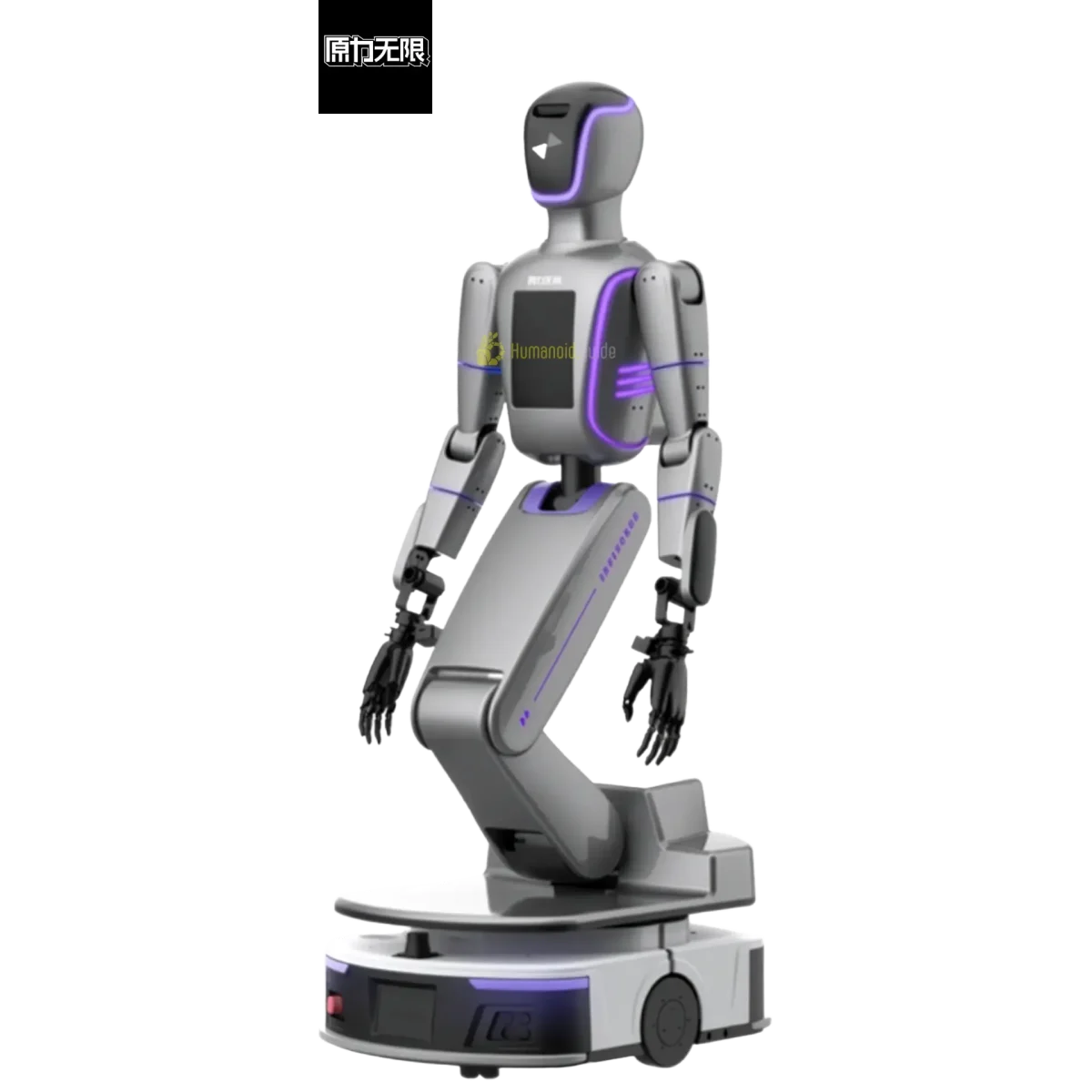
What is the Astrodroid Ad 01?
The AstroDroid AD-01 is a full-size humanoid robot designed by Elu.AI, a China-based robotics manufacturer. Standing 170 cm tall and weighing 120 kg, it is one of the heavier humanoids in its class, built for industrial logistics, manufacturing, and research applications. The robot features 21 degrees of freedom, including two 11-DOF anthropomorphic hands, and is powered by an NVIDIA Jetson AGX Orin 64GB compute module. It runs a Linux-based OS (Ubuntu 20.04/22.04) with ROS 2, and integrates a custom AI runtime environment supporting Hyper-VLA multimodal model for real-time instruction following. Connectivity includes Wi-Fi 6, Gigabit Ethernet, optional 4G/5G, and Bluetooth 5.0. Its frame combines aluminum alloy and carbon fiber for rigidity, with an IP42 ingress rating for dust protection. As a prototype, it is available on a pre-order basis from the manufacturer, but public pricing has not been disclosed.
Specifications
Here are the full technical specifications.
| Spec | Value |
|---|---|
| Height | 170 cm |
| Weight | 120 kg |
| Degrees of freedom | 21 |
| Battery life | 2 hours |
| Max speed | 7.2 km/h |
| Payload | 3 kg |
| Price (new) | Undisclosed (contact manufacturer) |
| Price (used range) | N/A |
Price & Value
New MSRP: Undisclosed (contact manufacturer)
Used range: N/A (pre-production)
Elu.AI has not disclosed the AD-01's price, requiring potential buyers to contact them directly. Based on its high-end components—Jetson AGX Orin, harmonic drive actuators, and carbon fiber construction—a six-figure price is inevitable. If priced competitively around $100,000, it could undercut competitors like UBTECH Walker S (~$200k) while offering superior dexterity and LLM integration. However, the absence of a track record and the pre-order nature place significant delivery risk on early adopters. Maintenance costs for precision gear systems and high-torque motors could add thousands annually when the unit eventually ships. Without independent verification, its value as an investment is speculative.
Who Is It For?
Best for: - University robotics labs (11-DOF hands and LLM integration enable dexterous manipulation research) - Advanced manufacturing lines needing human-robot collaboration with voice command capability and moderate payloads
Not for: - Heavy industrial tasks (3 kg arm payload insufficient for large components) - Wet or washdown environments (IP42 rating not waterproof)
Alternatives & Comparison
The full-size humanoid market is crowded with Chinese manufacturers like Fourier and UBTECH, as well as agile platforms like the Unitree H1. The AD-01 differentiates with a heavier build and advanced LLM for instruction-based tasks.
| Model | Price | Available | Key Difference |
|---|---|---|---|
| Fourier GR-2 | ~$150,000 (est.) | preorder | Lighter at 55 kg, less payload but more mature platform with Force Control |
| UBTECH Walker S | ~$200,000 | yes | Higher DOF (36), integrated full-body compliance, enterprise SAAS support |
| Unitree H1 | $150,000 | yes | Lighter weight, faster speed (11 km/h), but no manipulator dexterity like AD-01's 11-DOF hands |
Verdict: For dexterous manipulation with 11-DOF hands and a heavy-duty 120 kg frame, the AstroDroid AD-01 targets industrial logistics where payload and stability matter. However, pricing remains undisclosed and availability is pre-order only, making the Unitree H1 or UBTECH Walker S more practical for buyers needing a shipping platform today. If AD-01's price undercuts current alternatives, it could be a strong value.
Use Cases & Capabilities
Industrial Logistics
In warehouse and factory logistics, the AstroDroid AD-01 can handle pick-and-place operations, palletizing, and light material transport. With a 3 kg arm payload and 7.2 km/h maximum speed, it is suited for tasks requiring both speed and dexterity. Its 11-DOF hands allow it to manipulate diverse objects, from boxes to small components, guided by LLM-based natural language commands. The 2-hour battery life, however, necessitates scheduled charging breaks, potentially limiting continuous shift use. The IP42 protection means it can operate in dusty environments but not in wet or washdown areas. Its heavy 120 kg frame provides stability during fast arm movements but may present mobility challenges on uneven floors.
Research & Education
Universities and research institutes can employ the AD-01 as an experimental platform for humanoid robotics, AI integration, and human-robot interaction studies. The ROS 2 and Ubuntu stack ensures compatibility with a wide range of open-source tools, while the onboard Jetson AGX Orin enables advanced neural network inference. Its 21-DOF body and high-dexterity hands permit grasping, manipulation, and locomotion research. The LLM integration layer is a particular draw for studying language-to-action models and multimodal reasoning. However, the lack of an active developer community and unknown software maintenance commitments may hinder long-term research projects.
Manufacturing Assistance
On factory floors, the AD-01 can assist with machine tending, quality inspection, and assembly support. Its LLM capability allows operators to issue complex verbal instructions, adapting tasks on the fly without reprogramming. The robot's safety features, including safe human collaboration, enable it to work alongside human workers without cages. The 3 kg payload is adequate for small-part handling but limiting for heavy components. Frequent battery swaps every two hours could interrupt continuous line operations unless hot-swappable packs are supported.
History & Background
The AstroDroid AD-01 emerged from Elu.AI, a relatively obscure Chinese robotics firm. While the exact founding year of Elu.AI is undocumented in public records, the robot's details first appeared on humanoid.guide sometime after 2023, positioning it among the wave of Chinese humanoid startups responding to national automation initiatives. The AD-01 prototype emphasizes a cloud-edge collaborative architecture with a proprietary Hyper-VLA (Vision-Language-Action) multimodal model, aiming to enable natural language-driven task execution with sub-200 ms latency. Its design incorporates high-precision BLDC motors with harmonic drive reducers, suggesting a focus on industrial-grade durability. The robot has not been announced through conventional press releases; its entire public presence appears limited to a single product listing. As of 2026, no serial production, customer deliveries, or pilot programs have been confirmed. The pre-order status implies manufacturing intent, but the timeline remains uncertain. If commercialized, it would compete directly with Fourier's GR-2 and the UBTECH Walker S in the dexterous industrial humanoid space.
Buying Used — What to Check
Verify payload rating Actual arm payload may differ from spec under real-world conditions; no independent testing available.
Inspect joint harmonic drive wear Long-term reliability and maintenance needs are unknown for this unreleased platform.