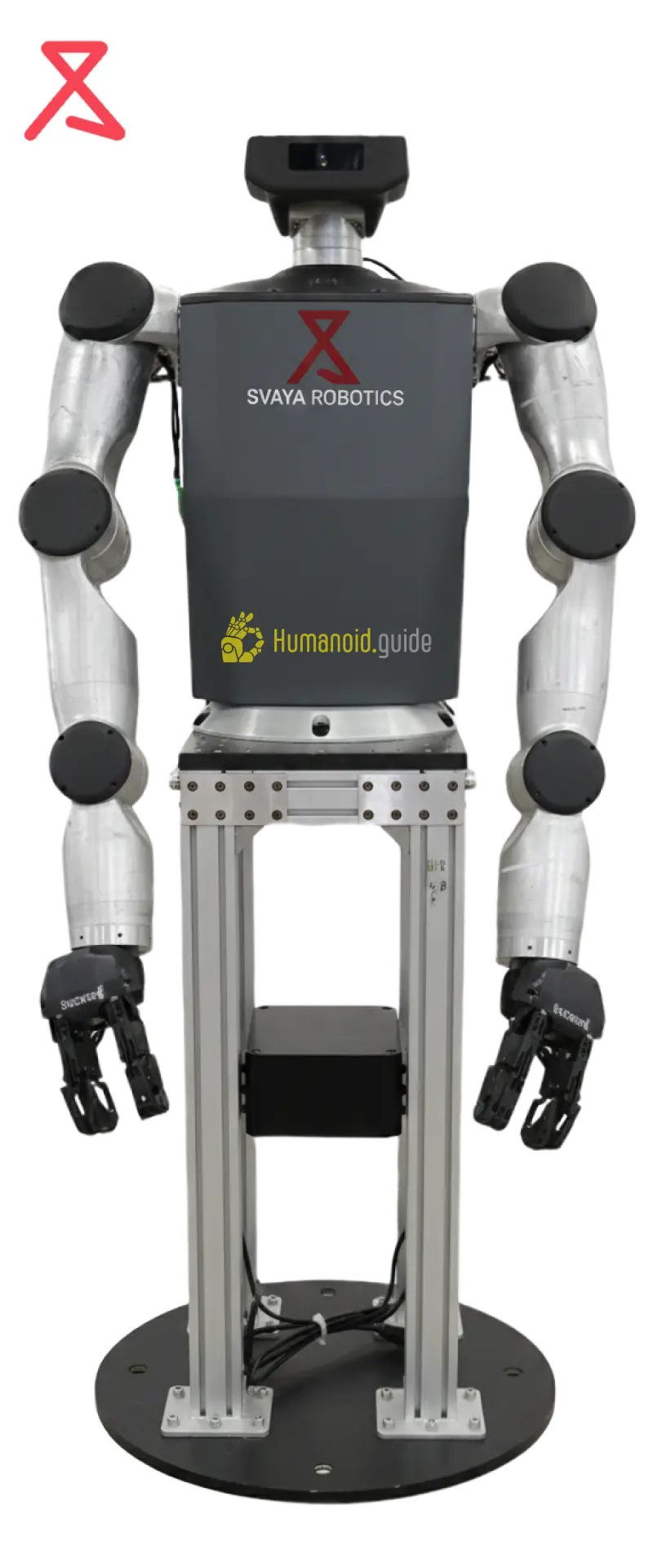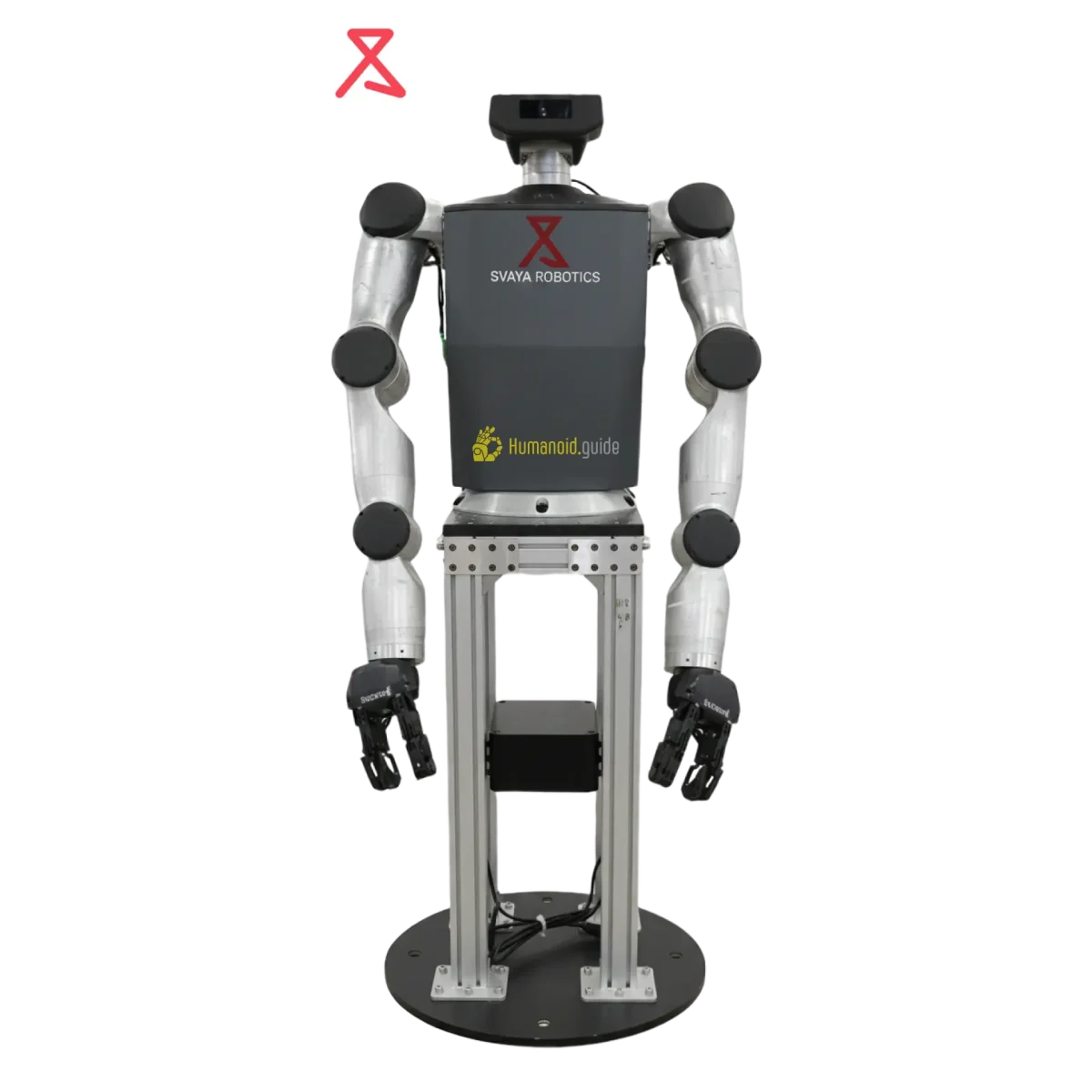
What is the Bimanual Svaya?
The Svaya Robotics Bimanual is a stationary dual-arm collaborative robot (cobot) developed by Svaya Robotics in Hyderabad, India. It is essentially an upper-body torso with two 6-degree-of-freedom arms, designed for fine manipulation tasks in manufacturing, assembly, and logistics. The system uses force/torque sensing and optional vision cameras to perform bin picking, machine tending, and lab automation. Unlike mobile humanoids, the Bimanual is pedestal- or table-mounted and focuses on precision (0.03 mm repeatability) and safe human interaction (ISO 10218-1, ISO/TS 15066 certified). It can be integrated with an AMR for extended reach. Key differentiators include a Made-in-India cost structure, EtherCAT backbone, and modular integration with ROS.
Specifications
Here are the full technical specifications.
| Spec | Value |
|---|---|
| Height | 155 cm |
| Weight | 70 kg |
| Degrees of freedom | 12 |
| Battery life | 2 h |
| Max speed | N/A |
| Payload | 10 kg (estimated) |
| Price (new) | Undisclosed |
| Price (used range) | N/A |
Price & Value
New MSRP: Undisclosed
Used range: N/A
Svaya Robotics does not publicly list pricing for the Bimanual system; it follows an enterprise direct-sales model typical of industrial cobots. Comparable dual-arm platforms like the ABB YuMi cost around $50,000, while the discontinued Rethink Baxter was $22,000. The Bimanual’s value proposition hinges on its Indian manufacturing (potentially lower cost than European/Japanese rivals) and modular design, which avoids paying for a mobile base when not needed. Without published pricing, total cost of ownership is unclear, but maintenance of harmonic drives and brushless motors should be manageable. Early adopters may benefit from direct support, but resale value is nonexistent because the robot is just entering the market.
Who Is It For?
Best for: - Manufacturing SMEs needing compact dual-arm manipulation for assembly lines, where space is limited and repeatability (0.03 mm) is critical. - Research labs exploring bimanual teleoperation and imitation learning with ROS-based open architecture. - Logistics and warehouse operators seeking a mountable pick-and-place unit that can be integrated with existing AMRs and vision systems.
Not for: - Heavy payload applications (per-arm payload is estimated at 10 kg, not suitable for lifting heavy engine parts). - Mobile manipulation without an additional mobile base — the Bimanual has no locomotion of its own, so deployment requires integration with a mobile robot or fixed station. - Budget-constrained projects expecting a sub-$20K cobot; the undisclosed pricing likely exceeds $30K given its specs and certifications.
Alternatives & Comparison
The Svaya Bimanual competes in the dual-arm industrial cobot niche, facing off against well-established players like ABB’s YuMi and the legacy Rethink Baxter.
| Model | Price | Available | Key Difference |
|---|---|---|---|
| ABB YuMi | $50,000 | yes | 7-axis arms, plastic skin, larger ecosystem |
| Rethink Robotics Baxter | $22,000 (discontinued) | no | Pioneer in collaborative dual-arm, but no longer sold |
Verdict: For buyers needing a modern, IP54-rated dual-arm cobot with ROS integration and cost-effective support from an Indian manufacturer, the Svaya Bimanual is a compelling choice — but only if you can obtain a quote and accept early-adopter risk. The ABB YuMi remains the safer, proven option with extensive tooling and global service, while the Baxter is only relevant for used-unit bargain hunters willing to deal with an unsupported platform.
Use Cases & Capabilities
Bin Picking and Precise Placement
The Bimanual excels at picking mixed objects from bins thanks to optional 3D vision cameras and 0.03 mm repeatability. Its force/torque sensors allow it to grasp delicate components without damage, making it ideal for electronics or pharmaceutical sorting. With IP54 rating, it can handle dusty packaging environments. When mounted on a mobile base, it can move between picking stations without a conveyor belt.
Assembly and Kitting
In electronics or automotive sub-assembly, the dual arms can simultaneously handle different parts to accelerate cycle times. The graphical programming and hand-guiding enable quick redeployment for varied product lines. Direct torque control ensures safe collaboration with human operators. It is also suited for kitting operations where items are grouped into kits for downstream processes.
Laboratory Automation and Machine Tending
With a clean, enclosed design (IP54) and ROS compatibility, the Bimanual integrates into research labs for sample handling and microplate manipulation. Its harmonic drives provide smooth, jitter-free motion essential for precision liquid handling. For machine tending, it can load/unload CNC or injection molding machines without additional guarding, as it meets collaborative safety standards.
History & Background
Svaya Robotics was founded in 2016 in Hyderabad, India, by entrepreneur Vijay Simha. The company initially focused on custom robotic solutions before developing a modular dual-arm platform. The Bimanual system was first revealed in 2023 as an upper-body manipulation robot designed for industrial R&D. It leverages the company's SR-L series arms, each with 6 degrees of freedom and integrated force sensing. In 2024, limited production began, targeting early-adopter factories and research institutions. As of 2026, Svaya continues to refine the platform, aiming to offer a Made-in-India alternative to expensive European and Japanese cobots.
Buying Used — What to Check
Verify operational hours Harmonic drives wear over time; high-hour units may need gearbox replacement.
Inspect IP54 seals If used in dusty or wet environments, seal degradation could affect electronics.
Confirm all software licenses ROS environment and optional GPU stack may require transferred licenses.