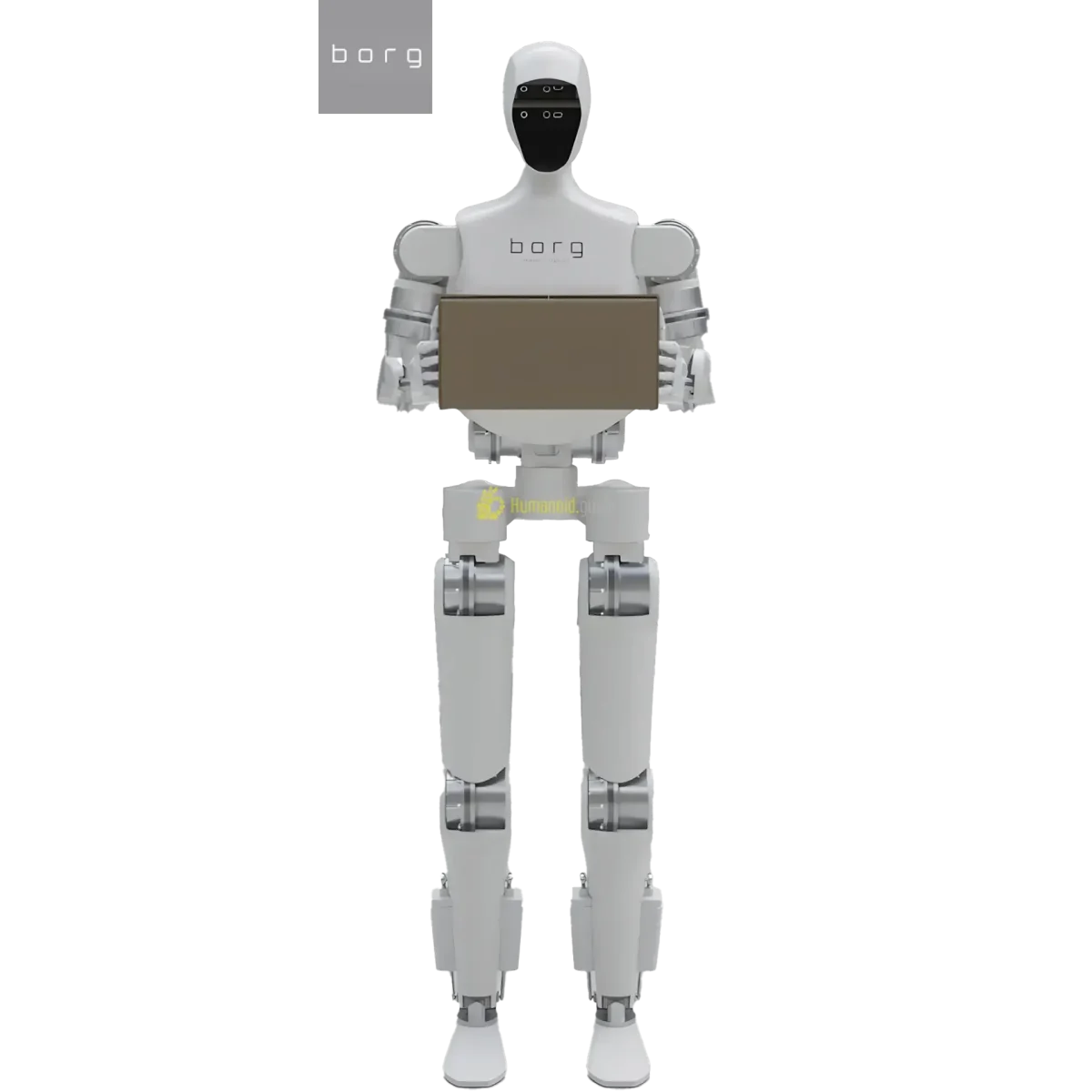
What is the Borg 01?
The Borg-01 is a prototype humanoid robot from Borg Robotics, a robotics startup reportedly based in the United States. Designed for research and early-stage development, the Borg-01 is built on a bipedal platform standing 173 cm tall and weighing 62 kg. It features 23 degrees of freedom across its body, enabling basic locomotion and manipulation tasks. The robot is powered by an electric battery system providing up to 6 hours of runtime, and can move at a maximum walking speed of 3 km/h. Its standing payload capacity is rated at 12 kg, though arm-end effector grip force and sensor specifications are not publicly disclosed. As of 2026, the Borg-01 remains a pre-commercial project with limited technical details, and no units are known to be deployed outside the developer's lab.
Specifications
Here are the full technical specifications.
| Spec | Value |
|---|---|
| Height | 173 cm |
| Weight | 62 kg |
| Degrees of freedom | 23 |
| Battery life | 6 hours |
| Max speed | 3 km/h |
| Payload | 12 kg (standing) |
| Price (new) | Undisclosed |
| Price (used range) | N/A |
Price & Value
New MSRP: Undisclosed
Used range: N/A
Borg Robotics has not released pricing for the Borg-01, which remains in the prototype phase. In the commercial humanoid market, comparable bipedal platforms like the Unitree G1 start at $16,000, while more advanced research robots like the Fourier GR-2 cost around $150,000. The Borg-01's modest 12 kg standing payload and 3 km/h walking speed place it at the entry level of bipedal capability, suggesting a potential price range in the low-to-mid tens of thousands of dollars if ever brought to market. However, without confirmed specifications for arm payload, onboard compute, or sensor suite, any estimate is purely speculative. The total cost of ownership would also depend on software support, spare parts availability, and potential upgrades—all unknown for this prototype. Buyers should contact Borg Robotics directly for development partnership opportunities rather than expecting a commercial purchase.
Who Is It For?
Best for: - Research labs exploring bipedal locomotion (23 DOF provides basic human-like motion without overwhelming complexity) - Universities teaching humanoid kinematics and joint control (lightweight 62 kg frame is easier to handle than industrial bots) - Early development partners of Borg Robotics contributing to hardware and control system refinement - Human-robot interaction studies requiring a humanoid form factor for simple gesture or walking demonstrations
Not for: - Commercial deployment requiring high-speed movement (3 km/h walking limits dynamic task execution in real environments) - Heavy lifting or industrial material handling (no published arm payload rating, standing payload only 12 kg) - Buyers seeking a ready-to-deploy service robot (no autonomous navigation, camera resolution, or safety certification confirmed) - Organizations needing a proven, supported platform (no manufacturing track record or customer references available)
Alternatives & Comparison
The Borg-01 competes in the emerging category of general-purpose humanoid robots, though it remains a prototype with limited public data. Below are realistic alternatives that buyers actually evaluate in this space.
| Model | Price | Available | Key Difference |
|---|---|---|---|
| Unitree G1 | $16,000 | yes | Lowest-priced bipedal humanoid, shipping now with 23–43 DOF options and modular arm payload capacity. |
| Fourier GR-2 | ~$150,000 (est.) | preorder | High-end bipedal with 40 kg arm payload, full sensor suite, and robust locomotion capabilities for research and light industry. |
| Agility Robotics Digit | ~$250,000 (enterprise-only) | enterprise-only | Proven bipedal logistics robot with field deployments, not a general-purpose humanoid but excelling in warehouse automation. |
Verdict: For researchers wanting a low-cost bipedal platform for locomotion studies, the Unitree G1 is the clear winner with its accessible price and modular design. The Borg-01, while promising a simple 23-DOF frame, lacks pricing, availability, and proven software support. Without concrete specifications or commercial plans, it cannot yet compete with established alternatives. Organizations requiring high payload or autonomous navigation should look to the Fourier GR-2 or Digit; the Borg-01 is only relevant for those specifically partnering with Borg Robotics on early R&D.
Use Cases & Capabilities
Bipedal Locomotion Research
The Borg-01's 23 DOF bipedal architecture and 3 km/h walking speed make it suitable for testing gait algorithms and balance control in a controlled lab environment. Its moderate height and weight allow safe indoor operation without requiring heavy infrastructure. Researchers can explore dynamic walking, step planning, and simple obstacle avoidance using the robot's legs. However, limited published sensor and compute details may restrict the integration of advanced vision-based navigation or force sensing.
Human-Robot Interaction Studies
With a human-like form factor and 6-hour battery life, the Borg-01 can serve as a platform for HRI studies focusing on social acceptance and physical interaction. Researchers can program the robot to gesture, walk towards participants, or hand over light objects. The quiet electric actuation reduces distraction during experiments. But without a known expressive display, voice interface, or safe interaction certification, its use in public-facing studies is premature.
Educational Platform for Humanoid Mechanics
Universities teaching robotics can use the Borg-01 as a physical platform to study joint configurations, actuator design, and power management in a humanoid. The 62 kg weight is manageable with proper equipment, and the 23 DOF expose students to full-body kinematics. A 6-hour battery allows all-day lab sessions without recharging. However, as a prototype, educational support, documentation, and spare parts availability are likely limited compared to off-the-shelf kits.
Early-Stage Service Robot Prototyping
Developers looking to prototype simple service tasks like delivering lightweight items indoors could adapt the Borg-01 as a testbed. The 12 kg standing payload supports carrying small packages, and the bipedal design navigates flat indoor floors. Its 3 km/h speed is sufficient for slow-paced environments. Yet the lack of arm-end effector dexterity, autonomous mapping, and safety certifications means any deployment would be strictly experimental and supervised.
History & Background
Borg Robotics, believed to be based in the United States, introduced the Borg-01 humanoid robot in 2024 as a research prototype. Very little is known about the company's founding date, team, or prior projects, and its online presence is limited to a basic website. The Borg-01 is the firm's first publicly shown bipedal robot, featuring a minimalist 23-DOF design intended for early development exploration. As of 2026, the robot remains in the development stage with no announced commercial release date, pricing, or production plans. The company has not disclosed any partnerships, pilot deployments, or intended target industries. While some third-party listings mistakenly label it as a Chinese startup, the primary data indicates a U.S.-based origin. The Borg-01’s technical documentation is sparse, and no independent hands-on reviews exist, leaving its real-world capabilities largely unverified.
Buying Used — What to Check
Verify payload and battery health The original 12 kg standing payload and 6-hour battery life may degrade rapidly in a prototype, and replacement cells may be proprietary.
Check for firmware and software support As an unreleased prototype, ongoing software support from Borg Robotics is unlikely, making long-term development difficult without source code or updates.
Inspect joint wear and structural integrity Lightweight frame and actuators may have accumulated fatigue from testing; ensure replacement parts are obtainable before purchase.
