What is the Boshiac Dexbot?
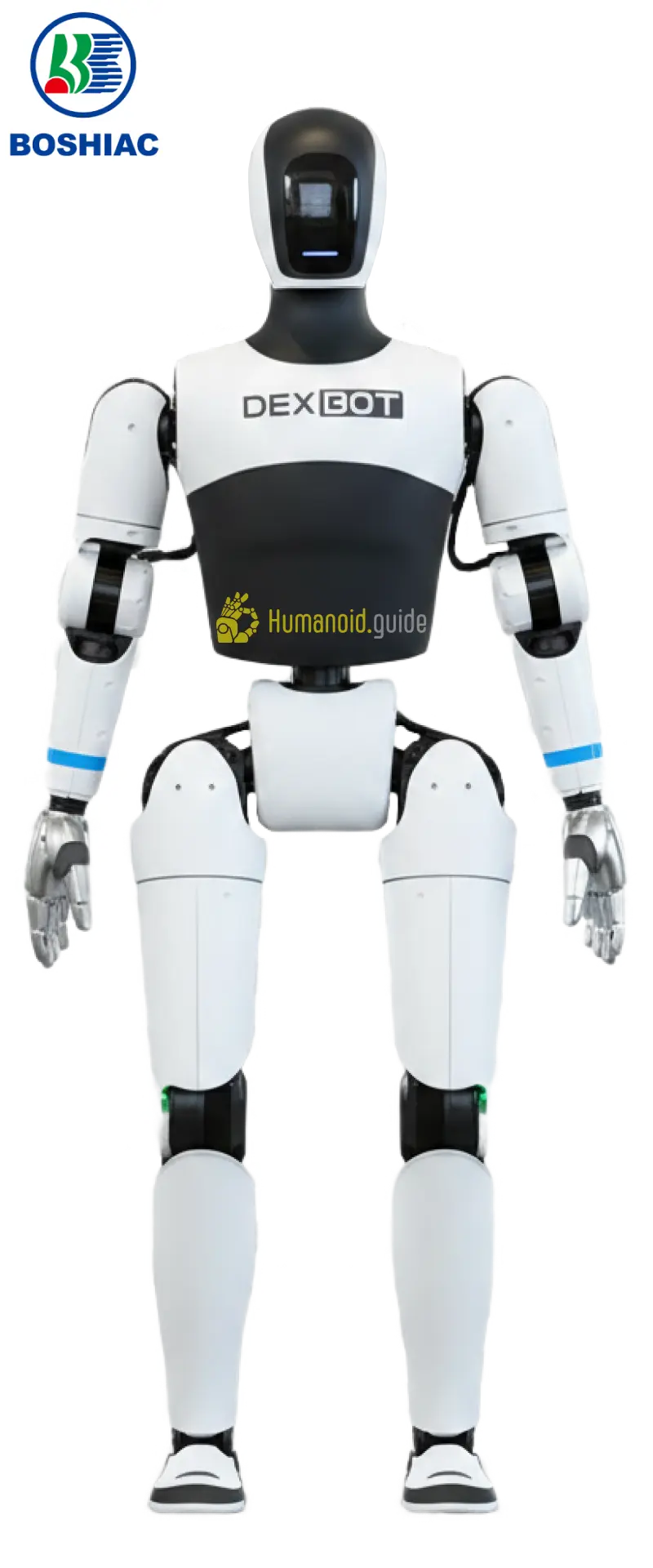
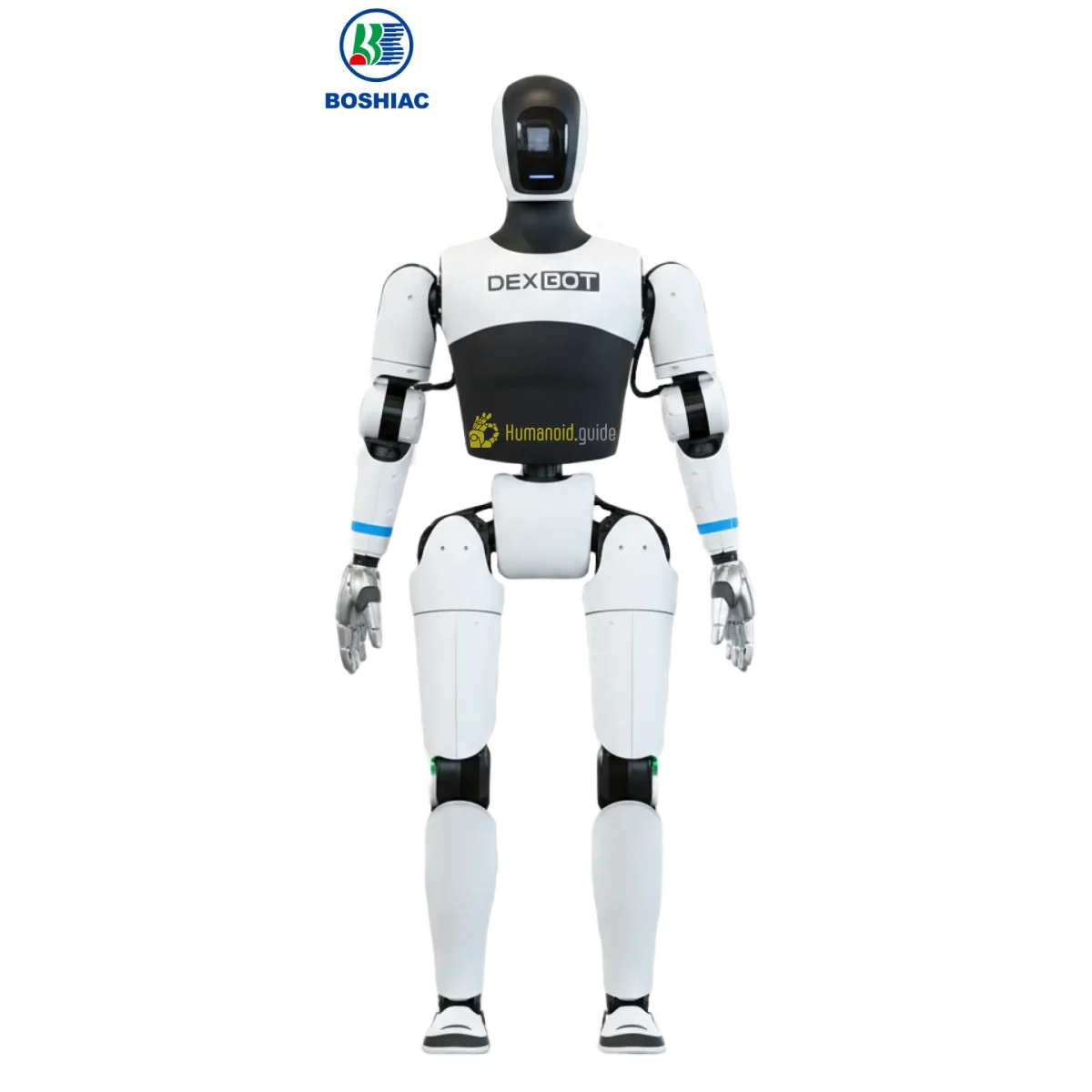
The Boshiac DexBot is a full-size humanoid robot designed for industrial automation, logistics, and manufacturing. Manufactured by BOSHIAC in Harbin, China, it features 50 degrees of freedom with a focus on dexterous manipulation—its 12-DOF hands incorporate tactile fingertip arrays for sensitive assembly tasks. Standing 160–175 cm tall and weighing 80 kg, the DexBot uses electric servo actuators and high-ratio industrial gears. It runs a Linux-based industrial OS with ROS integration and supports optional edge AI. The robot targets pick-and-place, logistics, and assembly workflows, with a payload capacity of 15 kg and a 3-hour battery runtime. Its IP20 rating limits it to controlled indoor environments.
Specifications
Here are the full technical specifications.
| Spec | Value |
|---|---|
| Height | 160–175 cm |
| Weight | 80 kg |
| Degrees of freedom | 50 (12-DOF hands) |
| Battery life | 3 hours |
| Max speed | 3 km/h |
| Payload | 15 kg |
| Price (new) | $120,000 |
| Price (used range) | N/A |
Price & Value
New MSRP: $120,000
Used range: N/A
The $120,000 price places the DexBot in the mid-range of industrial humanoids, undercutting the UBTECH Walker S (~$150,000) while sitting above the Unitree H1 ($90,000). However, the DexBot is still in development, so this figure likely reflects an early adopter pilot pricing. Its value proposition hinges on the 12-DOF dexterous hands and tactile sensing, which are rarer in this price bracket. Total cost of ownership will depend on support, software integration, and eventual volume pricing—BOSHIAC may offer leasing once the robot reaches commercial maturity. Depreciation outlook is highly uncertain given prototype status. For now, the DexBot is a speculative investment for labs and factories testing next-gen automation.
Who Is It For?
Best for: - Manufacturers evaluating dexterous humanoid robots for precision assembly lines—the 12-DOF hands and tactile sensors are a standout feature.
Not for: - Outdoor or harsh environments (IP20 rating only); factories needing heavy payloads beyond 15 kg; operations requiring long untethered runtime (3-hour battery limit).
Alternatives & Comparison
The DexBot competes with other Chinese-made industrial humanoids in the $90k–$150k range. Key differentiators are its dexterous hands and tactile feedback, while competitors often emphasize higher payload or more mature commercial availability.
| Model | Price | Available | Key Difference |
|---|---|---|---|
| Unitree H1 | $90,000 (est.) | yes | Faster walking (5.4 km/h) and higher battery capacity, but less dexterous hands. |
| UBTECH Walker S | ~$150,000 (est.) | preorder | Greater payload (20 kg) and full-body compliance, but higher cost and less proven hand dexterity. |
| Fourier GR-2 | Undisclosed (~$100k est.) | preorder | Modular design with 30+ DOF and open SDK; lacks the DexBot's tactile fingertips. |
Verdict: For buyers prioritizing sensitive assembly and tactile manipulation, the DexBot's 12-DOF hands give it an edge over rivals that offer simpler grippers. However, customers needing higher payloads or outdoor capability will find the Walker S or H1 more suitable. The DexBot is best for labs and pilot lines willing to invest in early-stage dexterous automation.
Use Cases & Capabilities
Dexterous Assembly
The DexBot's 12-DOF hands and tactile fingertip array allow it to handle small, delicate components—ideal for electronics, medical device, or automotive part assembly. Its 15 kg payload can manage sub-assemblies that require precise placement and gentle force control. The robot can adapt to variations in part orientation through tactile feedback, reducing the need for rigid fixturing. However, the 3-hour runtime may require frequent battery swaps during continuous shifts.
Pick-and-Place Logistics
In warehouse and logistics settings, the DexBot can pick items from bins or shelves using its articulate fingers and RGB-D vision. Its 3 km/h walking speed allows it to move between stations efficiently. The robot's onboard compute and optional edge AI enable real-time object recognition and grasp planning. Limitations include IP20 rating, restricting it to clean, indoor environments, and the need for safety fencing if humans are nearby.
Research Pilot for Automation Labs
With open ROS integration and Linux-based OS, the DexBot is a flexible platform for university or corporate labs testing new manipulation algorithms. Researchers can leverage the tactile data from fingertips for reinforcement learning or fine motor skill training. The prototype availability means early adopters can influence BOSHIAC's development roadmap. Cost and limited battery life may constrain large-scale deployment, but for proof-of-concept studies it's a compelling option.
Light Industrial Material Handling
In factories, the DexBot can transport parts or tools between work cells, using its arms to load conveyors or assist human operators. The high-ratio industrial gears provide the torque needed for sustained use. Its 3-hour runtime aligns with typical shift breaks for battery hot-swapping. However, facilities with heavy contaminants or moisture will find the IP20 protection insufficient without additional shielding.
History & Background
BOSHIAC (Harbin, China) emerged as an industrial automation firm, though the exact founding year is not publicly documented. The DexBot was first revealed in 2024, marking the company's entry into the humanoid robot space. This first-generation prototype was designed specifically for dexterous manipulation, featuring a tactile sensor array in its 12-DOF hands—a technical highlight that set it apart from more common gripper-based humanoids. As of 2026, the DexBot remains in the prototype stage with no official release date, though BOSHIAC has listed a preliminary price of $120,000 and is likely seeking pilot partners. The robot has not yet undergone any major hardware revisions or generation changes. BOSHIAC continues to operate independently out of northeastern China.
Buying Used — What to Check
Verify prototype revision Early prototypes may have hardware inconsistencies or missing safety certifications; confirm that any unit sold is a later engineering sample.
Test tactile sensor array The 12-DOF hands rely on delicate fingertip sensors—damage or miscalibration would undermine the robot's main selling point.
Battery health With only 3-hour runtime, a degraded battery could render the robot impractical for even short tasks.