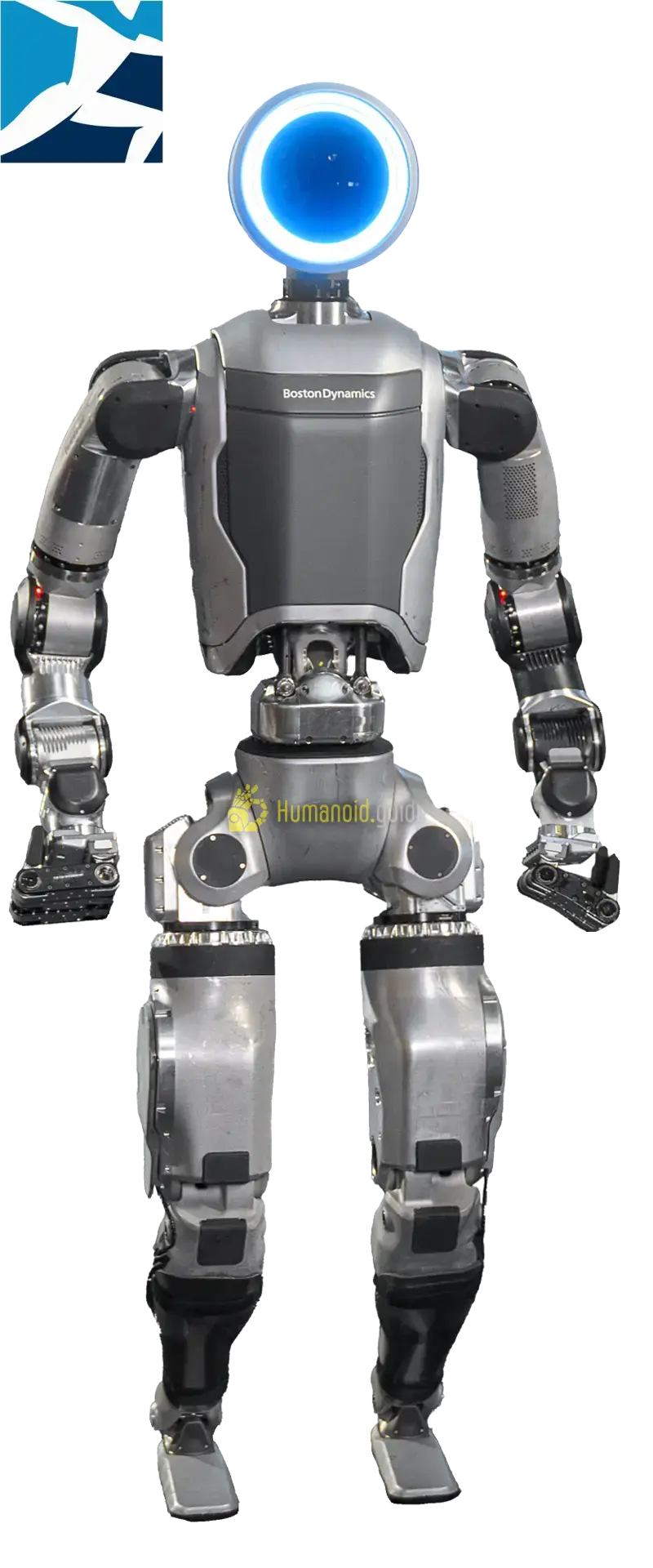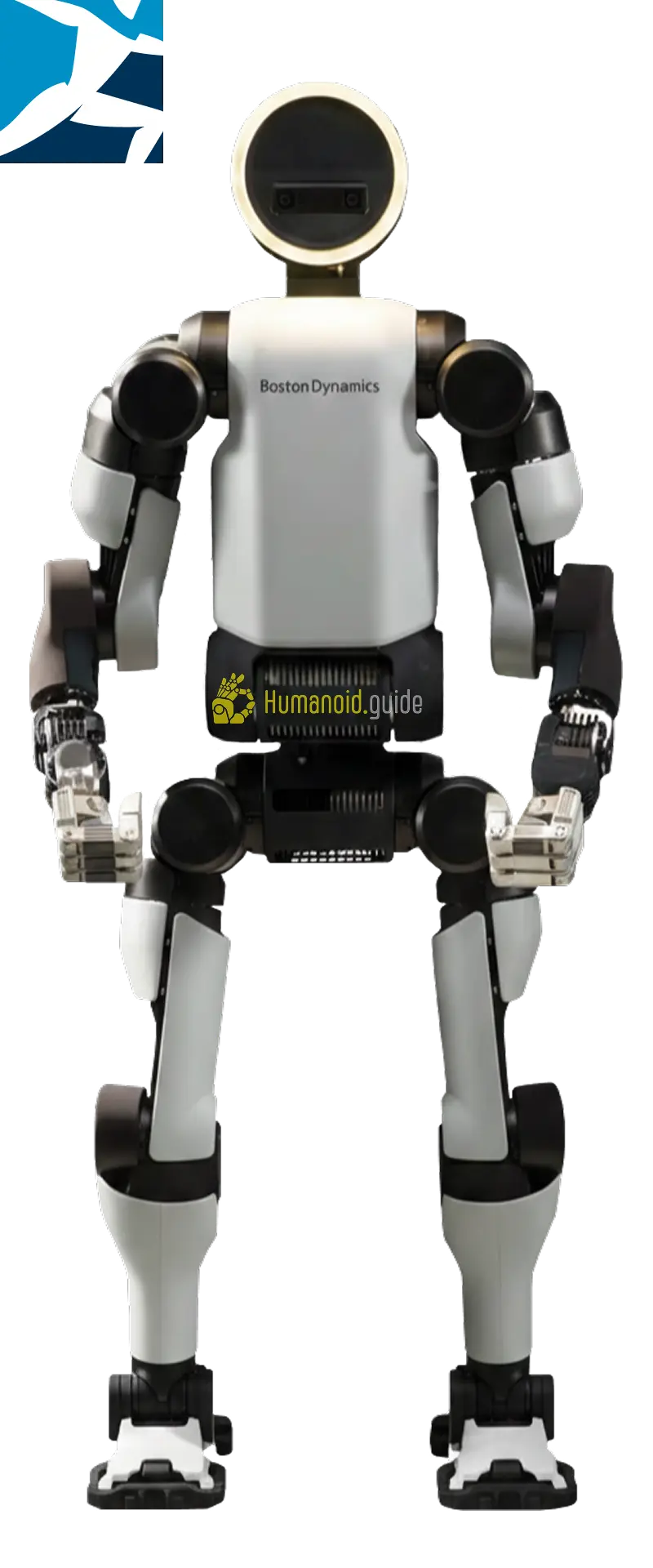
What is the Boston Dynamics Atlas?
The Boston Dynamics Atlas is a state-of-the-art all-electric humanoid robot developed in Waltham, Massachusetts. Standing 150 cm tall and weighing 89 kg, it features 56 degrees of freedom—the highest among production humanoids—enabling unparalleled dynamic mobility including backflips, parkour, and full 360° joint rotations. Equipped with NVIDIA Jetson Thor compute (800 TFLOPS) and a suite of sensors (LiDAR, stereo cameras, force/torque sensors), Atlas performs industrial tasks like palletizing, sorting, and disaster recovery. Its self-swappable battery system allows continuous operation, and the Boston Dynamics Orbit platform facilitates fleet management. Unveiled in its all-electric form at CES 2026, Atlas targets high-end industrial, warehousing, and logistics applications.
Specifications
Here are the full technical specifications.
| Spec | Value |
|---|---|
| Height | 150 cm |
| Weight | 89 kg |
| Degrees of freedom | 56 |
| Battery life | 4 hours |
| Max speed | 8 km/h |
| Payload | 50 kg |
| Price (new) | $420,000 |
| Price (used range) | No used market yet |
Price & Value
New MSRP: $420,000
Used range: N/A (recently launched)
Atlas is priced at an estimated $420,000 per unit, based on leaked manufacturer data. This positions it well above most competitors like the Unitree H1 ($90,000) or Tesla Optimus ($20,000), but Atlas justifies its cost through unmatched dynamic performance, 56 DOF, and proven manipulation capabilities such as heavy-box handling and backflips. In the high-end humanoid market, it competes with Agility Digit ($250,000) for logistics—both are enterprise-focused, but Atlas offers broader dexterity and mobility. The total cost of ownership will be high, with complex maintenance and likely limited third-party support. Organizations must also budget for training, integration, and potential insurance, given the robot's high asset value. Depreciation is uncertain since no used market exists yet, but early-adopter enterprises may see rapid technological obsolescence. For organizations needing extreme versatility and ruggedness, Atlas delivers value no cheaper robot can match.
Who Is It For?
Best for: - Manufacturers with high-mix, low-volume production lines (56 DOF handles varied tasks without reprogramming) - Logistics centers needing heavy-goods sorting and palletizing (50 kg payload, 230 cm reach) - Disaster response agencies requiring water-resistant, terrain-capable robots (walk through rubble, teleoperate valves) - Research labs pushing humanoid locomotion and whole-body manipulation (full 360° joints enable movements beyond human range)
Not for: - Small businesses or startups (enterprise-only pricing at $420,000) - Very heavy palletizing over 50 kg (max payload limited compared to forklifts) - Low-budget automation where fixed robotic arms or simpler cobots suffice
Alternatives & Comparison
Atlas competes in the high-end humanoid niche against a growing field of industrial bipeds. Below are the most direct alternatives a buyer would evaluate.
| Model | Price | Available | Key Difference |
|---|---|---|---|
| Tesla Optimus (Gen 2) | $20,000 (est.) | preorder | Mass-market price and Tesla AI inference chip, but lower 22‑28 DOF and less dynamic mobility |
| Figure 02 | Undisclosed | preorder | Advanced multimodal AI and 16+ DOF hands for general-purpose manipulation, still pre-production |
| Unitree H1 | $90,000 | yes | Cost-effective, 19 DOF, open-source platform, but far less dynamic and rugged |
| Agility Robotics Digit | $250,000 | enterprise-only | Legged humanoid optimized for tote handling in warehouses, simpler locomotion, but 18 kg payload |
Verdict: For buyers prioritizing extreme mobility and dexterity, Atlas is in a class of its own—no other humanoid can do backflips and 360° manipulation. However, at $420,000 it is out of reach for most. The Unitree H1 is the budget choice with solid performance, while Agility Digit is a better value for pure warehouse logistics. Tesla Optimus, at $20,000, promises mass-market scale but remains less capable physically. Choose Atlas if your application demands the absolute limits of humanoid robotics, and budget is not a primary constraint.
Use Cases & Capabilities
Industrial Material Handling
Atlas can lift up to 50 kg, making it suitable for moving heavy components on factory floors. Its 56 degrees of freedom and full 360° joint rotation allow it to reach into tight spaces and manipulate items with human-like dexterity. The NVIDIA Jetson Thor compute platform enables real-time object recognition and path planning. Atlas includes human detection sensors, allowing barrier-free collaboration with human workers, further enhancing flexibility on the line. With self-swapping batteries, it can operate continuously without downtime. Although initial cost is high, the reduction in human injury and increased throughput can justify the investment in high-throughput manufacturing.
Warehouse Palletizing and Sorting
Atlas can autonomously palletize and depalletize boxes using its force-sensitive limbs and integrated vision system. Its 230 cm reach lets it stack goods high, while dynamic balance recovers from slips on dusty warehouse floors. The robot's 50 kg payload capacity handles a wide range of box weights, and the self-swappable battery system ensures 24/7 operation without manual intervention. Integration with the Boston Dynamics Orbit fleet management platform enables coordinated sorting through barcode and RFID scanning. For e-commerce fulfillment centers handling diverse SKUs, Atlas's versatility offers a major advantage over fixed automation. The robot's ability to walk at speeds up to 8 km/h keeps cycle times low even in large facilities.
Disaster Response
Atlas’s water-resistant design and ability to navigate rubble and uneven terrain make it ideal for disaster zones. It can carry up to 30 kg of equipment sustainably, walk through water, and climb stairs with ease. The robot’s teleoperation mode allows a human controller to perform delicate tasks like shutting off valves or searching for survivors, using the robot’s stereo vision for depth perception. Autonomous fall recovery ensures it gets back up after being knocked over by debris. With its 56 DOF, Atlas can contort into tight spaces inaccessible to wheeled robots. While the $420,000 price tag limits fleet size, a single unit could be deployed for high-risk missions where human safety is paramount.
Research and Development
Research institutions can use Atlas to push the boundaries of locomotion and manipulation. With 56 degrees of freedom and full 360° joint rotation, researchers can explore motions impossible for humans, such as rotating joints in place while maintaining upper body tasks. Boston Dynamics’ partnership with Google DeepMind provides a foundation model for learning from demonstration, enabling rapid skill acquisition. The robot’s API allows custom control algorithms, and the NVIDIA Thor platform supports on-device AI training. While the price is prohibitive for most university labs, grants and consortiums could acquire one as a premier platform for AI-driven robotics research. The availability of a research SDK and community forums enhances its value as a development tool.
Heavy-Payload Logistics
For logistics tasks requiring sustained lifting beyond typical human ability, Atlas can carry up to 30 kg over long periods. Its strong titanium‑aluminum frame and high‑torque joints prevent fatigue during repetitive cycles. The robot’s autonomous battery swap capability eliminates charging idle time in continuous sortation lines, making it suitable for three‑shift operations. In shipping ports or freight terminals, Atlas could handle irregularly shaped cargo that traditional robots cannot. However, current payload limits (50 kg peak) may be insufficient for very heavy pallets; heavier payloads still require forklifts. Despite this, Atlas fills the gap between human workers and heavy machinery in mixed‑payload environments.
Public Engagement and Brand Demonstrations
Companies can deploy Atlas at trade shows and exhibitions to attract attention and demonstrate technological prowess. Performing backflips, dancing, or interactive demos, Atlas creates memorable brand experiences that traditional robots cannot. Its fine-tuned control and dynamic movement captivate audiences, making it a powerful marketing tool. While not a direct profit center, the PR value can justify the cost for large corporations. Atlas's safety features allow operation near crowds without barriers, enhancing show-floor utility.
History & Background
Boston Dynamics, founded in 1992 as an MIT spinoff, has pioneered dynamic legged robots for three decades. The original Atlas debuted in 2013 as a hydraulic humanoid built for the DARPA Robotics Challenge, standing 188 cm tall and weighing 150 kg. Over multiple iterations, Atlas evolved into a parkour-capable research platform, achieving fame through viral videos of backflips and acrobatics. The robot placed as a finalist in the 2015 DRC Finals, demonstrating semi-autonomous mobility in simulated disaster environments. In 2020, Hyundai Motor Group acquired Boston Dynamics for $1.1 billion, signaling a shift toward commercial products. By 2024, the company retired the hydraulic version and in 2025 unveiled an all-electric successor with 56 DOF and self-swapping batteries. The current production model was officially launched at CES 2026, marking Atlas’s transition from a research marvel to an industrial product.
Buying Used — What to Check
Battery health and cycle count Self-swappable lithium-ion packs degrade; confirm remaining capacity to ensure runtime claims.
Joint actuator wear Dynamic flips and heavy payloads stress joints; unusual noise or backlash may signal costly repairs.
Software version and update eligibility Later software releases improve autonomy and safety; ensure the unit can receive enterprise updates.