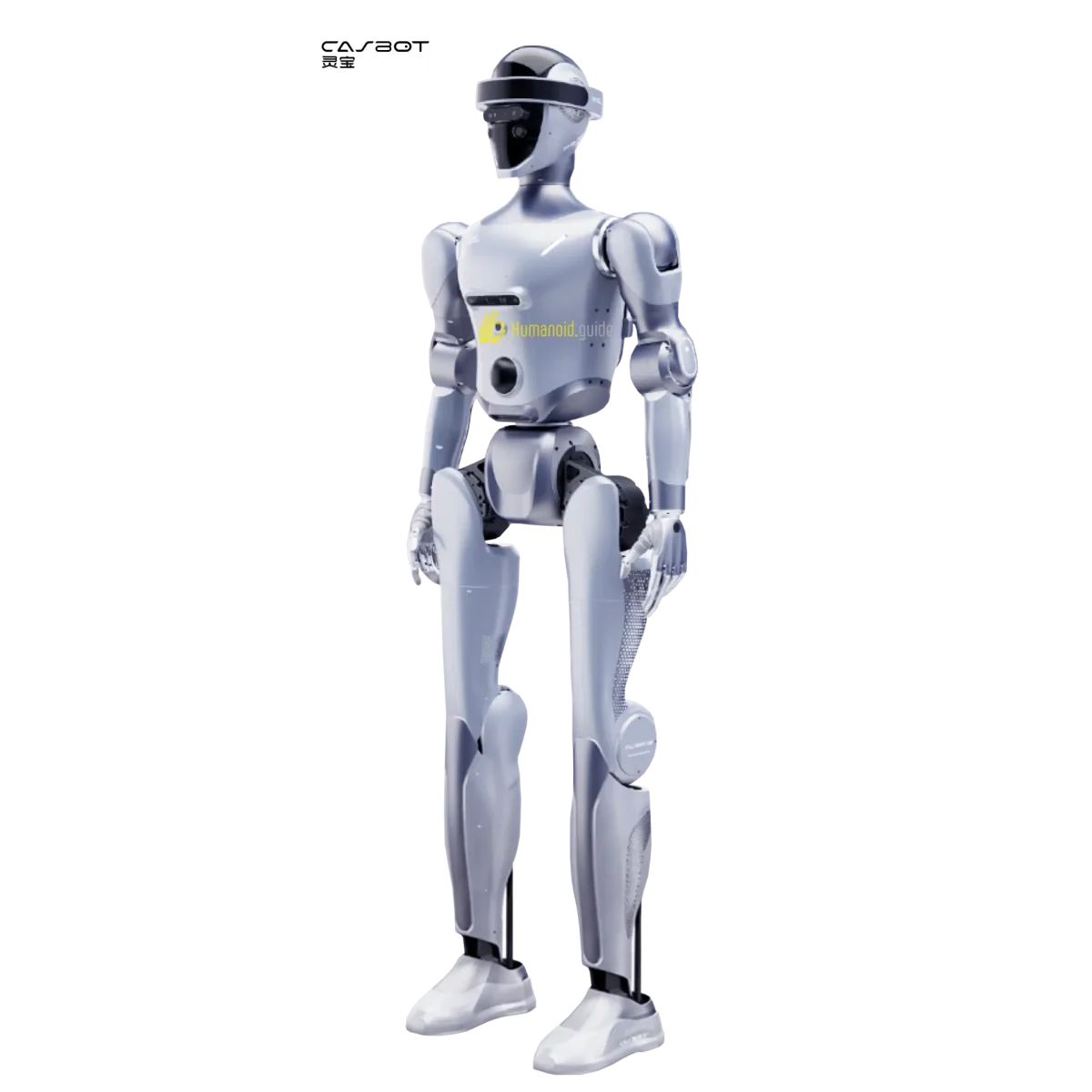
What is the Casbot 02?
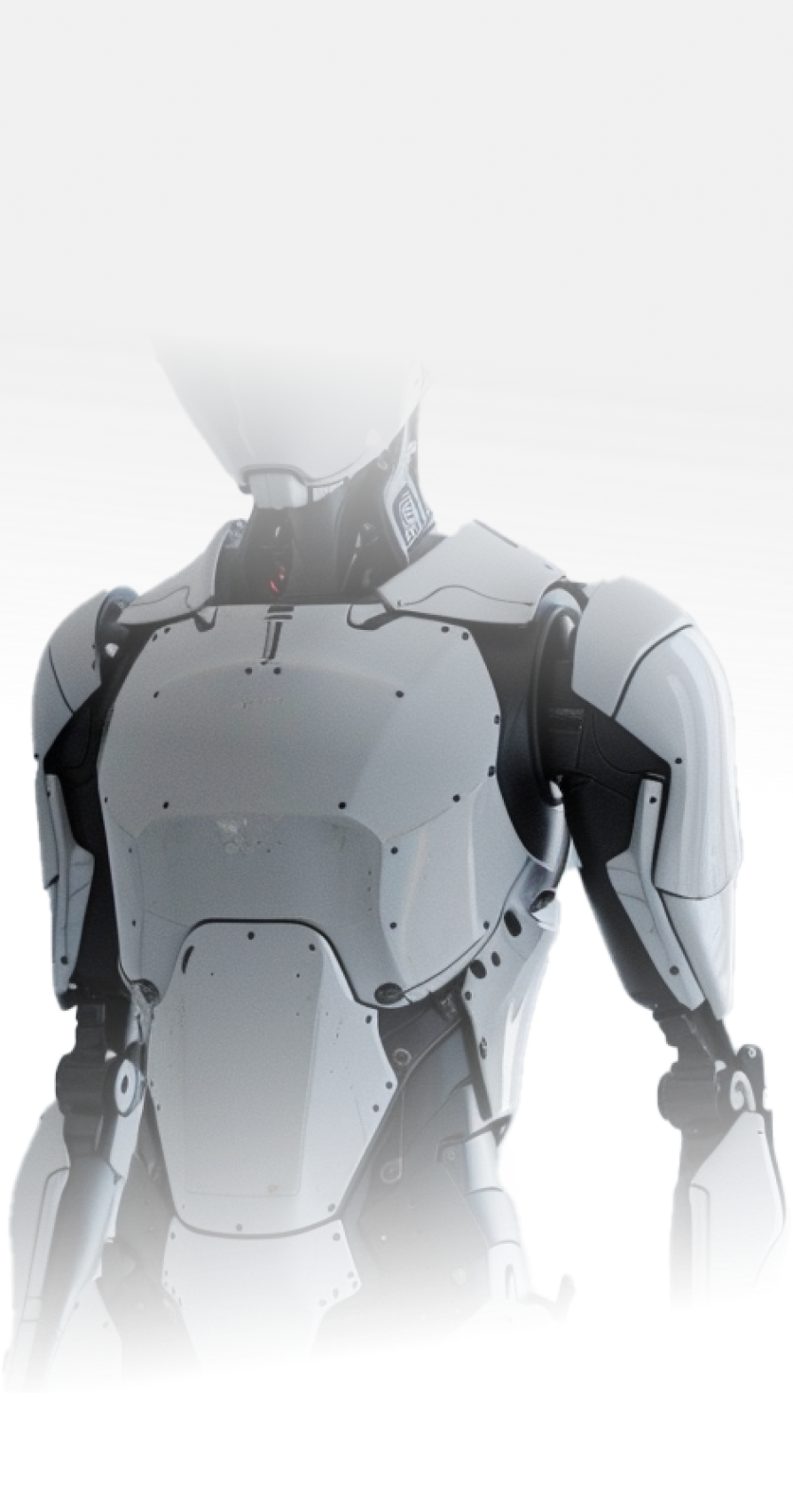
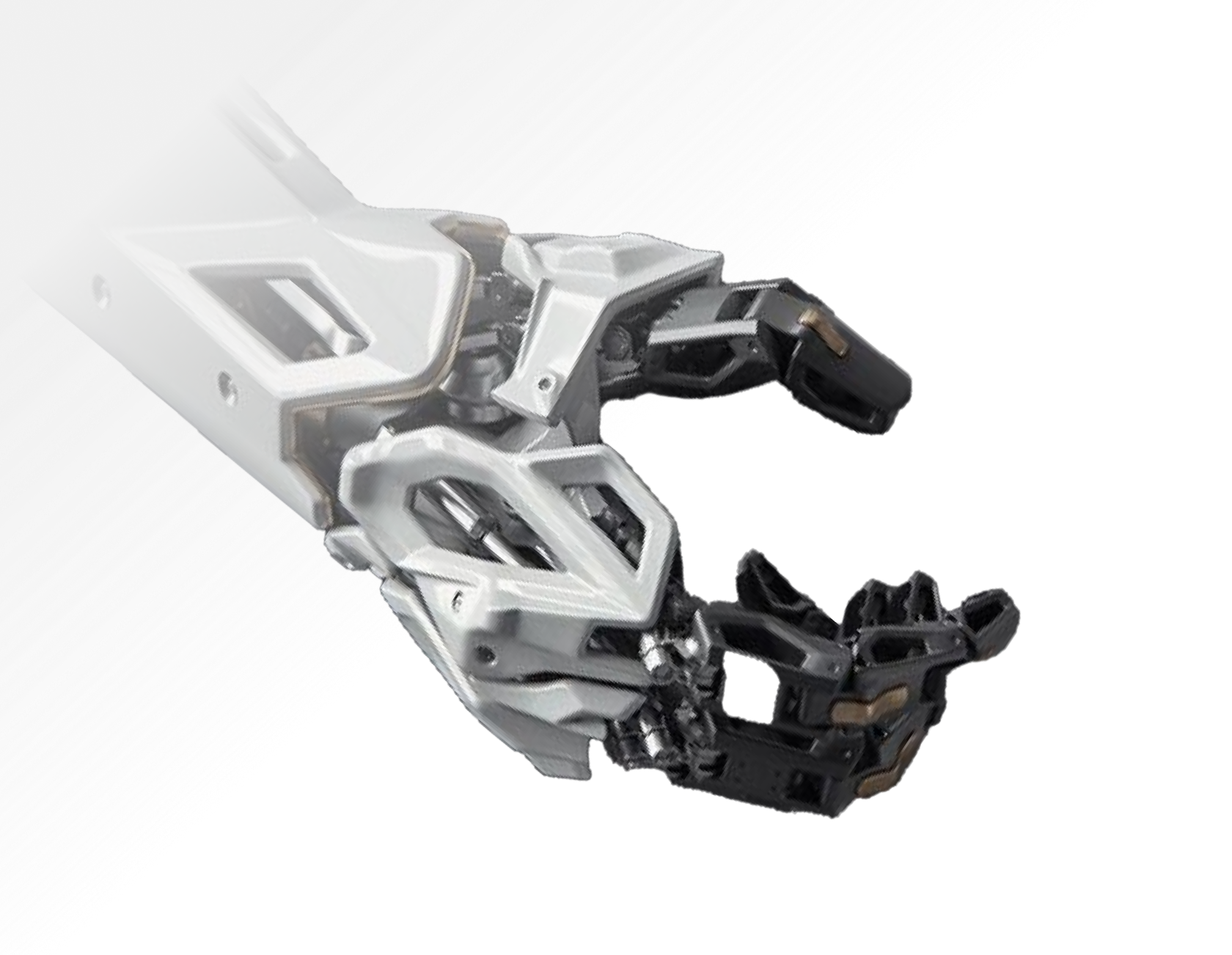
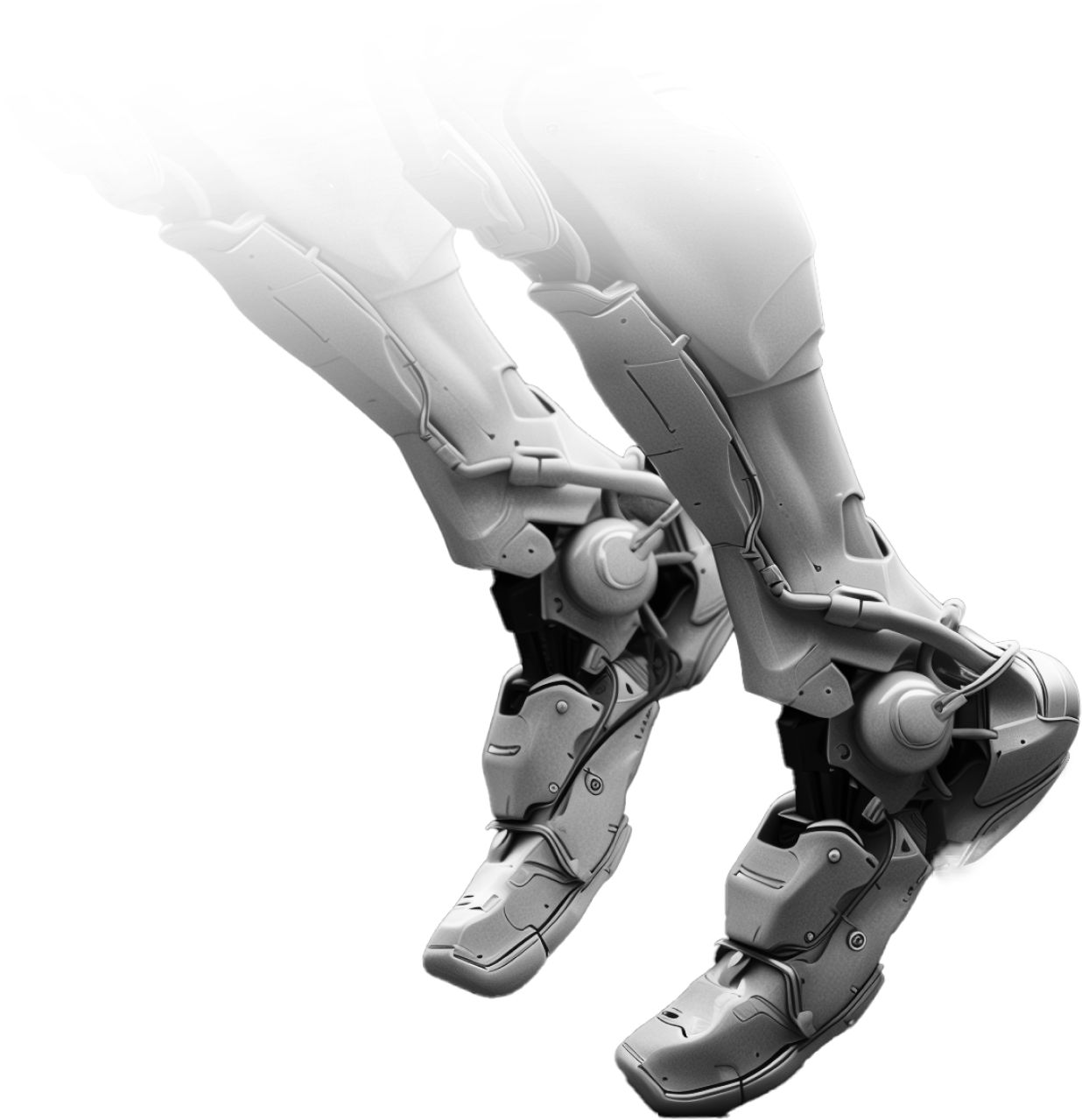
The CASBOT 02 is a bipedal humanoid robot developed by CASBOT (Beijing Zhongke Huiling Robotics Technology Co., Ltd.), headquartered in Beijing, China. It is the second-generation model, upgrading the CasBot-01 with added arm dexterity — each hand has 11 degrees of freedom (6 active) — and a larger battery for up to 2 hours runtime. Standing 163 cm tall and weighing 50 kg, it uses NVIDIA Orin AGX and RK3588 compute (275 TOPS) for real‑time AI‑powered interaction. Designed for education, exhibitions, interactive service, and retail, the robot walks at 4 km/h and runs up to 6 km/h. The CASBOT 02 targets structured environments like collaboration, manufacturing, and assembly, with a standing payload of 4 kg.
Specifications
Here are the full technical specifications.
| Spec | Value |
|---|---|
| Height | 163 cm |
| Weight | 50 kg |
| Degrees of freedom | 25 |
| Battery life | 1.5 hours |
| Max speed | 6 km/h |
| Payload | Not specified (standing 4 kg) |
| Price (new) | $63,500 |
| Price (used range) | N/A |
Price & Value
New MSRP: $63,500
Used range: N/A
At $63,500, the CASBOT 02 enters a competitive space between budget educational humanoids and high-end industrial models. While it undercuts the Unitree H1 ($90,000) and Tesla’s anticipated pricing, it lacks a confirmed arm payload and robust outdoor capability. The 1.5‑hour battery life and NVIDIA Orin compute offer good value for indoor interaction roles, but buyers should budget for potential maintenance on dexterous hands and proprietary software. Depreciation will be steep once production scales, as early units may lack refinements seen in later batches. Unlike mass‑market bots, the early‑commercial status means limited support and sparse used‑unit market, locking in the new price as the entry point.
Who Is It For?
Best for: - Structured indoor environments like exhibition halls and retail stores where dexterous hands (11 DOF per hand) and voice interaction can engage visitors, and where the robot can be recharged frequently. - Educational labs needing a ROS‑compatible, full‑size humanoid platform with moderate AI compute (275 TOPS) to teach bipedal locomotion, manipulation, and HRI research.
Not for: - Unstructured outdoor tasks or heavy industrial manipulation — the arm manipulation payload is unspecified and the standing payload is only 4 kg, ruling out rugged fieldwork or assembly line lifting. - Production lines requiring continuous 8‑hour shifts — the 1.5‑hour battery life demands frequent charging and is unsuitable for high‑uptime operations.
Alternatives & Comparison
The CASBOT 02 competes with China’s growing humanoid market in the $60–90k range, where dexterity, openness, and proven reliability are still shaping buyer choices.
| Model | Price | Available | Key Difference |
|---|---|---|---|
| Unitree H1 | $90,000 | yes | Open‑source platform with established sales and higher arm payload specifications |
| Fourier GR-2 | Undisclosed | preorder | Higher overall payload capacity and fully dexterous hands aimed at industrial trials |
| Tesla Optimus | Undisclosed | preorder | Integrated Tesla manufacturing ecosystem and aggressive mass‑production roadmap |
Verdict: For budget‑conscious labs needing bipedal mobility with modest dexterity, the CASBOT 02 at $63,500 is a strong contender, but if reliable heavy payload is a must, the Unitree H1 – though pricier – is a safer bet. For industrial trials, Fourier GR‑2’s higher robustness may justify the wait for pricing, while Tesla Optimus remains unproven in the wild, making early CASBOT 02 units a practical stepping stone.
Use Cases & Capabilities
Education & Research
Universities and research labs can use the CASBOT 02 as a realistic humanoid platform for courses in robotics, AI, and human‑robot interaction. Its ROS compatibility and NVIDIA Orin AGX onboard (275 TOPS) allow students to develop locomotion controllers, grasping policies, and perception pipelines on real hardware instead of simulation alone. The 25‑degree‑of‑freedom body, including dexterous hands with 11 DOF per hand, offers a rich testbed for manipulation research. The robot’s 1.5‑hour battery runtime is sufficient for lab sessions or demo days, and the relatively approachable $63,500 price tag fits within well‑funded academic budgets compared to far more expensive industrial humanoids.
Interactive Service & Exhibitions
Museums, trade shows, and corporate showrooms can deploy the CASBOT 02 as a greeter or product demonstrator. Its 163 cm height and 50 kg build give it a human‑like presence, while the multi‑sensor suite (RGB‑D, stereo, fisheye cameras) enables safe, collision‑free navigation around visitors. Voice interaction through integrated AI (likely via ROS and external LLM integration) and gesturing with 6 active DOF per hand can make interactions more engaging than stationary displays. The 6 km/h top speed means it can keep pace with walking crowds, and the 4G/Wi‑Fi 6 connectivity ensures seamless cloud updates and remote monitoring. A single charge supports roughly 1.5–2 hours of active duty, making it ideal for scheduled, intermittent appearances.
Retail & Brand Experiences
High‑end retail stores and pop‑up brand activations can use the CASBOT 02 to attract foot traffic and demonstrate products. With dexterous hands capable of handling small objects, the robot could hand out samples, pick up and display items, or perform simple assembly visually. The NVIDIA compute stack enables real‑time object recognition and branded interactions, while the lightweight metal‑composite frame allows repositioning across store layouts. Battery swaps or charging between shifts are necessary because the 1.5‑hour runtime won’t cover a full store day, so staffing must include technical support. At $63,500, the robot’s novelty value and potential for viral social media moments can justify the cost for marketing‑driven organizations.
Light Manufacturing Assistance
In structured manufacturing environments, the CASBOT 02 can assist with small‑part kitting or quality checks where its 4 kg standing payload and high‑precision joints are sufficient. The robot’s 25 DOF and dual‑arm dexterity let it perform pick‑and‑place tasks from conveyor belts or retrieve tools from organized racks. ROS compatibility enables integration with existing factory MES and vision systems for automated inspection routines. However, the lack of a published arm payload and the 1.5‑hour battery limit mean it is better suited as a flexible support unit rather than a production‑line workhorse. Maintenance of dexterous hands in dusty or oily settings remains an unknown, so it works best in clean, controlled assembly areas.
History & Background
Beijing‑based CASBOT (legal name Beijing Zhongke Huiling Robotics Technology Co., Ltd.) emerged as a humanoid robotics startup focused on general‑purpose bipedal machines. The company released its first‑generation CasBot‑01 around 2023, which focused mainly on walking and basic interaction. In 2024, it unveiled the CASBOT 02, a significant leap forward: dexterous hands with 11 degrees of freedom per hand (6 active), nearly double the battery life of its predecessor, and the integration of NVIDIA Orin AGX compute for onboard AI. The robot moved quickly into early commercial production, targeting exhibition, retail, and education sectors. As of 2026, CASBOT continues to refine the platform, with limited units shipping to strategic partners and lead times varying by configuration. The company’s slogan “scenario traction, making embodied intelligence move from stage to practical” reflects its mission to transition humanoids from demos to real‑world tasks.
Buying Used — What to Check
Battery health and cycle count Early production units may have used batteries with limited cycles; a degraded pack could drop runtime well below 1.5 h.
Dexterous hand calibration The 11‑DOF hands rely on precise calibration; verify all fingers move freely and the grip force matches factory specs.
Software update eligibility Cassbot 02 software updates may be tied to original purchase contracts; ensure the unit can receive future ROS stack improvements.