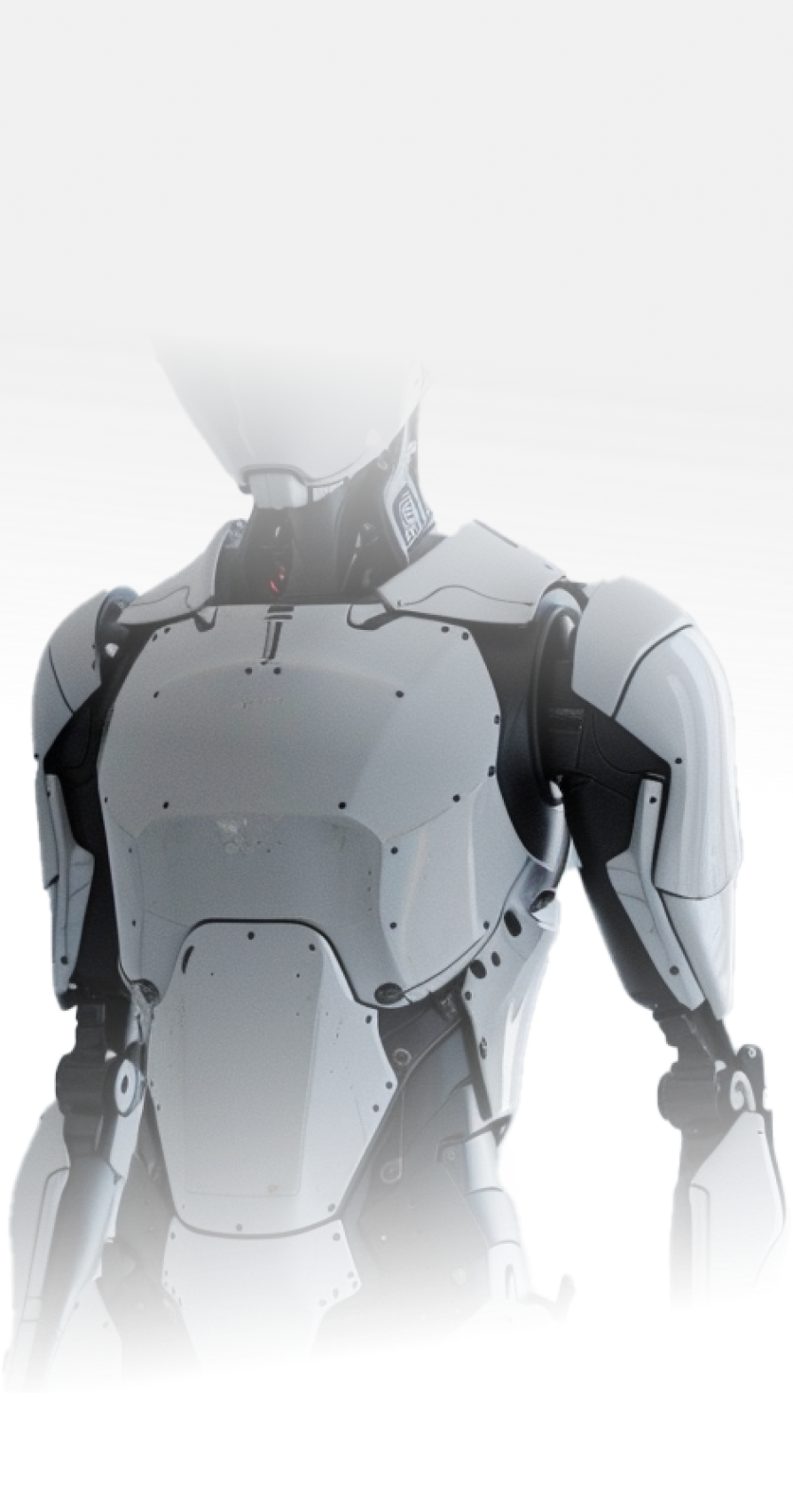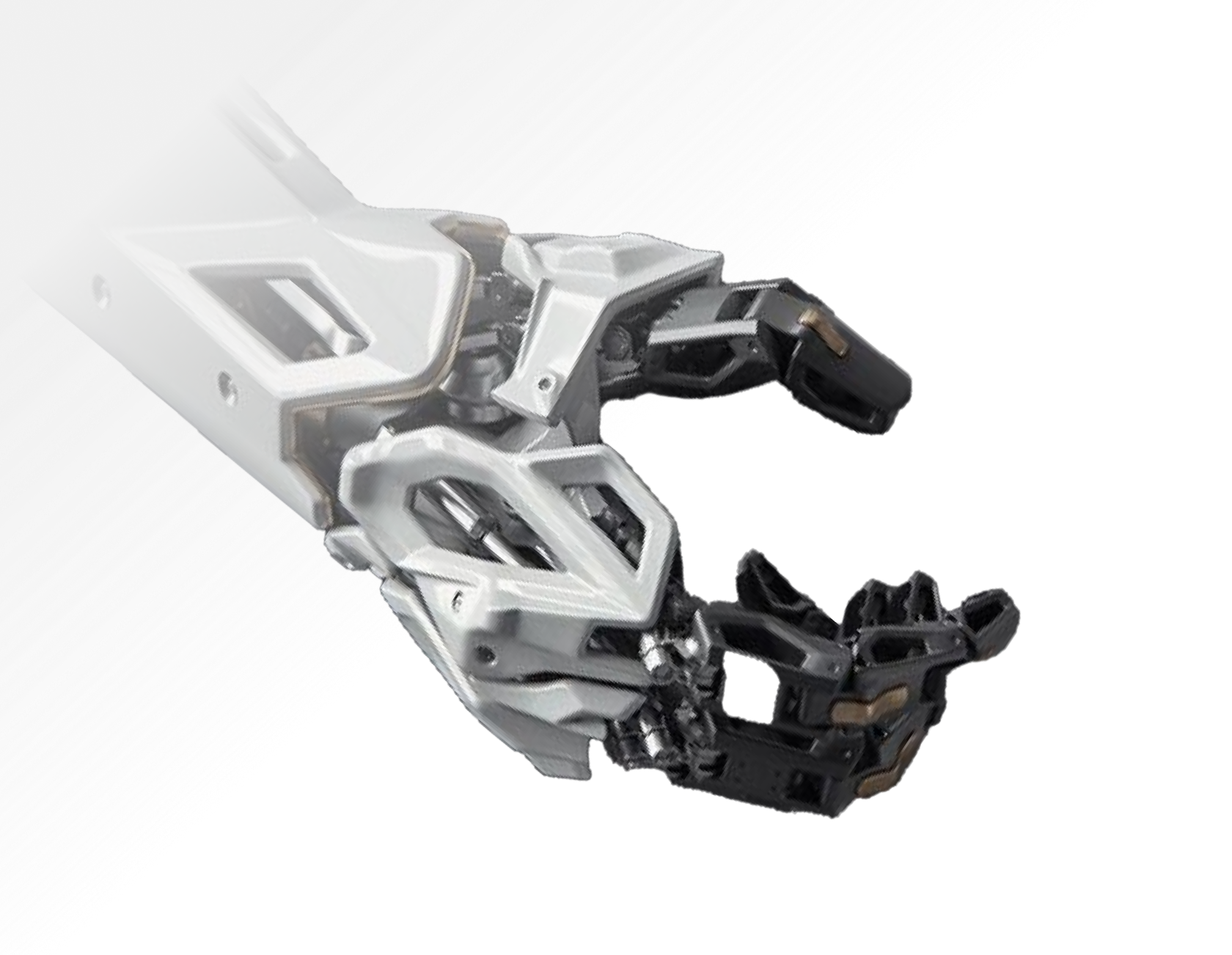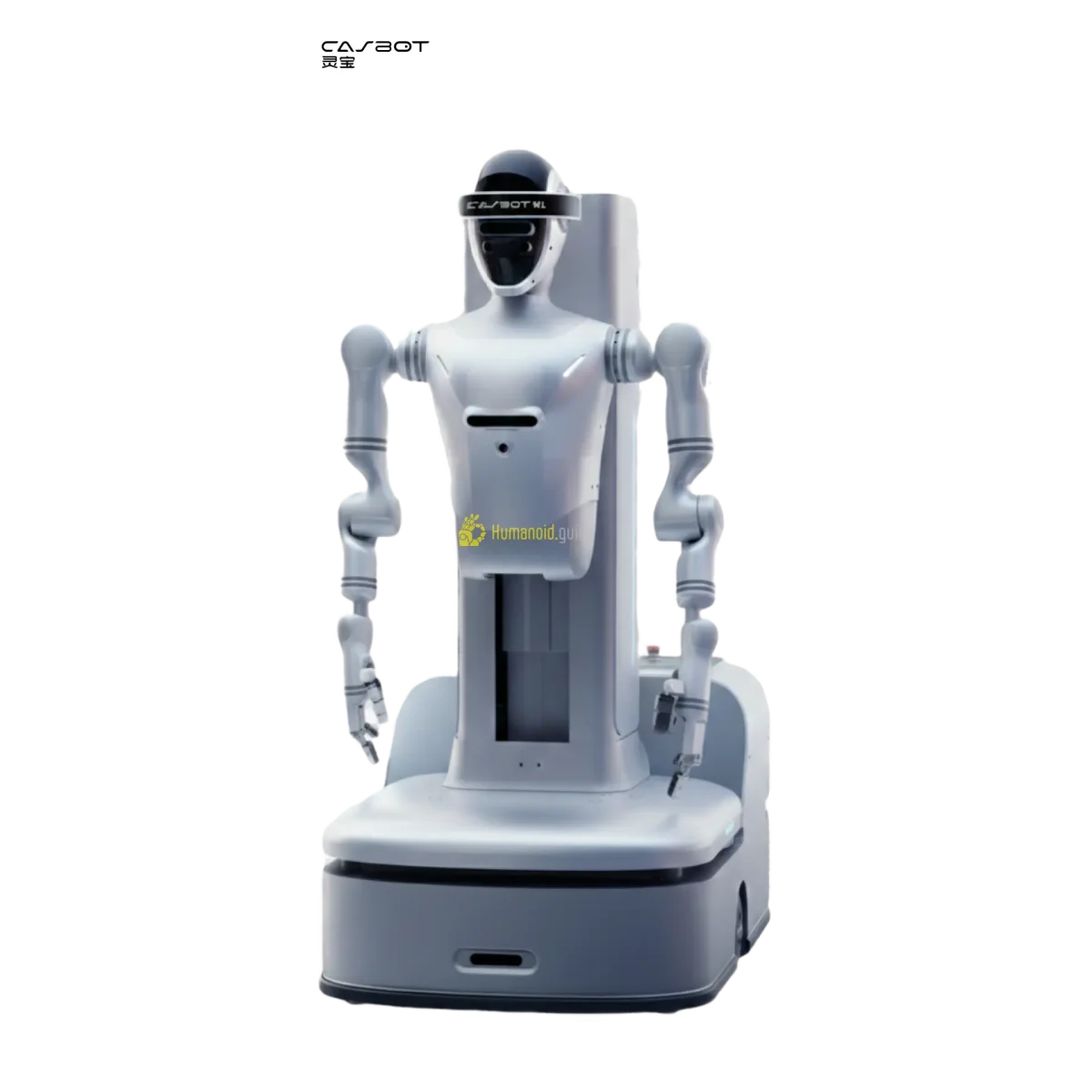
What is the Casbot W1?
The CASBOT W1 is a wheeled humanoid robot from CASBOT (Beijing Zhongke Huiling Robotics Technology Co., Ltd.), based in China. Unlike bipedal humanoids, the W1 pairs a wheeled omnidirectional base with a humanoid upper torso, integrating a telescoping spine that adjusts height from 112 cm to 210 cm. This design targets flat-floor industrial settings where wheeled stability outperforms bipedal balance. The robot features 20 degrees of freedom total, with 7 DOF per arm and three-finger grippers for manipulation. It weighs 260 kg and carries a 10 kg payload. Powered by an industrial PC with an Intel i9 CPU and NVIDIA 4060 GPU, it runs a ROS-compatible proprietary robotics stack. Sensors include RGB-D structured light cameras and stereo vision, while connectivity covers Wi‑Fi 6, 4G, Bluetooth 5.2, and Ethernet. Currently in development, the W1 is aimed at logistics, manufacturing, and research applications needing mobile manipulation on flat floors.
Specifications
Here are the full technical specifications.
| Spec | Value |
|---|---|
| Height | 210 cm |
| Weight | 260 kg |
| Degrees of freedom | 20 |
| Battery life | 5 hours |
| Max speed | 4.3 km/h |
| Payload | 10 kg |
| Price (new) | Undisclosed |
| Price (used range) | N/A |
Price & Value
New MSRP: Undisclosed
Used range: N/A
CASBOT has not publicly disclosed the price of the W1. Unverified third-party listings quote $67,700, but these figures are not confirmed by the manufacturer and should be treated as speculative. If commercialised, the W1 would likely compete with other Chinese wheeled humanoids and mobile manipulators, making its eventual price a critical success factor. Without a confirmed MSRP, buyers cannot yet evaluate total cost of ownership, including software licensing, integrator fees, and maintenance contracts. As the robot is still in development, no secondary market exists, and depreciation patterns are unknown. For now, budget planning should assume contact with CASBOT for pricing discussions.
Who Is It For?
Best for: - Logistics and warehouse automation: the wheeled base and 20‑DOF upper body suit picking, packing, and palletising on large flat floors. - Light manufacturing and assembly: 10 kg payload and 7‑DOF arms enable kitting, machine tending, and screw‑driving in structured cellular workflows. - Academic and industrial research: open ROS compatibility, RGB‑D cameras, and modern compute (i9 + RTX 4060) make it a versatile mobile manipulation research platform.
Not for: - Rough‑terrain or outdoor use: the wheeled base is designed exclusively for level indoor surfaces; stairs and unprepared ground are impassable. - Heavy‑payload operations: the arm payload is limited to 10 kg, ruling out tasks that require lifting or positioning heavy components. - High‑volume 24/7 deployment without rapid battery swapping: a 4‑5 h runtime per charge may require dual‑battery setups or opportunistic charging.
Alternatives & Comparison
The CASBOT W1 occupies a niche between conventional wheeled manipulators and full bipedal humanoids. Below, we compare it against two established alternatives that match its industrial flat‑floor use case.
| Model | Price | Available | Key Difference |
|---|---|---|---|
| Pollen Robotics Reachy | ~$33,000 (est.) | yes | Lower cost, more dexterous 7‑DOF arms, but fixed height and no telescoping torso. |
| Boston Dynamics Stretch | ~$75,000 (est.) | yes | Higher payload (23 kg), fully autonomous box moving, but lacks a humanoid upper body and fine manipulation. |
Verdict: For pure box moving and heavy logistics, Boston Dynamics Stretch is the proven, higher‑payload choice. For dexterous manipulation at lower cost, Pollen Robotics Reachy is immediately available and more mature. The CASBOT W1’s unique value—wheeled stability plus a telescoping humanoid torso—remains theoretical until it ships. If you need a mobile platform that can reach both floor level and high shelves with interchangeable arms, and you can afford the wait, the W1 warrants close monitoring.
Use Cases & Capabilities
Logistics Picking & Palletising
The W1’s wheeled omnidirectional base allows it to navigate warehouse aisles at up to 4.3 km/h, while the telescoping spine adjusts from 112 cm to 210 cm so it can pick from low bins and place onto high pallets. The 20‑DOF upper body, including 7‑DOF arms and three‑finger grippers, handles boxes, totes, and packaged goods up to 10 kg. Stereo vision and RGB‑D cameras enable real‑time object detection and pose estimation for reliable grasping. Integration with warehouse management systems over Wi‑Fi 6 or Ethernet supports autonomous sortation workflows. Currently, the robot must operate on smooth, level flooring, limiting its use to modern distribution centres.
Light Manufacturing & Assembly
In a structured factory cell, the W1 can tend CNC machines, perform kitting, or tighten screws using electric servos and high‑precision reduction gears. Its 7‑DOF arms provide the dexterity for tasks such as inserting components, applying adhesives, or inspecting parts with onboard cameras. The robot’s static wheeled base eliminates gait planning, so it can focus compute resources on fine manipulation. Safety features, including assumed IP20–IP54 ingress protection and human‑safe design, allow it to work alongside operators without cages. One limitation is the 10 kg payload, which restricts it to smaller parts and light sub‑assembly, not heavy engine blocks or large castings.
Research Platform for Mobile Manipulation
Research labs can leverage the W1’s ROS‑compatible stack, industrial PC (i9 CPU + RTX 4060 GPU), and sensor suite to develop new algorithms for visual servoing, task‑and‑motion planning, and human‑robot interaction. The wheeled base simplifies navigation research by removing the complexity of bipedal locomotion, letting teams focus on manipulation and perception. The robot’s ability to change its body height dynamically opens avenues for adaptive workspaces and whole‑body control studies. While not yet commercially available, early access to a pre‑commercial unit can position a lab at the forefront of wheeled humanoid research. The lack of published LLM integration does not preclude researchers from adding their own instruction‑following models via the open software environment.
History & Background
CASBOT (Beijing Zhongke Huiling Robotics Technology Co., Ltd.) is a Chinese company focused on general‑purpose humanoid robots and embodied intelligence. The CASBOT W1 was first built and shown in 2024, marking the firm’s entry into the industrial mobile manipulator market. Unlike its bipedal competitors, CASBOT chose a wheeled base for the W1, arguing that many industrial tasks happen on flat floors where wheels offer greater efficiency and stability. The robot features a telescoping spine that adjusts height between 112 cm and 210 cm, a distinctive design choice aimed at bridging low‑level picking and high‑shelf placing. As of 2026, the W1 remains in development, with no public announcement of a production version or delivery date. The company’s broader roadmap includes data‑driven embodied AI, suggesting future iterations may incorporate more advanced autonomous capabilities.
Buying Used — What to Check
Verify battery cycle count The 4‑5 h runtime per charge will degrade with heavy cycling; request a full discharge‑charge log to gauge remaining capacity.
Inspect wheel motors and base wear Industrial use on warehouse floors can accelerate wear on omni‑wheel motors and reduction gears; look for abnormal noise or play.
Test all 7‑DOF arms for backlash High‑precision reduction gears can develop backlash over time, impacting manipulation accuracy; request a calibration report.