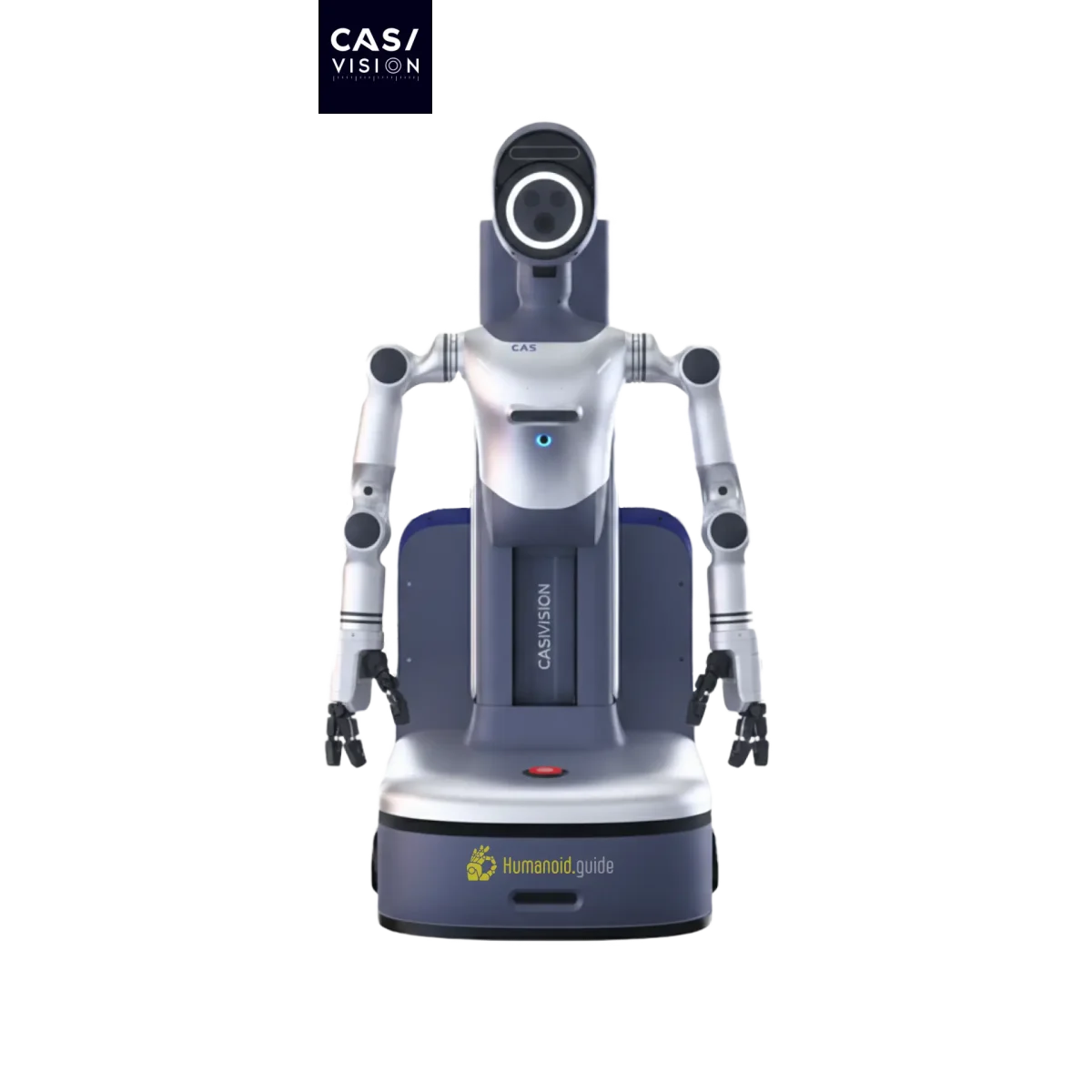
What is the Casivibot?
The CasiVision CASIVIBOT is a vision-first wheeled humanoid service robot developed by Chinese company CasiVision. Standing 140 cm tall and weighing 55 kg, it features a distinctive design with a torso-mounted touchscreen, two articulated arms with 2-finger grippers, and a wheeled mobile base. The robot is equipped with industrial CPU and embedded GPU (likely NVIDIA Jetson class), RGB-D cameras, and a Linux-based ROS operating system. With 14 degrees of freedom overall and a payload of 10 kg, it is designed for indoor environments like hospitals, hotels, and commercial spaces where it can perform tasks such as guiding, delivery, and light manipulation. Its wheeled platform allows for a max speed of 3.5 km/h, making it suitable for smooth floor navigation.
Specifications
Here are the full technical specifications.
| Spec | Value |
|---|---|
| Height | 140 cm |
| Weight | 55 kg |
| Degrees of freedom | 14 |
| Battery life | 8 hours |
| Max speed | 3.5 km/h |
| Payload | 10 kg |
| Price (new) | $29,000 |
| Price (used range) | ~$20,000–$25,000 (est.) |
Price & Value
New MSRP: $29,000
Used range: ~$20,000–$25,000 (est.)
At $29,000, the CASIVIBOT sits in a competitive sweet spot for a wheeled humanoid service robot with real arm manipulation. It undercuts more advanced bipedal humanoids (typically over $100,000) while offering far more physical capability than interaction-only robots like SoftBank’s Pepper (~$20,000) or kiosk-style bots like UBTECH’s Cruzr (~$15,000). Its 10 kg payload and 8-hour runtime make it suitable for real-world shift work, reducing the need for mid-day recharging. As a relatively new entrant with limited brand recognition, depreciation may be steeper than established names—used units currently sell for $20,000–$25,000 on specialist platforms. Ongoing ownership costs are moderate: the IP20 rating means indoor-only use, and the ROS environment allows for community-driven software support, potentially lowering integration expenses.
Who Is It For?
Best for: - Healthcare and hospitality facilities needing an indoor service robot with arm-based delivery and navigation (10 kg payload, 8-hour battery) - Research labs exploring vision-based human-robot interaction and manipulation in a controllable indoor environment (ROS-based, likely NVIDIA Jetson compute)
Not for: - Heavy industrial tasks or outdoor environments (no weather sealing, IP20 rating, wheeled base limited to smooth floors) - High-speed logistics or large-facility patrol (maximum 3.5 km/h wheeled speed, no stair-climbing capability)
Alternatives & Comparison
The wheeled humanoid service robot market offers several options under $30,000, but few combine mobility, arm manipulation, and an open ROS stack like the CASIVIBOT.
| Model | Price | Available | Key Difference |
|---|---|---|---|
| SoftBank Robotics Pepper | ~$20,000 | yes | No arms; speech-first interaction without physical manipulation |
| UBTECH Cruzr | ~$15,000 | yes | Limited arm DOF; primarily a mobile display and navigation kiosk |
Verdict: If your deployment demands object handling—delivering items, pushing buttons, opening doors—the CASIVIBOT easily outperforms both Pepper and Cruzr. It’s the only sub‑$30k wheeled humanoid that includes real 2‑finger grippers and a 10 kg payload. However, if your use case is purely conversational or screen‑based, Pepper’s established ecosystem and lower price may be the more cost‑effective choice. For labs that want a manipulator on a wheeled base with full ROS access, the CASIVIBOT is currently unmatched at this price.
Use Cases & Capabilities
Healthcare Assistance
In hospitals or elder-care facilities, the CASIVIBOT can navigate corridors to deliver medications, meals, or lab samples up to 10 kg. Its 8-hour battery covers a full nursing shift, and the torso touchscreen doubles as a patient-facing interface for wayfinding or teleconsultation. The 2-finger grippers allow it to open cabinet doors or push elevator buttons, while its vision‑first sensor suite provides safe human-aware navigation. Limitations include IP20 rating—it must stay indoors and away from contaminants—and the wheeled base cannot climb stairs without a ramp.
Hospitality & Retail
Hotels, restaurants, and shopping malls can deploy the CASIVIBOT as a concierge, food runner, or roving information kiosk. Its compact 140 cm height is unintimidating for guests, and the navy-blue and white design suits modern commercial interiors. The robot can carry trays or light packages, freeing staff from repetitive transport tasks. With a maximum speed of 3.5 km/h, it moves at a comfortable walking pace among people, and the RGB‑D cameras support robust obstacle avoidance. It cannot operate outdoors in rain or on cobblestones, and its manipulation is limited to objects within the 10 kg payload.
Research & Education
University labs and corporate R&D teams benefit from the CASIVIBOT’s open Linux‑ROS ecosystem and probable Jetson GPU, enabling rapid prototyping of vision‑based behaviors and manipulation algorithms. At $29,000, it is one of the most affordable full‑body humanoid platforms with arms available—making it accessible for grant‑funded projects. The wheeled base simplifies navigation research, avoiding the complexity of bipedal balance while still offering a humanoid‑style interaction. Students can safely test HRI applications thanks to its human‑safe design, and the standard ROS middleware means existing codebases can often be ported with minimal modification.
History & Background
CasiVision emerged as a robotics startup in China, specializing in humanoid service robots. The CASIVIBOT was first revealed in 2024, marking the company’s entry into the commercial robotics market. Unlike many Chinese humanoids that focus on bipedal locomotion, CasiVision opted for a wheeled platform to ensure reliability and cost efficiency. The robot’s development emphasized vision‑first capabilities, likely leveraging NVIDIA Jetson modules for AI processing. By 2025, units began appearing in hospitals and hotels across China. The manufacturer’s website (zhongkehuiyuan.com) lists it as an active product, and third‑party distributors like MERA Robotics have offered it internationally. No major generational update has been announced yet, though the platform continues to be sold as a current model.
Buying Used — What to Check
Battery cycle count Lithium batteries degrade with use; an 8-hour robot with hundreds of cycles may only deliver 5–6 hours. Ask for a diagnostic log showing current full-charge capacity.
Arm and gripper wear The 2-finger grippers and harmonic/planetary gears can develop backlash or loose joints after heavy payload cycles. Inspect for repeatability and listen for unusual noise during slow articulation.
ROS system version Older firmware or a locked-down ROS distribution may limit your ability to deploy custom code. Verify that the robot ships with a current, standard ROS environment and any necessary NUC/GPU drivers.