What is the Casivision Casivibot?
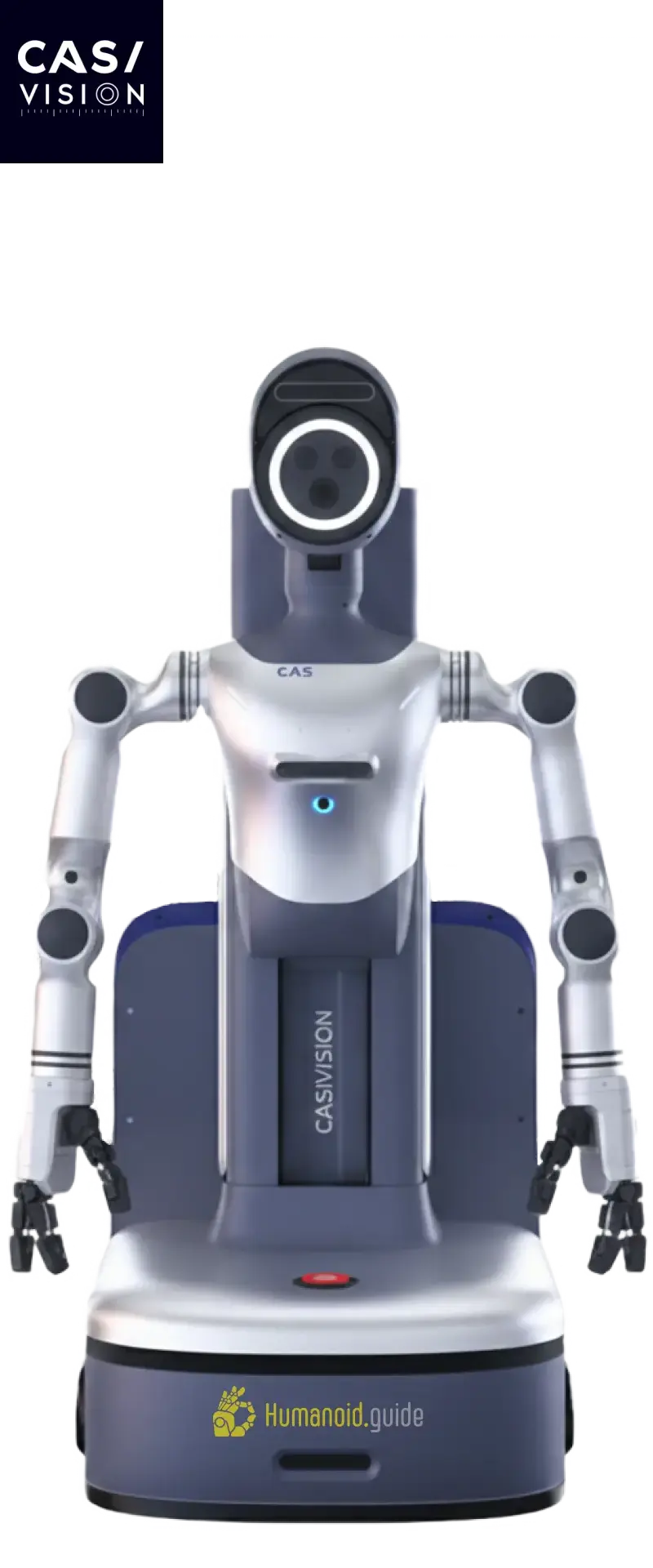
The CasiVision CASIVIBOT is a wheeled humanoid service robot designed for indoor environments. Manufactured by Chinese robotics firm CasiVision, it combines a mobile wheeled base with an upper-body torso, two articulated arms, and a vision-centric sensor suite. The robot targets healthcare, hospitality, industrial service, and research applications, where it can assist with light material transport, patient interaction, and lab automation. Its 14 degrees of freedom, split between the arms and a pan-tilt head, enable dexterous manipulation of objects up to 10 kg. The platform runs on an embedded Linux-ROS stack with industrial-grade computing, offering a 3.5 km/h maximum speed and IP20 dust protection. It communicates via Bluetooth, Ethernet, and Wi‑Fi, and its white, grey, and navy blue ABS composite body provides a clean, approachable appearance.
Specifications
Here are the full technical specifications.
| Spec | Value |
|---|---|
| Height | 140 cm |
| Weight | 55 kg |
| Degrees of freedom | 14 |
| Battery life | 8 hours |
| Max speed | 3.5 km/h |
| Payload | 10 kg |
| Price (new) | $29,000 |
| Price (used range) | $25,000–$29,000 |
Price & Value
New MSRP: $29,000
Used range: $25,000–$29,000
The CASIVIBOT is listed at a flat $29,000 USD, positioning it above delivery-only robots like the $15,000 UBTECH Cruzr or $20,000 Pudu BellaBot, but below full humanoids. This pricing reflects its dual-arm manipulation capability and ROS-based openness, which adds value for custom integration. In a commercial fleet, the main ongoing costs are battery replacements (approximately every 2–3 years) and software support; the unit is not likely to depreciate sharply because of niche demand, but early buyers may find limited third-party service options. Compared to purchasing separate mobile bases and collaborative arms, the CASIVIBOT’s all-in-one design offers a simpler – though less modular – solution. For organizations already using CasiVision’s software ecosystem, the robot integrates more seamlessly than competing brands. Overall, it represents a mid-range investment for service robots with arms.
Who Is It For?
Best for: - Hospitals seeking a mobile assistant for patient transport and light supplies delivery with 10 kg payload - Research institutions that need a ROS-native wheeled manipulation platform for indoor robotics studies - Hotels and retail spaces where a humanoid presence improves customer engagement while moving items
Not for: - Outdoor or rough-floor deployment (IP20 rating, 3.5 km/h max speed) - Budgets under $20,000 – cheaper arm-less alternatives exist - High-speed or safety-critical tasks requiring fail-safe collision avoidance
Alternatives & Comparison
The CasiVision CASIVIBOT sits in a competitive landscape of indoor service robots, but most alternatives lack its arm-equipped form factor.
| Model | Price | Available | Key Difference |
|---|---|---|---|
| UBTECH Cruzr | $15,000 | yes | Smaller humanoid service robot without wheeled base, no gripper arms, lower payload. |
| Pudu BellaBot | $20,000 | yes | Delivery robot with shelves, no arms, primarily food service. |
Verdict: If your workflow depends on physically manipulating objects—such as picking up items, pressing elevator buttons, or handing over supplies—the CASIVIBOT is the clear choice in this price bracket. For simple delivery tasks, the Pudu BellaBot’s shelf system and lower price represent better value. The UBTECH Cruzr is more affordable but cannot manipulate at all, making it suitable only for information-display roles.
Use Cases & Capabilities
Healthcare Assistance
In a hospital or elder care facility, the CASIVIBOT can shuttle medications, lab samples, and linens between stations using its 10 kg payload arms and wheeled base. Its 2-finger grippers allow it to open lightweight doors or press buttons, reducing staff workload for repetitive courier tasks. The robot’s 8-hour runtime covers a typical nursing shift, and its humanoid appearance can be less intimidating to patients than a purely functional cart. However, the IP20 rating means it cannot be used in wet areas without extra protection, and infection control protocols would require regular wipe-downs.
Hospitality Service
Hotels and conference centers deploy the CASIVIBOT to greet guests, deliver room service items, and provide information. The vision-first sensor suite, likely including 1080p RGB and depth cameras, enables safe navigation around people and furniture. Its 140 cm height gives it an approachable yet noticeable presence, while the white-grey-navy color scheme fits modern lobbies. The robot’s arms can hand out brochures or hold a tablet for guest check-ins, though actual room service delivery may require specially sized trays and careful programming to avoid spills.
Industrial and Commercial Service
In factory or warehouse settings, the CASIVIBOT can transport small parts, tools, or documentation between workstations. The harmonic/planetary gear servomotors provide precise, repeatable motions for pick-and-place tasks within its 10 kg limit. Its ROS environment allows integration with manufacturing execution systems, and the wheeled base moves at 3.5 km/h along defined paths. However, the lack of waterproofing and relatively low speed rules out heavy-load outdoor logistics, and the IP20 rating limits deployment to clean, dry floor areas.
Research and Development
Robotics labs and universities value the CASIVIBOT for its combination of a mobile base and dexterous arms, all running on a standard Linux-ROS stack. Researchers can quickly prototype navigation and manipulation algorithms without assembling hardware from separate vendors. The industrial CPU plus embedded NVIDIA Jetson-class GPU provides enough compute for onboard SLAM and vision processing. The robot’s IP20 construction is acceptable for benchtop experiments, and its payload is adequate for typical lab automation tasks like sample handling or tool delivery.
Education and Training
Technical colleges and corporate training centers use the CASIVIBOT to teach robotics, AI, and human-robot interaction. The ROS-based system and likely NVIDIA Jetson module give students a real-world platform to program perception, path planning, and manipulation. The 10 kg payload allows for lab-scale payload handling exercises, while the safe-human-interaction design ensures it can operate in classrooms. The robot’s relatively low cost compared to fully humanoid platforms makes it accessible for departmental budgets seeking a hands-on teaching tool.
History & Background
CasiVision, a Chinese robotics manufacturer operating through the web domain en.zhongkehuiyuan.com, first publicly unveiled the CASIVIBOT in 2024. The company markets the robot as a ‘vision-first’ entrant into the service robotics space, emphasizing camera-based sensing and AI. Little is known about the firm’s background; it may be a division of the broader Zhongke Huiyuan group. The CASIVIBOT itself appears to be the brand’s debut product, with no earlier generations documented. Since its launch, the robot has been listed on industry databases like humanoid.guide and MERA Robotics, suggesting an active albeit low-profile sales effort. As of 2026, the unit remains in production and is available for order directly from CasiVision, though no large-scale deployment announcements have been made.
Buying Used — What to Check
Verify battery health Battery degradation directly impacts the 8-hour runtime; replacement can be costly without official service channels.
Inspect gripper wear The 2-finger claws are the primary wear items and may lose calibration after heavy use.
Confirm software license transfer The ROS environment may include proprietary packages that require reactivation upon ownership change.