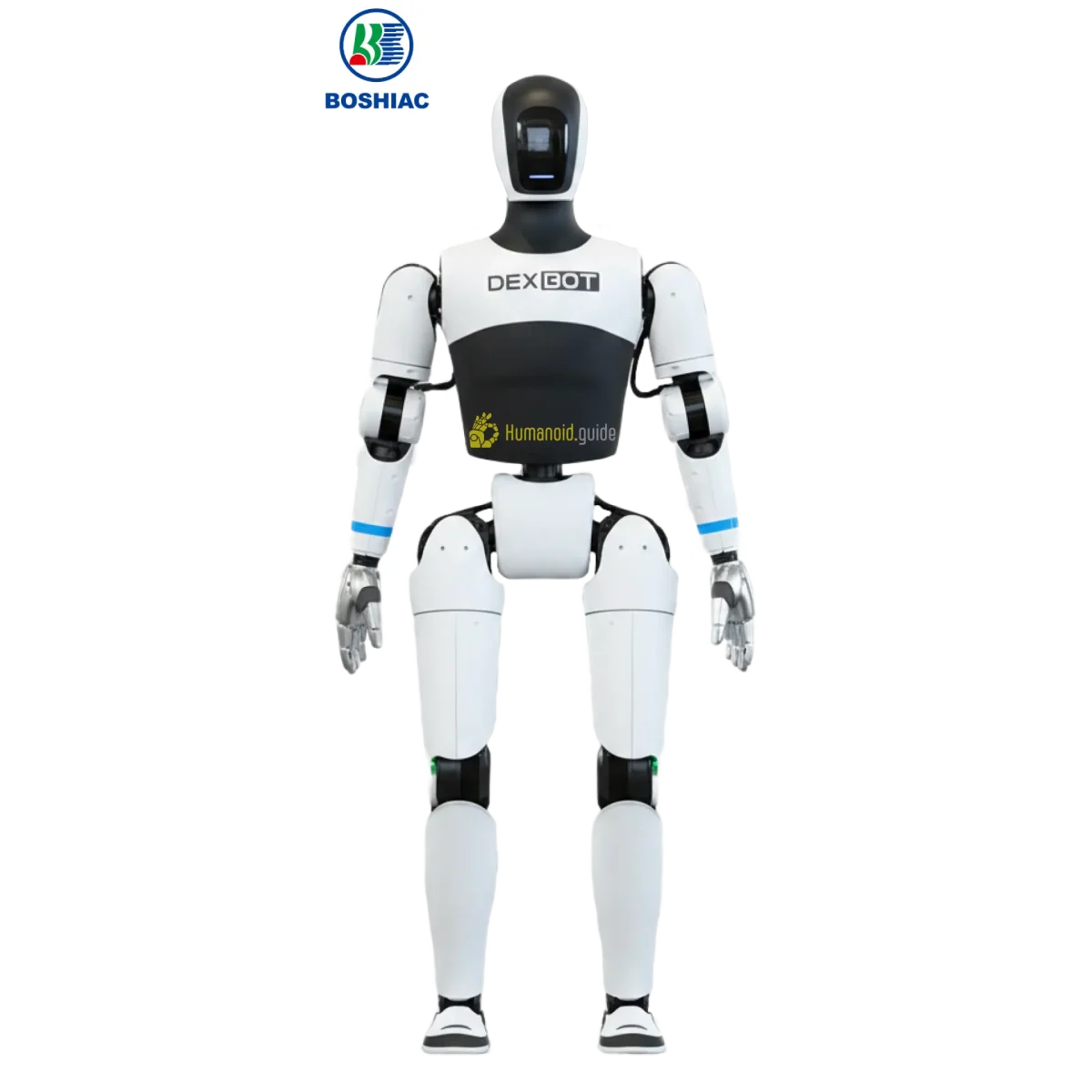
What is the Dexbot Boshiac?
The DexBot Boshiac is a full-size humanoid robot developed by BOSHIAC, a robotics company based in Harbin, China, in collaboration with Harbin Institute of Technology. Designed for industrial automation and logistics, it features a dual-arm, bipedal form factor with an estimated 50 degrees of freedom and dexterous five-fingered hands. The robot stands 160 cm tall, weighs 80 kg, and can walk at speeds up to 3 km/h. Its payload is reported at 15 kg, making it suitable for light material handling. The platform runs a Linux-based operating system with ROS framework and supports onboard compute for edge AI. As of 2026, the DexBot Boshiac remains a pre-commercial research prototype without an official price or release date.
Specifications
Here are the full technical specifications.
| Spec | Value |
|---|---|
| Height | 1600 mm |
| Weight | 80 kg |
| Degrees of freedom | 50 (est.) |
| Battery life | 3 hours |
| Max speed | 3 km/h |
| Payload | 15 kg |
| Price (new) | Undisclosed |
| Price (used range) | N/A |
Price & Value
New MSRP: Undisclosed (contact manufacturer)
Used range: N/A
As a research prototype, the DexBot Boshiac has no commercial pricing. When it eventually reaches market, pricing will likely be in the high six-figure range typical of full-size humanoids like the UBTECH Walker S or Fourier GR-1, but that is speculative. Without a price, value comparisons are impossible; however, the low published payload of 15 kg suggests it would be positioned for light industrial tasks. Used units do not exist, so depreciation is not applicable. For now, interested parties should contact BOSHIAC directly for collaboration or research partnership opportunities. Given its early stage, total cost of ownership including maintenance, software, and integration is unknown. Any potential buyer should verify actual performance and safety certifications as the robot progresses toward commercialization.
Who Is It For?
Best for: - Industrial research labs developing bipedal manipulation algorithms (50 DOF enables complex motion studies). - Academic robotics groups needing a humanoid platform for human-robot interaction studies. - Manufacturing pilot programs testing humanoid robots for light assembly assistance (15 kg payload).
Not for: - High-payload industrial tasks (only 15 kg payload; competitors offer up to 50 kg). - Deployment-ready warehouse automation (no certified safety or reliability data). - Budget-constrained projects (no pricing available and expected to be expensive).
Alternatives & Comparison
Although the DexBot Boshiac is still a prototype, it competes for attention with other emerging full-size humanoids targeting industrial research niches.
| Model | Price | Available | Key Difference |
|---|---|---|---|
| UBTECH Walker S | ~$150,000 (est.) | preorder | Commercially oriented with integration into smart factories and higher payload. |
| Fourier GR-2 | ~$150,000 (est.) | available | Higher payload (50 kg) and full-body agility for heavy industrial tasks. |
| Xiaomi CyberOne | Undisclosed | no | Consumer-oriented brand, also a prototype but with less dexterous hands. |
Verdict: The DexBot Boshiac's focus on dexterous manipulation with high-DOF hands could give it an edge in precision assembly tasks, but its low payload and pre-commercial status put it behind competitors like the Fourier GR-2, which offers more capability. If you need a research platform for advanced hand studies, DexBot might be worth watching, but for real industrial deployment, the Walker S or GR-2 are nearer-term options.
Use Cases & Capabilities
Industrial Material Handling
The DexBot Boshiac can pick and place parts weighing up to 15 kg using its dexterous five-fingered hands. Its 50 DOF enable complex manipulation tasks such as aligning components or sorting mixed objects. The bipedal design allows it to move between workstations in a factory. However, the 3-hour battery life may require mid-shift charging. As a prototype, reliability and speed are still unproven, and integration effort would be significant.
Assembly Line Assistance
With high-DOF hands and tactile sensing capabilities, the robot could perform delicate assembly tasks like cable insertion or small parts fastening. Its 160 cm height and 80 kg weight make it small enough to work alongside humans safely, though its IP20 rating limits environmental ruggedness. The prototype stage means safety certifications like ISO 10218 are not yet obtained. Future iterations may improve precision and repeatability for real production lines.
Humanoid Robotics Research
Universities and corporate R&D labs can use the DexBot Boshiac to develop whole-body control algorithms, test advanced grasping strategies, and study human-robot collaboration. The ROS-based Linux OS provides an open platform for customization and integration with external sensing. Battery runtime may limit continuous experiments, but the robot's modular design may allow future upgrades. Being unvalidated, researchers should plan for significant integration effort and potential hardware modifications.
History & Background
BOSHIAC, a robotics startup based in Harbin, China, emerged from the industrial automation sector and partnered with the renowned Harbin Institute of Technology (HIT) to develop humanoid robots. The DexBot Boshiac platform was first unveiled in 2024, showcasing dexterous manipulation capabilities with 12+ DOF hands. The robot was designed to target industrial logistics and manufacturing applications, emphasizing precision over raw payload. As of 2026, the DexBot remains in the prototype stage, with no commercial release date announced. Limited public demonstrations have been recorded, and technical specifications remain partially speculative. The company continues development, potentially aiming for a market-ready version in the coming years.
Buying Used — What to Check
Verify payload rating Payload is critical for material handling tasks; 15 kg reported but unconfirmed.
Inspect battery health Used units may have degraded batteries; 3-hour runtime is already limited.
Check safety certifications Prototype may lack ISO 10218 or collaborative safety ratings, impacting real-world deployment.