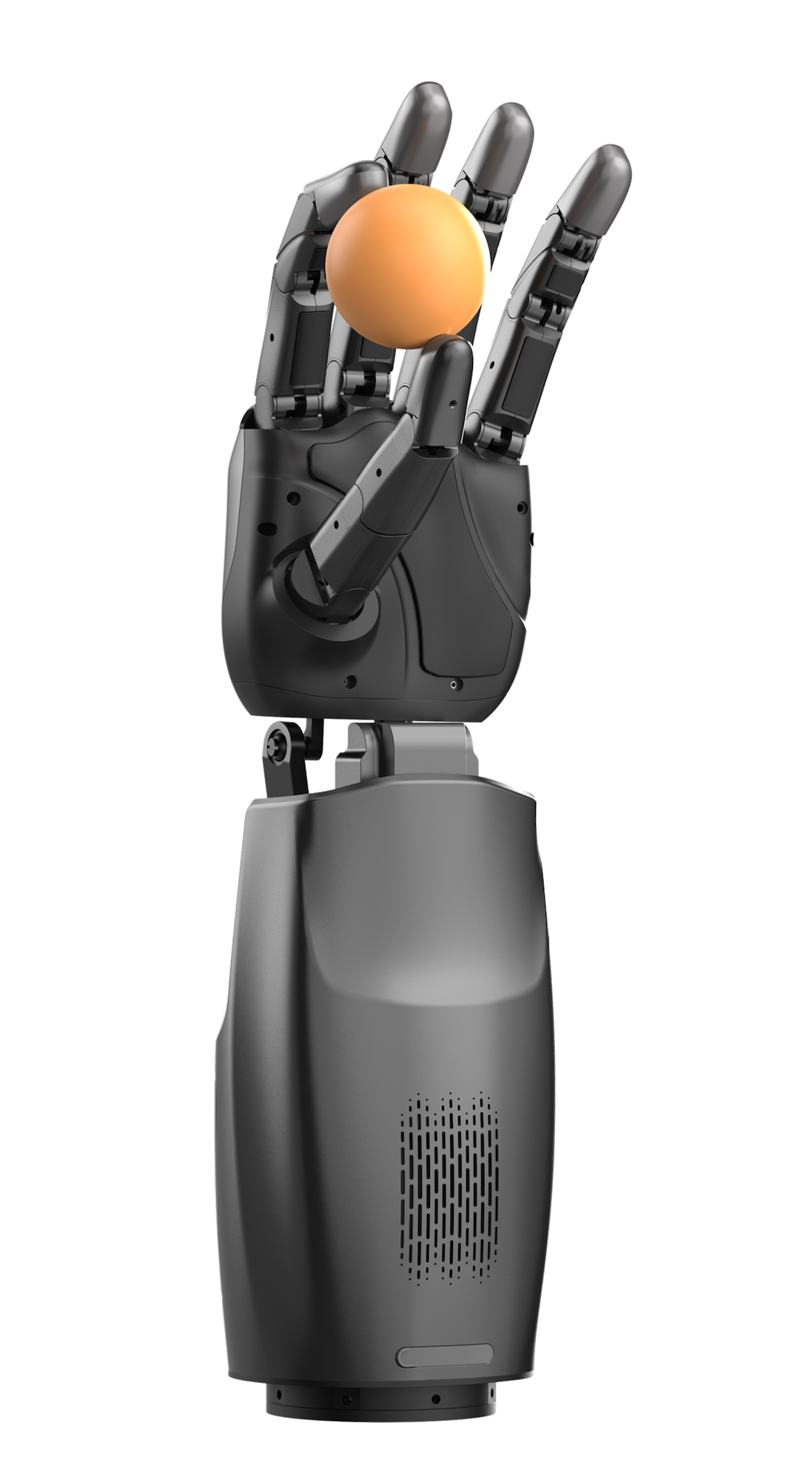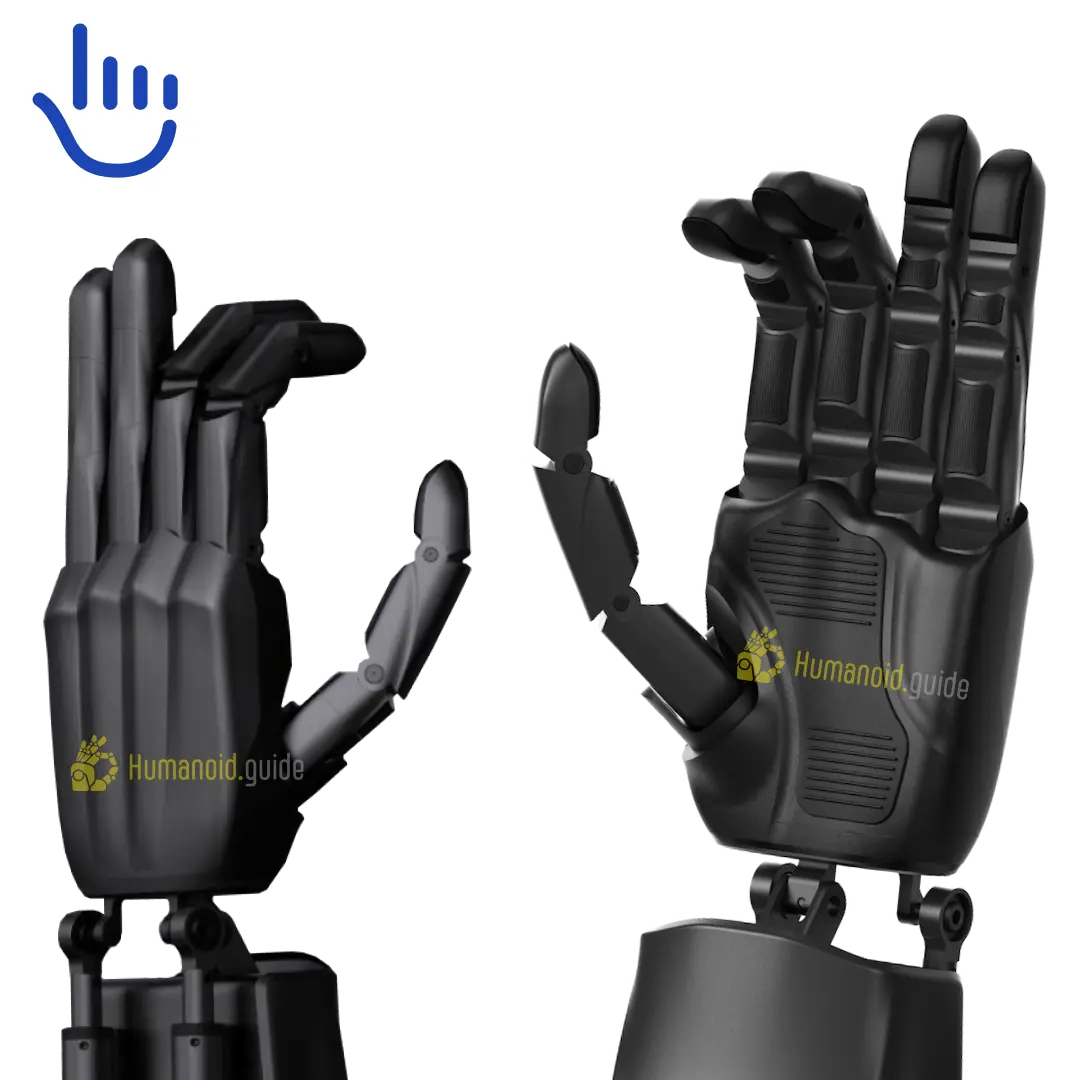
What is the Dexmano D22 Pro?
The DexMano D22-PRO is a five-fingered humanoid robotic hand developed by Botyard Intelligence, a Chinese robotics company. It utilizes an artificial tendon-driven actuation system to achieve 22 degrees of freedom, enabling human-like dexterity and precise force control. The hand incorporates tactile and force sensors for feedback, making it suitable for dexterous manipulation tasks such as object grasping, surgical training, and prosthetic research. Weighing 1.8 kg and measuring 18–22 cm in length, it is designed to be mounted on various robotic arms. The D22-PRO is currently in production and available for commercial purchase, offering a mid-range price point in the dexterous hand market.
Specifications
Here are the full technical specifications.
| Spec | Value |
|---|---|
| Height | 18–22 cm length |
| Weight | 1.8 kg |
| Degrees of freedom | 22 |
| Battery life | 0 hours (tethered) |
| Max speed | N/A |
| Payload | 8 kg |
| Price (new) | $30,000 |
| Price (used range) | $20,000 – $28,000 (est.) |
Price & Value
New MSRP: $30,000
Used range: $20,000 – $28,000 (estimated)
At $30,000 new, the D22-PRO occupies a competitive niche in the dexterous hand market, offering 22 DOF and integrated sensing at a fraction of the cost of the $90,000 Shadow Dexterous Hand. Used units typically trade between $20,000 and $28,000, reflecting reasonable depreciation for a specialized robotic end-effector. Total cost of ownership remains predictable, but buyers must factor in custom mounting adapters for specific robot arms and the tethered power requirement, which necessitates a fixed DC supply. Compared to simpler adaptive grippers from Robotiq or QB Robotics priced around $25,000–$28,000, the D22-PRO provides dramatically higher dexterity, justifying the modest price premium for research and precision automation. Overall, the hand delivers strong value for labs requiring realistic finger motion without the budget for pneumatically actuated alternatives.
Who Is It For?
Best for: - University robotics labs (22 DOF and tactile sensing enable advanced dexterous manipulation research) - Prosthetics R&D teams (five-finger anthropomorphic design suitable for testing control algorithms) - Industrial automation integrators (8 kg grip force for light assembly and pick-and-place tasks) - Surgical training centers (realistic hand motion for instrument handling and suturing simulation) - Humanoid robot developers (high-DOF end-effector for teleoperation and human-robot interaction)
Not for: - Heavy manufacturing (maximum payload only 8 kg, insufficient for moving heavy parts) - Mobile untethered applications (requires wired power, no onboard battery for portable use)
Alternatives & Comparison
The DexMano D22-PRO competes against several established robotic hands, each targeting different trade-offs between dexterity, cost, and simplicity.
| Model | Price | Available | Key Difference |
|---|---|---|---|
| Shadow Dexterous Hand | $90,000 | yes | Pneumatic actuation, extremely high dexterity but triple the cost |
| Robotiq 3-Finger Adaptive Gripper | $25,000 | yes | 3-finger underactuated design, far fewer DOF, simpler grasping |
| QB SoftHand | $28,000 | yes | Soft compliant structure, 1 DOF control, much lower dexterity |
| ReFlex Hand | $25,000 | yes | 4-finger underactuated hand, fewer sensors and degrees of freedom |
Verdict: For researchers needing the highest dexterity under $30,000, the D22-PRO is the standout choice — its 22 DOF, tendon-driven fingers, and tactile feedback outclass similarly priced grippers. If budget is no constraint and ultra-smooth motion is paramount, the Shadow Dexterous Hand remains the pinnacle. However, for labs prioritizing affordability without sacrificing realistic hand kinematics, the D22-PRO represents the best value on the market today.
Use Cases & Capabilities
Dexterous Manipulation Research
The D22-PRO’s 22 degrees of freedom and tendon-driven actuation make it ideal for studying human-like grasping and manipulation. Researchers can test control algorithms for precision tasks such as picking up delicate objects, using tools, and performing in-hand manipulation. The integrated tactile and force sensors provide rich feedback data for training machine learning models. Its anthropomorphic design allows seamless transfer of insights to prosthetic hands and humanoid robots. At $30,000, it enables labs to outfit multiple workstations without the prohibitive cost of pneumatic alternatives, accelerating experiment throughput.
Prosthetics Development
With five fingers and human-scale dimensions, the D22-PRO serves as a testbed for advanced prosthetic control systems. The force and tactile sensing allow closed-loop feedback critical for amputee trials. Its lightweight 1.8 kg build can be mounted on socket simulators for realistic evaluation. Researchers can develop myoelectric or neural interface algorithms and validate them in real time. The modular design facilitates replacement of individual fingers and tendons, lowering long-term testing costs compared to monolithic hands.
Industrial Light Automation
The D22-PRO’s 8 kg grip strength and fine motor control suit light assembly lines, packaging, and quality inspection. Its ability to handle varied objects with delicate force prevents damage to fragile components. The hand can be integrated with collaborative robot arms from Universal Robots or FANUC, though custom mounting interfaces may be needed. Tethered operation is acceptable in fixed factory setups with accessible power. The hand reduces the need for custom tooling, offering flexibility for high-mix, low-volume production environments.
Surgical Training and Simulation
Medical institutions use the D22-PRO for realistic surgical skills training, such as suturing and instrument handling. The 22-DOF finger dexterity closely mimics human hand movements, providing trainees with haptic feedback via force sensors. Its small size and low weight allow mounting on patient simulators without altering balance. The hand can be programmed to replicate various pathologies for standardized training scenarios. At $30,000, it is cost-effective compared to dedicated medical training robots, which often exceed $100,000.
Teleoperation and Humanoid Robotics
As an end-effector for humanoid robots, the D22-PRO enables remote manipulation in hazardous environments. Operators can control the hand via glove interfaces or motion capture, leveraging its 22 DOF for intuitive telepresence. The tactile sensors relay grip pressure back to the user, enhancing situational awareness. Its tethered design suits controlled environments like nuclear decommissioning or explosive ordnance disposal. The hand’s compatibility with standard arm mounts simplifies integration into existing humanoid platforms, reducing deployment time.
Education and STEM Outreach
The D22-PRO’s realistic hand motion and sensor feedback make it an engaging platform for university robotics courses. Students can program grasp patterns and force control algorithms on a physical hand, bridging theory and practice. Its moderate cost allows departments to acquire multiple units for lab exercises, encouraging hands-on learning. The hand’s durability and modular design facilitate exploration of tendon-driven mechanisms and sensor integration. Combined with open-source software, it provides a comprehensive introduction to dexterous manipulation in academic settings.
History & Background
Botyard Intelligence, a Chinese robotics company, developed the DexMano D22-PRO to address the demand for affordable, high-dexterity robotic hands. While the exact release year is not publicly documented, the hand is actively listed as in production and available for purchase through the company’s website. It represents Botyard’s core focus on artificial tendon-driven actuation, which balances mechanical complexity with cost efficiency. The D22-PRO likely evolved from earlier DexMano prototypes, incorporating 22 degrees of freedom and integrated tactile and force sensing. As of 2026, it remains one of the few commercially available dexterous hands priced under $30,000, positioning Botyard Intelligence as a competitive alternative to established players like Shadow Robot Company. The hand continues to serve research labs, prosthetic developers, and industrial integrators worldwide.
Buying Used — What to Check
Inspect tendon and actuator wear Tendon degradation can reduce dexterity and grip force; replacement may be needed if the hand was used intensively.
Test all tactile and force sensors Malfunctioning sensors compromise feedback quality essential for precision manipulation and research data integrity.
Confirm included mounting adapter Custom mounts for specific robot arms may not be included, adding significant cost and lead time to integration.