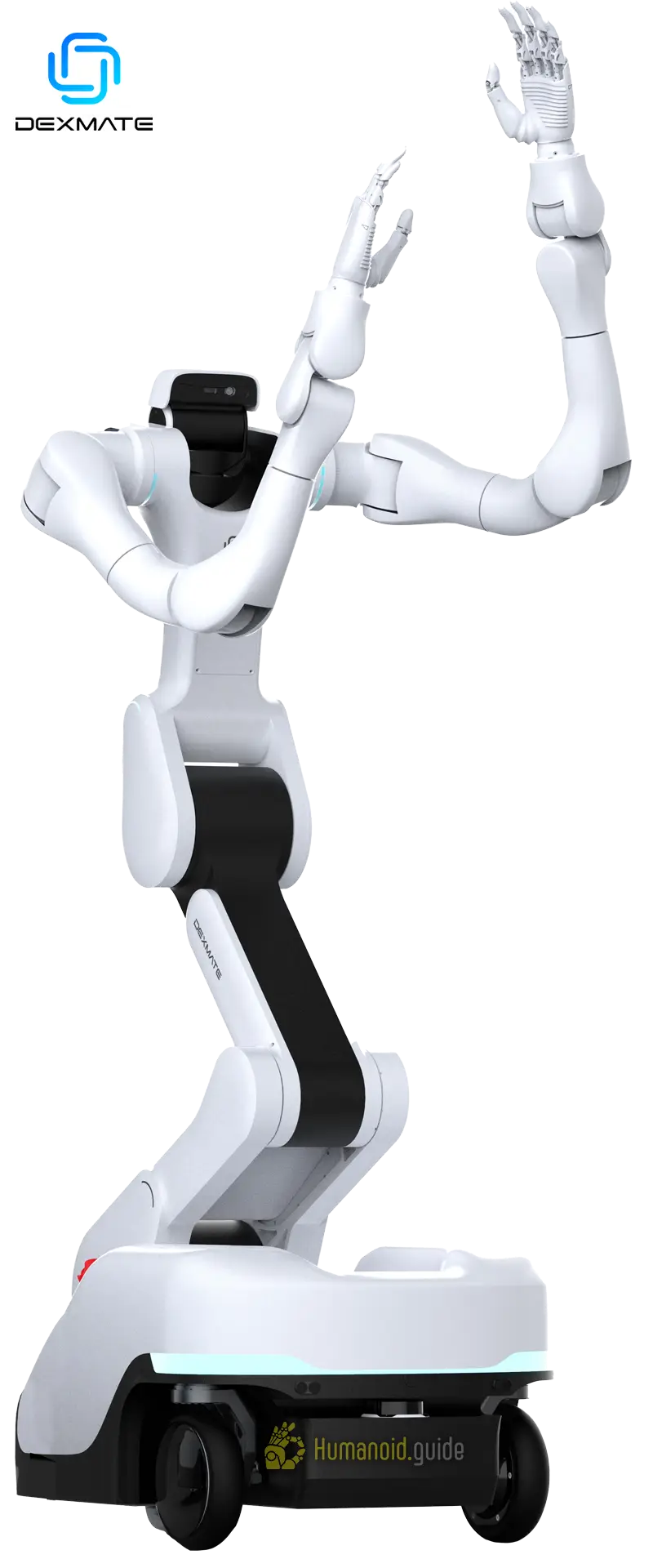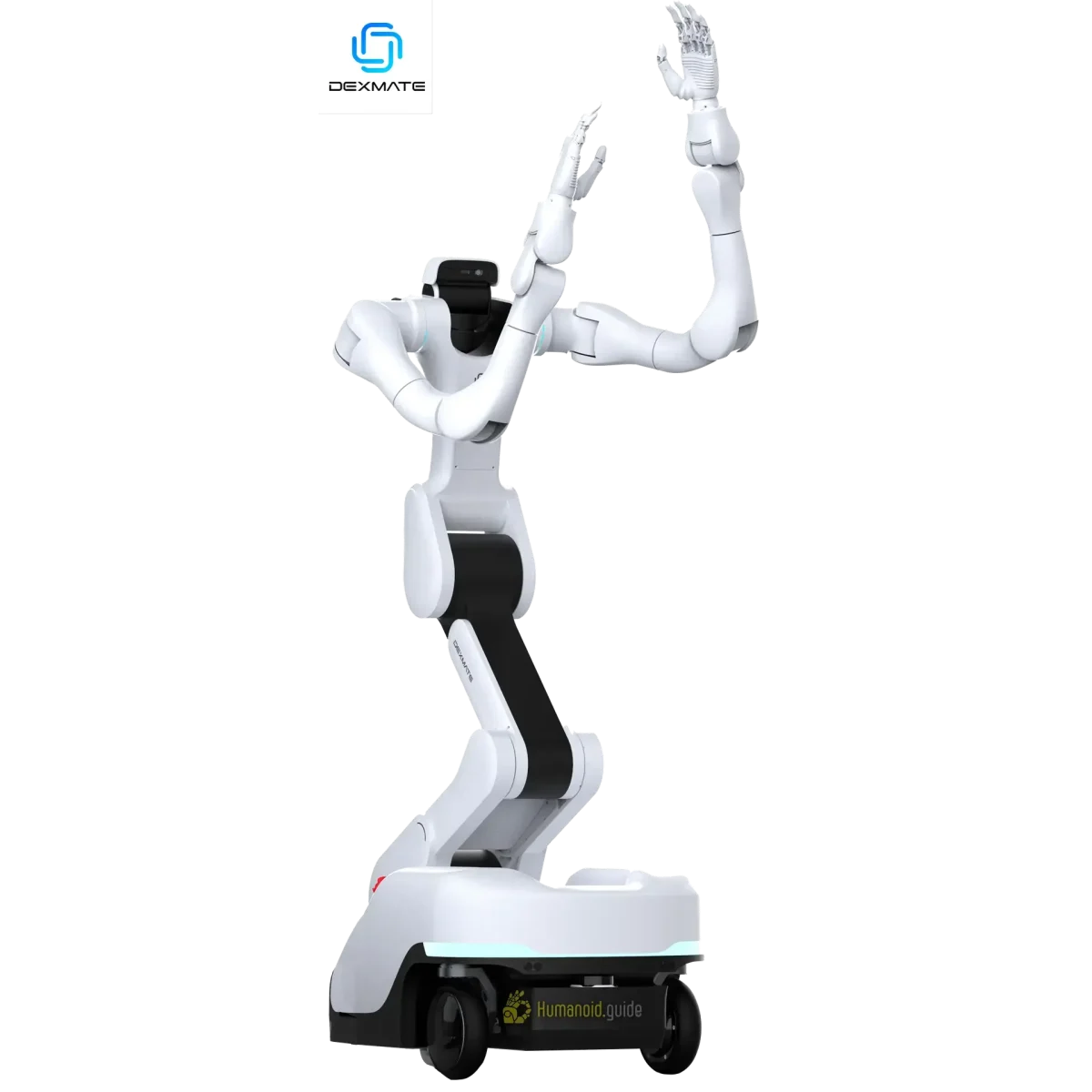
What is the Dexmate Vega?
The Dexmate Vega is a full-size humanoid robot developed by Dexmate, a US-based robotics startup with team members from MIT, CMU, UCSD, Nvidia, TRI, and other top institutions. It is designed for precise dexterity in industrial automation and R&D settings, featuring 36 total DOF including 12 in its two 5-fingered hands. Standing 171 cm tall and weighing 135 kg, it moves at up to 4 km/h on an omnidirectional wheeled base, not bipedal walking. Its compute runs on Intel x86 and Nvidia Jetson, with Linux OS and LLM integration for intelligent task handling. Brushless motors with harmonic gear reduction drive the joints, and it is rated safe for human collaboration. The robot targets sorting, assembly, and manipulation tasks requiring fine motor control.
Specifications
Here are the full technical specifications.
| Spec | Value |
|---|---|
| Height | 171 cm |
| Weight | 135 kg |
| Degrees of freedom | 36 |
| Battery life | 20 hours |
| Max speed | 4 km/h |
| Payload | 15 kg |
| Price (new) | $80,000 |
| Price (used range) | N/A (pre-commercial) |
Price & Value
New MSRP: $80,000
Used range: N/A
At $80,000, the Dexmate Vega sits in the mid-range for full-size humanoids, undercutting the Unitree H1 ($90k) but above the Fourier GR-2 ($55k). Its cost reflects a focus on advanced dexterity (12-DOF hands, 10 fingers) and high-quality harmonic drive actuation, suitable for precision tasks. Since the Vega is still in development, buyers are likely to purchase directly from the manufacturer on a project basis, with no secondary market yet. Depreciation remains unclear as no used units circulate, but enterprise support and software updates will be critical to long-term value. Comparing to research-oriented alternatives, the Vega offers a compelling balance of manipulation capability and runtime (20 hours) for labs and pilot production lines. All-in costs will depend on custom integration and tooling.
Who Is It For?
Best for: - Research labs exploring dexterous manipulation (12-DOF hands enable fine motor studies) - Industrial automation pilots requiring precise pick-and-place with 15 kg payload
Not for: - Heavy payload operations (15 kg max, not suited for moving heavy engine parts) - Outdoor or uneven terrain (wheeled base, no IP rating, not bipedal)
Alternatives & Comparison
The Dexmate Vega competes in the burgeoning humanoid market for precise manipulation, facing rivals at various price points and readiness levels.
| Model | Price | Available | Key Difference |
|---|---|---|---|
| Unitree H1 | $90,000 | yes | Bipedal, faster (18 km/h), but less dexterous hands |
| Fourier GR-2 | $55,000 | preorder | Lower cost, 7-DOF hands, less dexterity than Vega |
| Figure 02 | Undisclosed | no | AI-first design, not publicly available |
| Tesla Optimus | Undisclosed | no | Tesla ecosystem integration, not for external sale |
Verdict: For labs and factories needing high dexterity in a stable wheeled platform, the Vega is a strong front-runner, provided you can secure a pilot unit directly from Dexmate. Buyers prioritizing bipedal locomotion should choose the Unitree H1 despite its lower hand dexterity. Budget-constrained teams will find better value in the Fourier GR-2, though it compromises on finger DOF. Both Figure 02 and Tesla Optimus remain unavailable for purchase, making the Vega a tangible option for 2026.
Use Cases & Capabilities
Precision Assembly
The Vega’s 12-DOF hands and 15 kg payload make it ideal for assembling small components in electronics or automotive manufacturing. Its LLM integration allows it to follow complex sequences and adapt to variations, while the 20-hour battery life supports multi-shift operations. The wheeled base provides stability on factory floors, though the lack of bipedal locomotion limits mobility over stairs or rough terrain. Safety features enable close human-robot collaboration on assembly lines.
Laboratory Research
Research institutes studying dexterous manipulation benefit from the Vega’s fully articulated hands and open Linux-based system. It can be programmed for grasping experiments, tool use, and human-robot interaction studies without the complexity of bipedal balancing. High computing power (Intel x86 + Nvidia Jetson) supports real-time vision and AI processing, and the 20-hour runtime ensures full-day experiments with minimal downtime. Researchers can customize its LLM integration for novel task learning.
Quality Inspection
With precise motion control and the ability to wield inspection tools, the Vega excels in visual and tactile quality checks on production lines. Its 10 fingers can handle delicate parts and probes, and the robot can navigate between stations using its omnidirectional wheeled base. As it is safe for human proximity, it can share workspaces with operators, reducing the need for fencing. The 15 kg payload is adequate for holding measurement equipment, and the long battery life supports continuous scanning of batches.
Pharmaceutical Handling
In pharmaceutical labs, the Vega’s dexterous hands can manipulate vials, pipettes, and labware with contamination-free repeatability. Its 20-hour battery allows for extended sessions of sample preparation or sorting, while its LLM integration interprets high-level commands like ‘prepare 96-well plate.’ The robot’s aluminium structure is easy to clean, and its wheeled base navigates smooth lab floors safely. Though lacking a cleanroom certification, it can operate in controlled environments with appropriate protocols.
Electronics Manufacturing
The Vega is suited for handling small electronic components such as PCBs, connectors, and sensors, thanks to its fine finger control and brushless motor precision. It can work alongside human technicians on assembly lines, reducing errors in tasks like wire routing or screw fastening. Its compute platform can integrate with manufacturing execution systems via Ethernet and WiFi, and the 4 km/h speed covers typical workstation ranges efficiently. The lack of ingress protection means it should be kept in dry, clean production areas.
Academic Dexterity Research
Universities focusing on robotics and AI can use the Vega as a research platform for advanced grasping and in-hand manipulation. Its 12-DOF hands allow exploration of complex finger gaits and tool manipulation, while the Linux OS and LLM integration enable students to develop custom control architectures. The robot’s wheeled mobility simplifies navigation in indoor labs, and its safety rating makes it appropriate for supervised human-robot interaction studies. Compared to custom-built research hands, the Vega offers a turnkey solution with industrial-grade reliability.
History & Background
Dexmate emerged from a team with backgrounds at MIT, CMU, UCSD, Nvidia, TRI, OSU, UMich, and INSEAD, likely founded in 2023 or 2024 to pursue humanoid robotics. The Vega was first built in 2024, targeting industrial automation and R&D with a unique emphasis on dexterity over bipedal walking. Unlike many humanoids, it adopts a wheeled omnidirectional base for stability and simplicity in factory settings. The robot’s initial reveal attracted interest from the research community, and by 2026 it remains in active development with pilot deployments possible. Dexmate continues to refine the platform, accepting inquiries via its website for custom use cases and partnerships. No generational variants have been announced, and the Vega remains the company’s sole product as it scales toward broader availability.
Buying Used — What to Check
Verify real-world battery runtime The 20-hour claim may be under ideal conditions; actual workload will affect duration.
Inspect harmonic gears and motors These are critical to dexterity and payload; wear could degrade precision.
Confirm software licensing LLM integration and OS may require active subscriptions or updates for ongoing use.