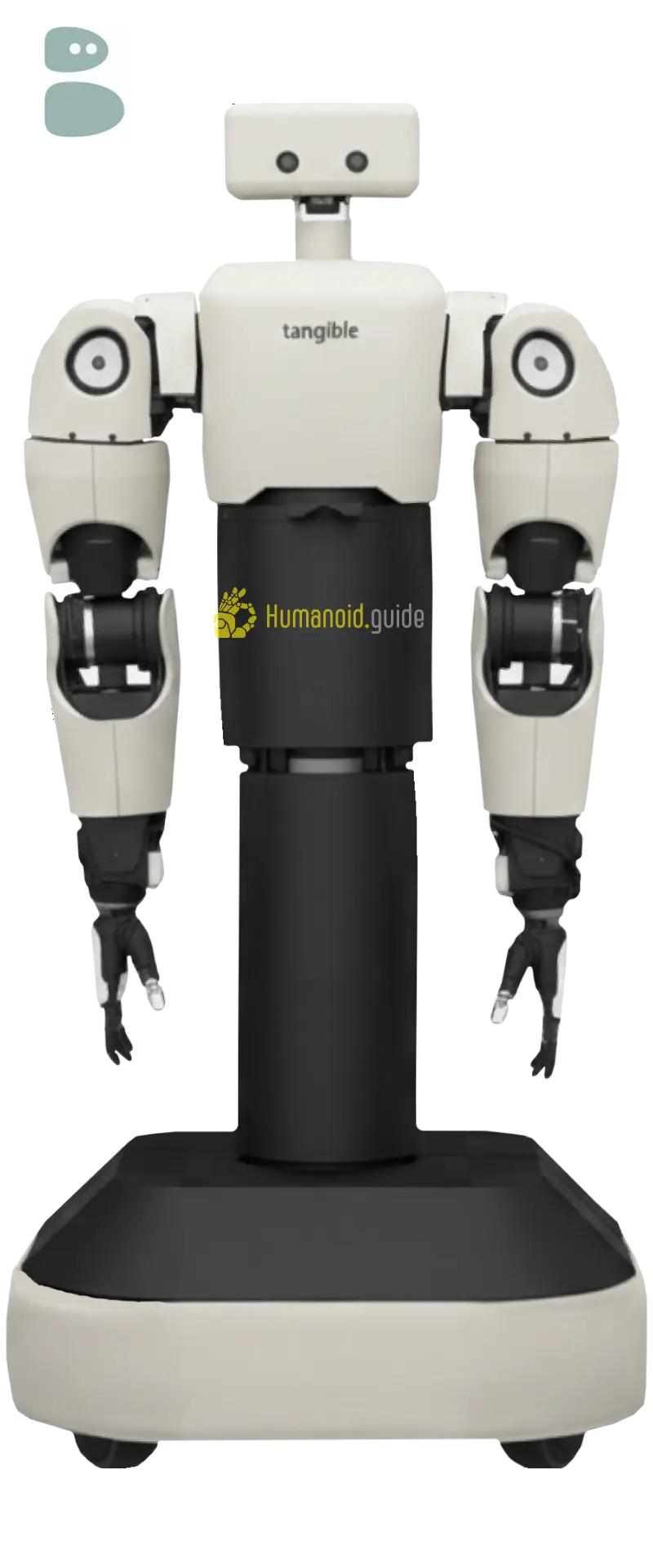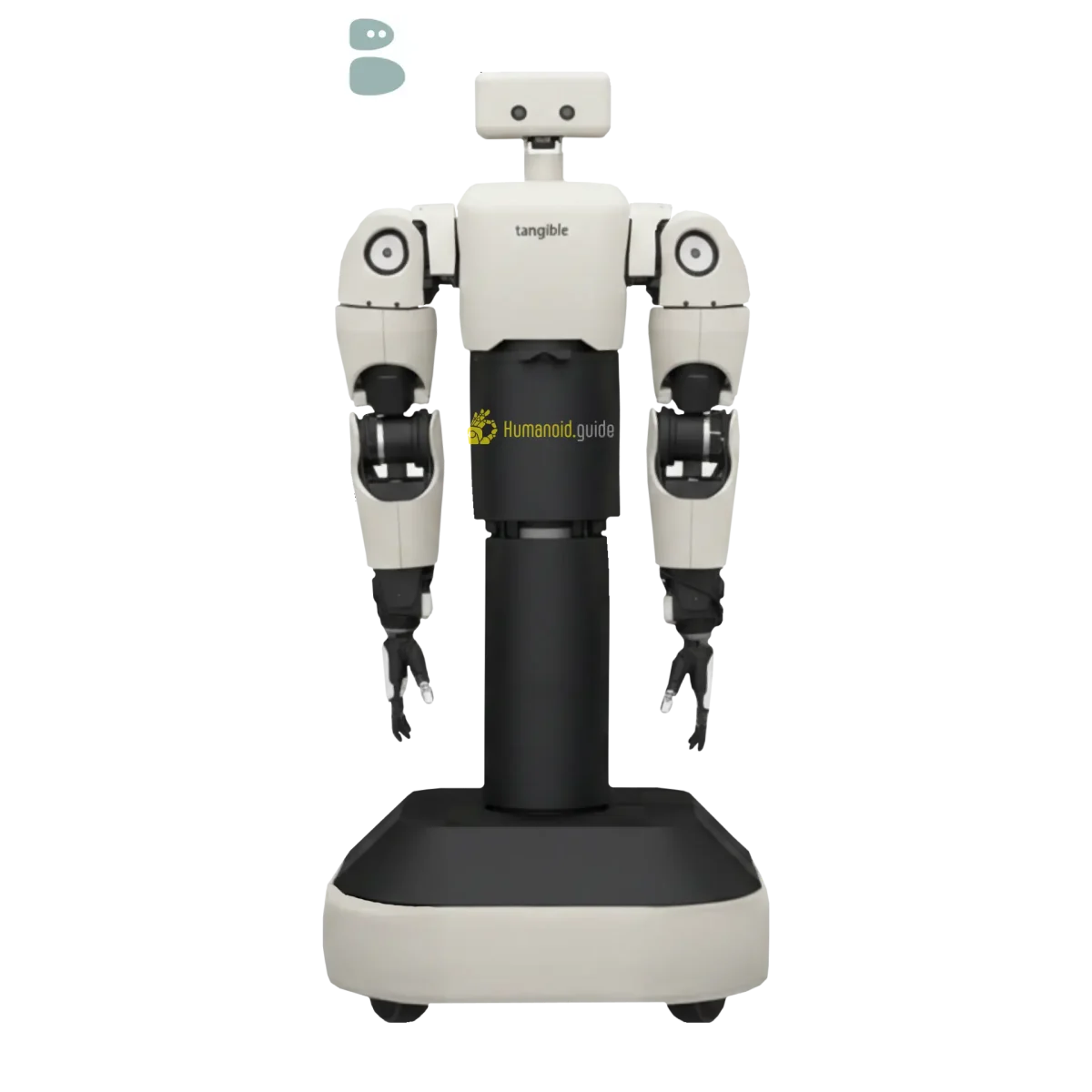
What is the Eggie Tangible?
The Tangible Robots Eggie is a wheeled social humanoid robot designed for public interaction, hospitality, and exhibitions. Manufactured by Tangible Robots, a US-based robotics startup, it stands 160 cm tall and weighs 45 kg. The robot features an egg-shaped body with expressive arms, each hand having 5 fingers and 3 degrees of freedom. Its total DOF is 20, enabling gestures and light manipulation tasks. Eggie navigates on a wheeled base at speeds up to 3 km/h and operates for up to 7 hours per charge. It integrates dual 1080p depth cameras, a likely NVIDIA Jetson embedded AI board, and LLM integration via cloud APIs for natural conversation. The robot is safe for human interaction (IP20) and targets hospitality, research, and education.
Specifications
Here are the full technical specifications.
| Spec | Value |
|---|---|
| Height | 160 cm |
| Weight | 45 kg |
| Degrees of freedom | 20 |
| Battery life | 7 hours |
| Max speed | 3 km/h |
| Payload | 4 kg |
| Price (new) | Undisclosed (contact manufacturer) |
| Price (used range) | N/A (pre-order) |
Price & Value
New MSRP: Undisclosed (contact manufacturer)
Used range: N/A (pre-order)
As a pre-order product from a startup, the Eggie’s pricing remains undisclosed, requiring direct inquiry. For budget comparison, similar wheeled social robots like SoftBank Pepper have an MSRP of approximately $20,000, while more capable platforms like UBTECH Cruzr reach $30,000. Given the Eggie’s unique egg-shaped design and expressive hands, it could be positioned in this range, but without official numbers, any estimate is speculative. Depreciation for early production runs is likely steep, especially if the company scales and releases improved versions; however, low initial supply might sustain resale value for early adopters. Total cost of ownership includes potential cloud API fees for LLM integration, which are not included in the hardware price, and unknown maintenance costs for custom parts. Prospective buyers should consider the financial risk of investing in an unproven platform with no track record of support or software updates.
Who Is It For?
Best for: - Exhibition and hospitality venues seeking an interactive, humanoid presence for guest engagement (7-hr battery, expressive arms, LLM conversation) to stand out from traditional kiosks. - University robotics labs requiring a pre-built, wheeled humanoid platform for HRI research, especially those studying gestural communication and social AI (20 DOF, ROS, camera suite).
Not for: - Operations requiring heavy payload transport (arm strength limited to 4 kg, no manipulator for objects over 1 kg). - Outdoor or rugged deployments (IP20 protection, no weather sealing, wheeled base struggles with uneven terrain). - Budget-constrained projects (likely $10k+ price unconfirmed, support costs unknown).
Alternatives & Comparison
In the wheeled social humanoid category, Eggie faces competition from established players such as SoftBank Pepper, Sanbot Elf, and UBTECH Cruzr. These robots all target hospitality and exhibition roles but differ markedly in manipulation ability, price, and software maturity.
| Model | Price | Available | Key Difference |
|---|---|---|---|
| SoftBank Pepper | $20,000 (est.) | yes | Slightly taller (120 cm), no arms/manipulation, focused on conversation and touchscreen. |
| Sanbot Elf | $10,000 (est.) | yes | Lower cost, smaller (90 cm), touchscreen, but no expressive hands or DOF arms. |
| UBTECH Cruzr | $30,000 (est.) | yes | Similar wheeled base, arms for grasping, higher payload (1 kg arm lift), but smaller screen. |
Verdict: For buyers prioritizing natural, human-like interaction, the Eggie’s expressive hands and 20 DOF give it a clear advantage over Pepper’s static body, but until pricing is known, it’s a gamble. The SoftBank Pepper’s proven reliability and large app ecosystem make it the safe choice for conversational kiosks, while UBTECH Cruzr is better suited for light physical tasks. Sanbot Elf remains the budget-friendly option. Ultimately, the Eggie is most compelling for pioneers willing to bet on a startup’s vision, but pragmatic buyers should wait for commercial release and independent reviews.
Use Cases & Capabilities
Exhibition Ambassador
At trade shows and museums, Eggie can greet attendees with natural conversation powered by cloud-based LLMs, while its 20 DOF allow expressive gestures that enhance storytelling. The dual 1080p depth cameras and sub-200ms latency ensure real-time, responsive interaction, making visitors feel engaged. Its wheeled base navigates at 3 km/h, enabling it to guide groups or approach specific displays. A 7-hour battery supports a full exhibition day without recharging, and its safe design (IP20) allows close proximity to crowds. However, the robot must stay indoors and avoid spills due to the IP20 rating, so outdoor or wet environments are off-limits. This use case highlights the Eggie's ability to serve as a memorable, non-threatening representative for brands.
Hospitality Service
Eggie can act as a concierge or greeter in hotels and restaurants, providing check-in assistance, menu recommendations, and light food or brochure delivery. Its arms and 4 kg payload are sufficient to carry small trays, business cards, or tablets. With LLM integration, it can communicate in multiple languages, enhancing guest experience for international clientele. Navigation at 3 km/h is adequate for lobbies and dining areas, though it may struggle in tight spaces or busy corridors. The 7-hour runtime covers peak service hours, but staff must plan charging breaks. As a pre-order product, reliability and service support are unknown, making it a higher-risk choice for mission-critical hotel roles.
Research Platform
University labs studying human-robot interaction (HRI) can deploy the Eggie as a research platform, leveraging its ROS environment and NVIDIA Jetson compute for custom experimentation. The 20 DOF, including 3-DOF hands, provide a robust testbed for gestural communication and social cue studies. Dual cameras support vision-based research, and the wheeled base allows controlled navigation in lab settings. The robot’s safe, rounded design minimizes risk in human-subject experiments. However, the closed nature of some hardware (servo motors, gears) may limit deep mechanical modification. Pre-order status means labs must plan for lead times and cannot rely on instant availability.
Education and Edutainment
In educational settings like science centers or university outreach, Eggie can teach robotics concepts through interactive demos. Students can program simple gestures or conversational flows using ROS tools, while the expressive body makes abstract concepts tangible. The 7-hour battery and IP20 rating suit indoor classroom use. Its affordability—assuming a price in the $10k–$30k range—makes it a candidate for well-funded K-12 or undergraduate programs. However, as a pre-commercial product, educational discounts and curriculum support are absent, requiring institutions to develop their own materials.
History & Background
Tangible Robots appeared in 2024 with the unveiling of the Eggie prototype, aiming to carve a niche in the social humanoid market. The company is reportedly US-based, though limited public information exists about its founders, funding, or exact location. The Eggie was first shown on tech blogs and humanoid directories as a pre-production model, emphasizing a friendly egg-shaped form factor and wheeled mobility for indoor venues. No prior generations or variants have been announced, and as of 2026, the robot remains in pre-order status without a confirmed shipment date. The startup appears to be self-funded or in early stages, as no major investment rounds are public. The Eggie’s design philosophy—combining an expressive humanoid upper body with a stable wheeled base—sets it apart from walking humanoids, but it also limits its application to flat indoor surfaces. Despite its novelty, the robot has yet to generate significant industry buzz or adoption.
Buying Used — What to Check
Verify actual runtime The 7-hour battery life may degrade; confirm battery health and availability of replacements.
Test manipulation strength The 4 kg arm payload is estimated; check that arm servos operate correctly for intended light tasks.
Inspect wheel drive As a wheeled robot, motor and tire wear could affect top speed of 3 km/h.