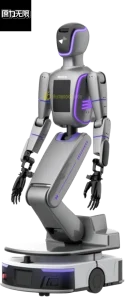
What is the Elu Astrod Ad01?
The Elu.AI AstroD AD-01 is a dual-arm upper-body humanoid robot mounted on a wheeled base, designed primarily for manipulation research and industrial applications. Manufactured by Elu.AI in China, it integrates 21 degrees of freedom across its arms and torso, with each hand possessing 11 DOF for dexterous tasks. The robot runs on NVIDIA Jetson AGX Orin compute, ROS 2, and a proprietary vision-language-action multimodal AI system for natural language instruction following. Key differentiators include its cloud-edge collaborative architecture and integrated harmonic drive reducers for low-backlash precision. Standing 170 cm tall and weighing 120 kg, the AD-01 is a heavy-duty research platform targeting manufacturing, logistics, and academia. It remains in prototype stage as of 2026, with early adopter pricing set at $100,000.
Specifications
Here are the full technical specifications.
| Spec | Value |
|---|---|
| Height | 170 cm |
| Weight | 120 kg |
| Degrees of freedom | 21 |
| Battery life | 2 hours |
| Max speed | 7.2 km/h |
| Payload | 3 kg |
| Price (new) | $100,000 |
| Price (used range) | N/A |
Price & Value
New MSRP: $100,000
Used range: N/A
At $100,000, the AstroD AD-01 enters the market as a competitively priced dual-arm research humanoid, especially when compared to bipedal platforms like Figure 01 or Tesla Optimus that may cost more or remain undisclosed. For labs focused purely on upper-body manipulation, the wheeled base eliminates stability concerns, offering a more practical experimental setup. Early adopters may benefit from custom software integration support directly from Elu.AI. Since no used units exist, depreciation is impossible to estimate, but the niche nature of high-end research platforms typically means value retention depends heavily on the ecosystem’s evolution. Total cost of ownership extends beyond the hardware to include dedicated engineering time for programming and maintaining the multimodal AI pipeline, which could easily double the initial investment over three years. Buyers should weigh this against renting cloud robotics services or waiting for a more polished commercial release.
Who Is It For?
Best for: - University robotics labs needing an integrated bimanual manipulation research platform with built-in vision-language AI. - Industrial R&D teams testing automated kitting and assembly workflows that benefit from natural language instruction following. - Logistics innovation centers exploring wheeled mobile manipulators for warehouse pick-and-place with dexterous hands.
Not for: - High-volume production lines requiring >3 kg payload and >2-hour continuous operation per charge. - Outdoor deployment or rough-floor environments (IP42 protection limits moisture/dust exposure).
Alternatives & Comparison
For a dual-arm wheeled humanoid torso priced around $100k, the AstroD AD-01 faces both direct competitors like the Sanctuary AI Phoenix and conceptual rivals among bipedal humanoids such as Tesla Optimus and Figure 01.
| Model | Price | Available | Key Difference |
|---|---|---|---|
| Sanctuary AI Phoenix | Undisclosed | preorder | General-purpose AI control; no public pricing or multimodal model details. |
| Tesla Optimus | Undisclosed | preorder | Bipedal design, strong Tesla brand, but much earlier in development for upper-body tasks. |
| Figure 01 | Undisclosed | preorder | Bipedal, advanced AI integration, but undisclosed arm payload and wheeled mobility lacks. |
Verdict: If your research demands an out-of-the-box dual-arm platform with an integrated multimodal AI stack, the AD-01 is the most transparently priced and fastest to deploy today. For general-purpose AI research that doesn't require wheels, the Phoenix may mature into a stronger alternative, but its missing price and availability make it a gamble. Bipedal humanoids like Optimus or Figure 01 excel in whole-body mobility but introduce balancing complexities that distract from pure manipulation studies — choose them only if walking is essential to your use case.
Use Cases & Capabilities
Dual-Arm Manipulation Research
The AD-01’s 21 DOF upper body and 11-DOF hands enable a wide range of dexterous manipulation experiments, from peg-in-hole assembly to precise tool use. Its Vision-Language-Action (VLA) model allows researchers to test new imitation learning and reinforcement learning algorithms directly through natural language commands, bypassing traditional scripted programming. The wheeled base provides a stable, repeatable platform for camera-based object tracking and motion planning trials. However, the 3 kg payload and 2-hour battery may limit long-duration complex sequences. Labs can leverage ROS 2 compatibility to integrate custom sensors and end-effectors.
Industrial Kitting and Assembly
With its IP42 rating and low-backlash harmonic drive transmissions, the AD-01 suits semi-structured manufacturing environments where precision bin-picking and small-parts assembly are required. The robot’s ability to interpret natural language instructions means factory technicians could quickly re-task it without coding. The wheeled base allows it to autonomously navigate between workstations in a pre-mapped facility. Despite its limited payload, it can handle many electronics or automotive connector sub-assemblies. Real-time multimodal reasoning ensures safety when working alongside humans, though the 2-hour runtime demands frequent breaks or battery swaps in a continuous line.
Logistics Pick-and-Place
For warehouse or logistics R&D, the AD-01 combines mobile navigation with dual-arm picking, offering a testbed for advanced order fulfillment workflows. Its 7.2 km/h max speed on wheels covers ground quickly in a lab-scale mock warehouse, while the 10-finger dexterity handles fragile or irregular items. The integrated 4G/5G optional connectivity enables real-time inventory updates and remote supervision. However, the 120 kg weight may require reinforced flooring, and the lack of outdoor capability restricts its validation to indoor facilities. Researchers can validate cycle times and grasp success rates before scaling to full-size automation.
University Education and AI Development
Colleges and AI institutes can use the AD-01 as a turn-key platform for teaching modern embodied AI. Students can interact with the robot via natural language and see immediate physical results, accelerating learning curves in robotics and machine learning. The Ubuntu 20.04/22.04 environment and ROS 2 ensure compatibility with a vast library of open-source tools. The $100,000 price point is attainable for well-funded labs and beats building a comparable system from scratch. Long-term, the platform can support thesis work on continual learning and sim-to-real transfer, though institutions must budget for compute upgrades and sensor additions.
History & Background
Elu.AI, based in China, emerged as a robotics company focusing on embodied AI and humanoid platforms. While its founding year is not publicly documented, the firm unveiled the AstroD AD-01 in 2024 as a prototype dual-arm upper-body robot on a wheeled base. The design leverages NVIDIA Jetson AGX Orin compute and a proprietary cloud-edge AI architecture developed in-house. The AD-01 represents the company’s first humanoid torso offering, likely built upon earlier single-arm or mobile manipulation projects. As of 2026, the robot remains in active development with no publicly announced commercial release date; early adopter units are being negotiated on a case-by-case basis. Elu.AI has not disclosed any subsequent generations or variants, positioning the AD-01 as its flagship for collaborative manufacturing and research sectors. The company’s roadmap suggests ongoing improvements to the Hyper-VLA multimodal model and potential teleoperation features.
Buying Used — What to Check
Verify payload capability Payload is critical for any manipulation task; ensure the 3 kg rating holds under dynamic conditions and not just static lifting.
Inspect battery endurance The 2-hour runtime may degrade after repeated charge cycles; early adopters should confirm actual runtime under typical lab loads.
Confirm ROS 2 driver maturity Pre-commercial robots often ship with beta software; ask for documentation on motor controller APIs and multimodal model updates to avoid maintenance dead-ends.