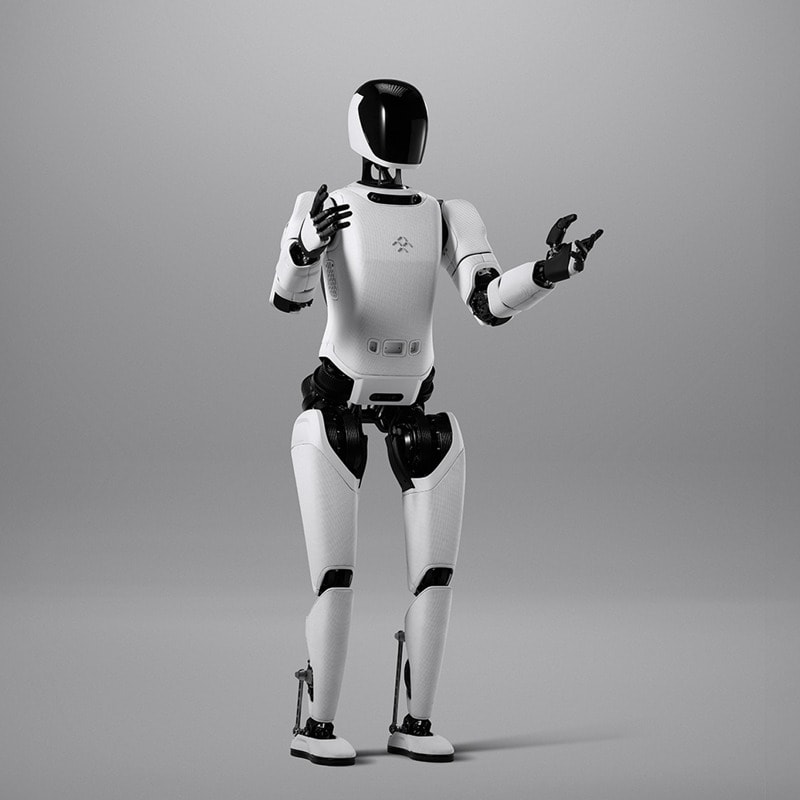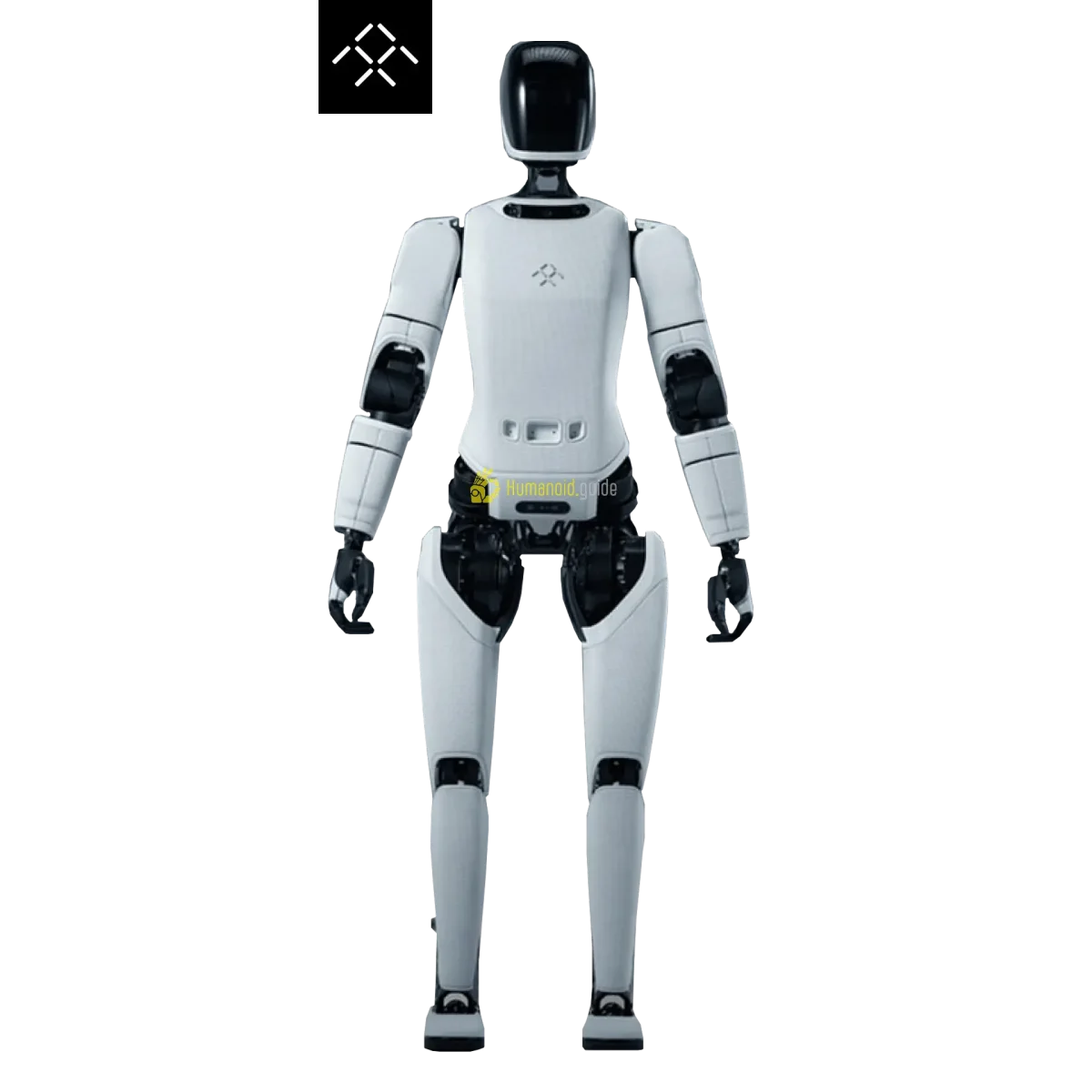
What is the Futurist?
The Faraday Future Robotics Futurist is a full-size humanoid robot developed in Los Angeles, California. Designed for commercial service roles, it stands 169 cm tall, weighs 69 kg, and features 40 degrees of freedom with 7-DOF hands. It runs on an NVIDIA Jetson Orin module delivering 200 TOPS of AI compute and supports 4G/5G, Wi‑Fi, and VR teleoperation. Onboard AI handles natural language in approximately 50 languages. With a 15 kg payload and 3-hour battery, it targets customer interaction, professional service, and workplace assistance. Its headline differentiator is the sub-$35,000 price—radically lower than most full-scale humanoids—making advanced bipedal robotics accessible to small and medium enterprises for the first time.
Specifications
Here are the full technical specifications.
| Spec | Value |
|---|---|
| Height | 169 cm |
| Weight | 69 kg |
| Degrees of freedom | 40 |
| Battery life | 3 hours |
| Max speed | 3 km/h |
| Payload | 15 kg |
| Price (new) | $34,990 |
| Price (used range) | N/A (pre-commercial) |
Price & Value
New MSRP: $34,990
Used range: Not yet on secondary market
At $34,990, the Futurist undercuts every other full-size humanoid on the market, including the UBTECH Walker S (~$150,000) and Engineered Arts Ameca (~$250,000). This aggressive pricing likely reflects Faraday Future’s strategy to seed a developer ecosystem before ramping up production. While upfront cost is low, total cost of ownership may rise with rapid obsolescence and potential upgrade needs in a fast-moving field. Battery replacements and wear items like harmonic drives will add recurring expenses; however, even with these factored in, the Futurist remains the most affordable humanoid for early-stage exploration. Depreciation is expected to be steep as next-generation models emerge, but early adopters may recoup value through R&D tax credits or service differentiation.
Who Is It For?
Best for: - Businesses experimenting with humanoid robots for customer-facing tasks (low $34,990 entry) - Retail and hospitality chains exploring eye-catching AI greeters or wayfinding assistants (40 DOF, multiple languages) - University labs needing a full-body humanoid platform for locomotion and manipulation research (NVIDIA Jetson Orin, VR teleoperation)
Not for: - Continuous heavy‑load operations (only 3‑hour battery, 15 kg payload) - Safety‑certified industrial environments (no ingress protection rating disclosed) - Large‑scale fleet deployments without local support infrastructure (pre‑order, early market presence)
Alternatives & Comparison
The Futurist enters a market dominated by research-oriented platforms and premium service robots. At $34,990 it undercuts all competitors, but it must prove itself against established players with real-world deployments.
| Model | Price | Available | Key Difference |
|---|---|---|---|
| UBTECH Walker S | ~$150,000 (est.) | enterprise-only | Proven in smart factory logistics; 3× more expensive |
| Engineered Arts Ameca | ~$250,000 | yes | Industry-leading facial expressiveness; no bipedal walking |
| Fourier GR-2 | Undisclosed | preorder | Higher torque actuators (300 Nm); price likely >$100k |
Verdict: For cost-conscious buyers, the Futurist is the only option under $50,000—a genuinely disruptive price point. However, businesses that need immediate reliability and support should consider the UBTECH Walker S, which has factory-proven deployments. If emotive customer interaction is paramount, Ameca remains unbeatable, though it cannot walk. The Futurist wins on affordability and versatility for labs and pilot programs, but its long‑term viability hinges on Faraday Future’s ability to deliver consistent quality and spare parts.
Use Cases & Capabilities
Customer Interaction
In retail stores, hotels, or airports, the Futurist can serve as an interactive greeter or information kiosk. Its 40 DOF enable expressive gestures, and the onboard AI supports real‑time conversation in roughly 50 languages. The 3‑hour battery allows a full morning or afternoon shift before recharging. However, because it lacks ingress protection, it should be used indoors and away from spills.
Workplace Assistance
For office or event environments, the Futurist can carry documents, deliver packages, or assist with meeting setup using its 15 kg payload. VR teleoperation allows a remote operator to take over for complex tasks, making it suitable for hybrid autonomous/human‑guided workflows. Its 3 km/h walking speed is adequate for indoor corridors, but it cannot match the speed of wheeled delivery robots.
Robotics Research & Education
University labs will find the Futurist an attractive platform for full‑body motion planning, manipulation, and human‑robot interaction studies. Access to NVIDIA Jetson Orin’s 200 TOPS and 5G connectivity opens possibilities for edge‑AI experiments. The low $34,990 price makes it viable for grant‑funded projects that cannot afford $100k+ humanoids. Researchers should verify access to low‑level control APIs and spare parts before purchasing.
History & Background
Faraday Future was founded in 2014 by Jia Yueting and initially focused on luxury electric vehicles, gaining attention with the FF 91 concept. The robotics division emerged as a separate venture, first introducing the FF Master humanoid. In 2025, the company revealed the FF Futurist as a more advanced successor with refined manipulation capabilities and a 40‑DOF body. The robot was shown as a production‑ready prototype, and shortly after, pre‑orders opened at a highly competitive $34,990 MSRP. Deliveries are expected to begin in 2026, positioning Faraday Future Robotics as an early mover in affordable humanoid service robots. The company remains headquartered in Los Angeles, California, and benefits from its parent company’s experience in EV manufacturing and supply chains.
Buying Used — What to Check
Verify payload capacity The 15 kg rating is unverified outside of manufacturer claims; a real‑world test ensures it meets your task requirements.
Inspect battery health With only 3 hours of runtime, a degraded battery could slash usable working time; ask how many cycles the battery has seen and what a replacement costs.
Confirm software update policy Early units may lack the latest LLM integration or VR teleoperation improvements; ensure the seller can transfer support and how OTA updates are handled.