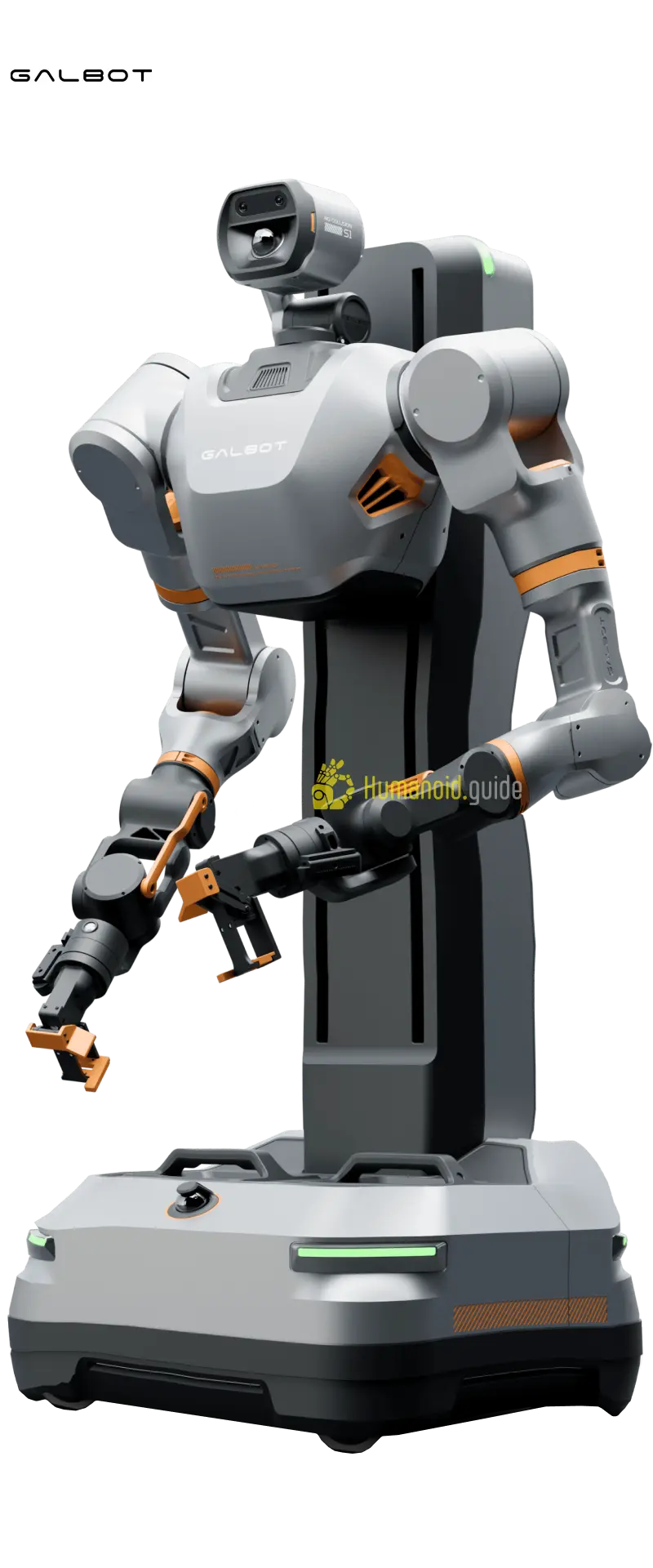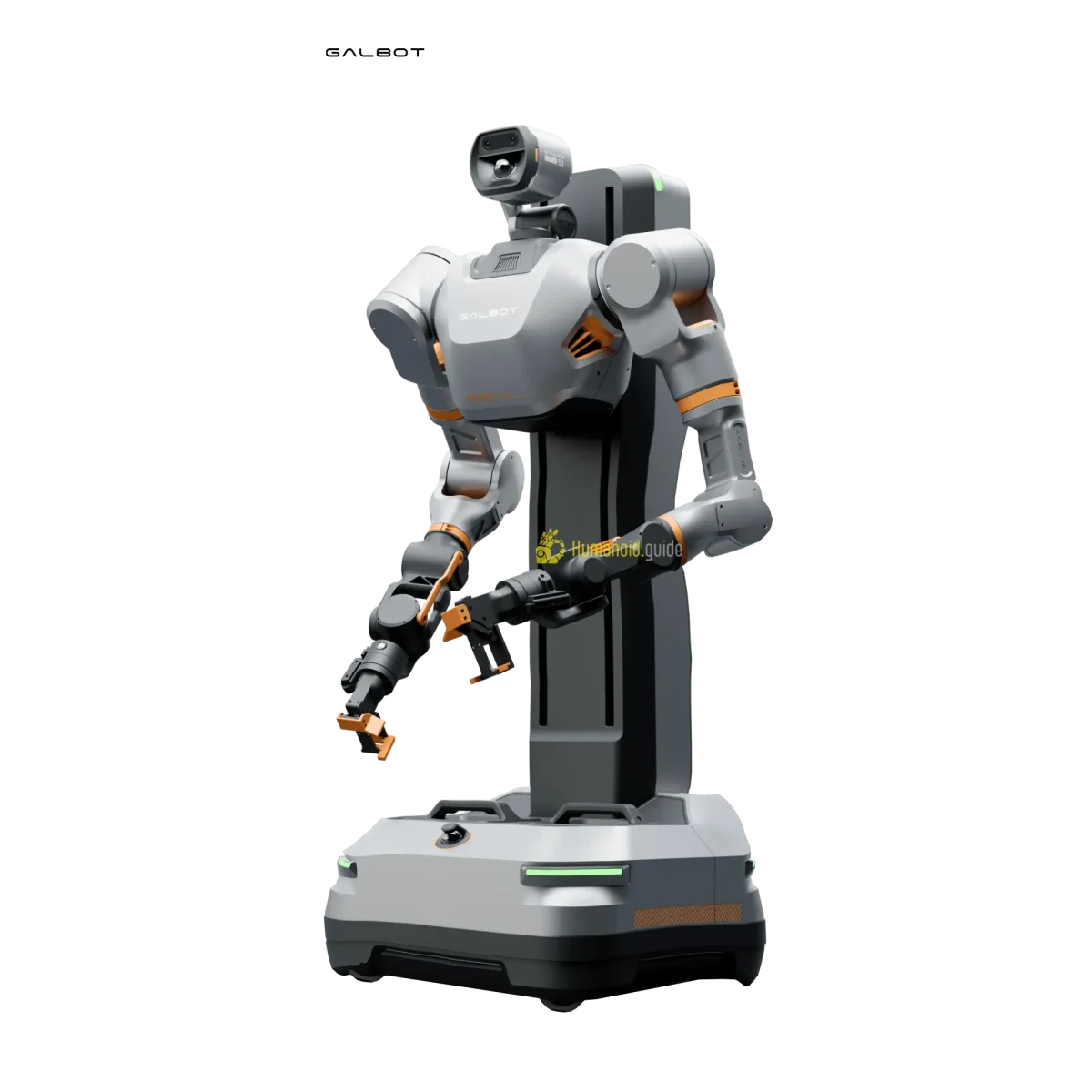
What is the Galbot S1?
The Galbot S1 is a bimanual humanoid robot with a wheeled differential-drive base, developed by Beijing Galbot AI, Inc., a Chinese robotics startup founded in 2023. Unveiled in 2024 at the World Robot Conference, the S1 combines a humanoid upper torso with two 7-DOF arms, each equipped with a 2-finger gripper, and a stable wheeled platform that eliminates the complexity and cost of bipedal walking. Its sensor suite includes RGB-D cameras, lidar, and ultrasonic sensors, enabling navigation, object detection, and voice interaction. The robot is designed for indoor service environments—retail stores, hotel lobbies, exhibition halls—where it can perform reception, guidance, and light manipulation tasks. With an Intel processor and NVIDIA Jetson module, it runs ROS for research-friendly development.
Specifications
Here are the full technical specifications.
| Spec | Value |
|---|---|
| Height | 157 cm |
| Weight | 55 kg |
| Degrees of freedom | 20 |
| Battery life | 8 hours |
| Max speed | 4.3 km/h |
| Payload | 5 kg per arm |
| Price (new) | Undisclosed (contact manufacturer) |
| Price (used range) | N/A (pre-commercial) |
Price & Value
New MSRP: Undisclosed
Used range: N/A
Galbot has not publicly disclosed the S1’s price, but industry insiders expect it to fall in the range of $30,000–$50,000 for base configurations, targeting institutional buyers. This positions it as a mid-cost alternative to full legged humanoids like the Unitree H1 ($90,000) or the Astribot S1 (price undisclosed), while offering bimanual capability that single-arm platforms like the Hello Robot Stretch RE1 ($17,900) lack. For a wheeled humanoid, the total cost of ownership is likely lower than legged systems due to simpler mechanics and less maintenance on the differential drive base, though users will sacrifice navigation across stairs and uneven terrain. As a pre-order product, depreciation is uncertain, but early adopter pricing may be higher than eventual production units if volume manufacturing is achieved. Budget-conscious labs may find the Stretch RE1 more economical, but for tasks requiring two coordinated arms in a human-facing setting, the S1’s value proposition is compelling.
Who Is It For?
Best for: - Retail and hospitality businesses needing indoor reception and guidance (bimanual interaction, 8-hour runtime) - University robotics labs researching bimanual mobile manipulation (ROS-native, NVIDIA compute) - STEM education programs wanting a platform for human-robot interaction and voice navigation (sensor-rich, wheeled stability)
Not for: - Outdoor or multi-floor deployments (wheeled base cannot handle stairs or rough terrain) - Heavy payload industrial tasks (each arm limited to 5 kg manipulation payload) - Buyers seeking immediate used units (no secondary market exists yet)
Alternatives & Comparison
The Galbot S1 competes in the emerging market of mobile manipulation robots designed for service and research. Its main rivals offer different trade-offs in mobility and manipulation.
| Model | Price | Available | Key Difference |
|---|---|---|---|
| Astribot S1 | Undisclosed | preorder | Full-legged humanoid with 41 DOF; S1 uses a wheeled base for better indoor stability and lower cost. |
| Unitree H1 | $90,000 | yes | Full-scale legged humanoid; S1’s wheeled design cuts cost and maintenance dramatically. |
| Hello Robot Stretch RE1 | $17,900 | yes | Single-arm research platform; S1 adds a second arm for bimanual tasks but at a higher expected price. |
Verdict: For indoor roles where stair climbing is irrelevant, the Galbot S1’s stable wheeled base, long 8-hour runtime, and bimanual dexterity offer an excellent package at a likely mid-range price point. Researchers or retailers who absolutely need legged mobility should consider the Unitree H1, while budget-constrained labs with single-arm use cases will find the Stretch RE1 unbeatable. If the S1’s final price lands under $50,000, it will be a strong recommendation for service humanoid deployments.
Use Cases & Capabilities
Retail & Hospitality Reception
The Galbot S1 can greet visitors, answer common questions via voice interface, and guide guests to specific locations within a store or hotel lobby. Its wheeled base allows it to navigate smoothly indoors without the risk of falling, and the 8-hour battery covers a full shift. The bimanual arms can perform simple tasks like handing over flyers or scanning tickets, though the 5 kg per arm limit means it cannot carry heavy luggage or stock. Panoramic cameras and lidar ensure safe operation around customers, and the robot’s humanoid appearance creates an engaging, novel experience for visitors.
Object Manipulation Research
With 14 arm DOF and ROS compatibility, the S1 serves as an affordable platform for bimanual mobile manipulation research. Labs can program coordinated pick-and-place, handovers, and tool use, leveraging the on-board NVIDIA Jetson for perception. The differential drive base simplifies navigation experiments without the complexity of bipedal balance. Compared to a dual-arm stationary setup, the S1’s mobility opens research into mobile manipulation in realistic cluttered environments. The harmonic drive actuators provide smooth, precise motion, though the 5 kg payload per arm limits experiments with heavier objects.
Education & STEM Outreach
The S1’s humanoid form factor and interactive voice system make it an attention-grabbing tool for university robotics courses and STEM demonstrations. Students can learn ROS programming, sensor integration, and mobile manipulation on a single hardware platform. The robot’s safety-rated design (compliant motors with torque limits) and wheeled stability reduce risks in classroom settings. While the undisclosed price may be a barrier for some departments, group purchases or rental schemes could bring the S1 into educational labs, providing hands-on experience with a cutting-edge service humanoid.
History & Background
Beijing Galbot AI Inc. was founded in 2023 in Beijing, China, with a focus on wheeled humanoid robots for service and logistics. The S1 model was first revealed at the World Robot Conference 2024 in Beijing, attracting attention for its combination of a humanoid upper body with a stable omnidirectional wheeled base—a pragmatic alternative to expensive bipedal designs. The S1 is the company’s first-generation humanoid; a sister model, the D1 Pro delivery robot with a backpack module, was also announced in 2024. Galbot has not disclosed any ownership changes or external investment rounds. The S1 remains in pre-order status as of 2026, with no known production deliveries yet.
Buying Used — What to Check
Verify payload and runtime The 5 kg arm payload and 8-hour battery are critical for service shifts; ask for test logs or calibration certificates.
Inspect base drive motors and wheels Differential drive systems can wear unevenly in high-mileage units; check for alignment and unusual noise.
Sensor calibration RGB-D cameras and lidar require precise calibration; request recent calibration reports to confirm navigation accuracy.