What is the Galbot?
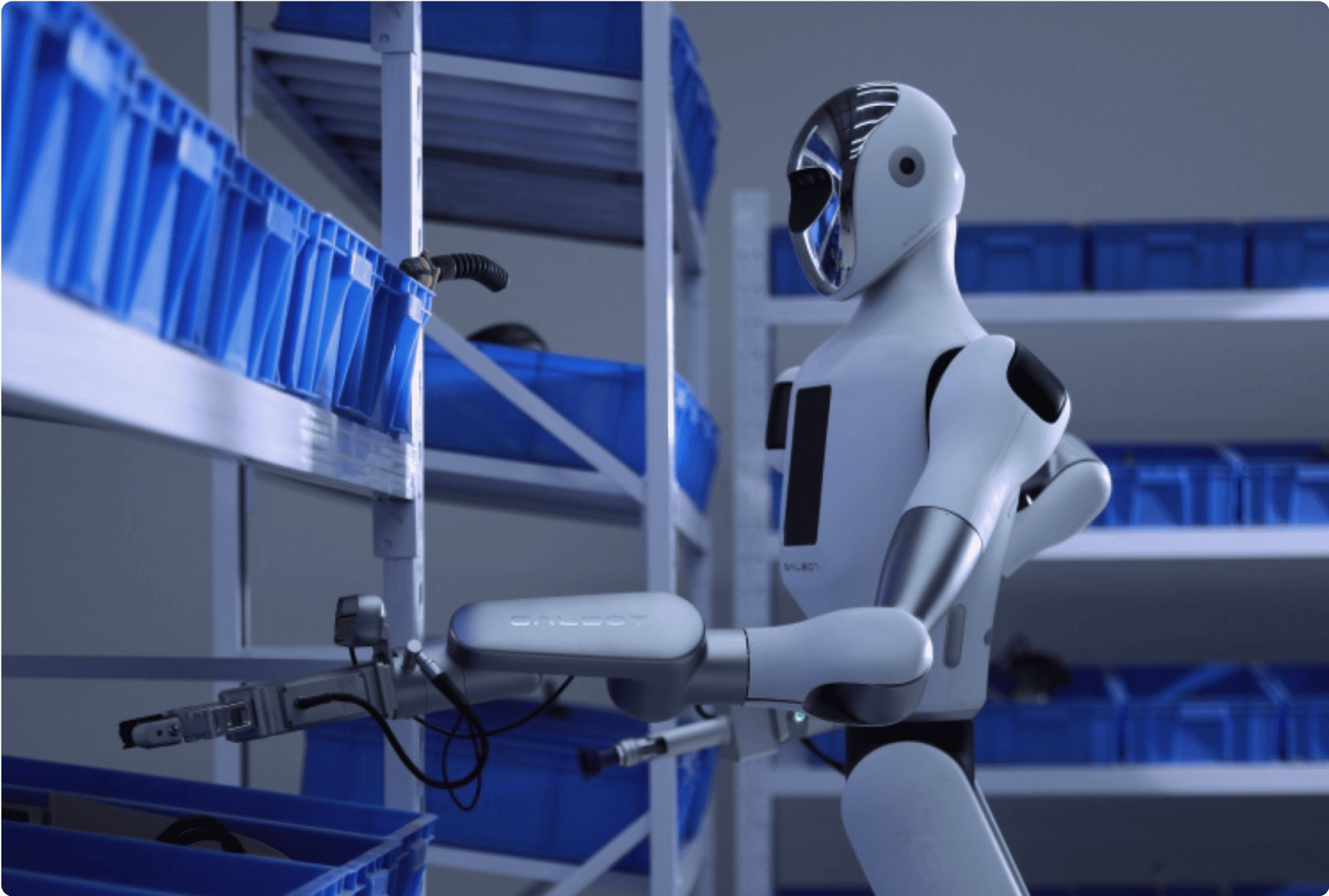
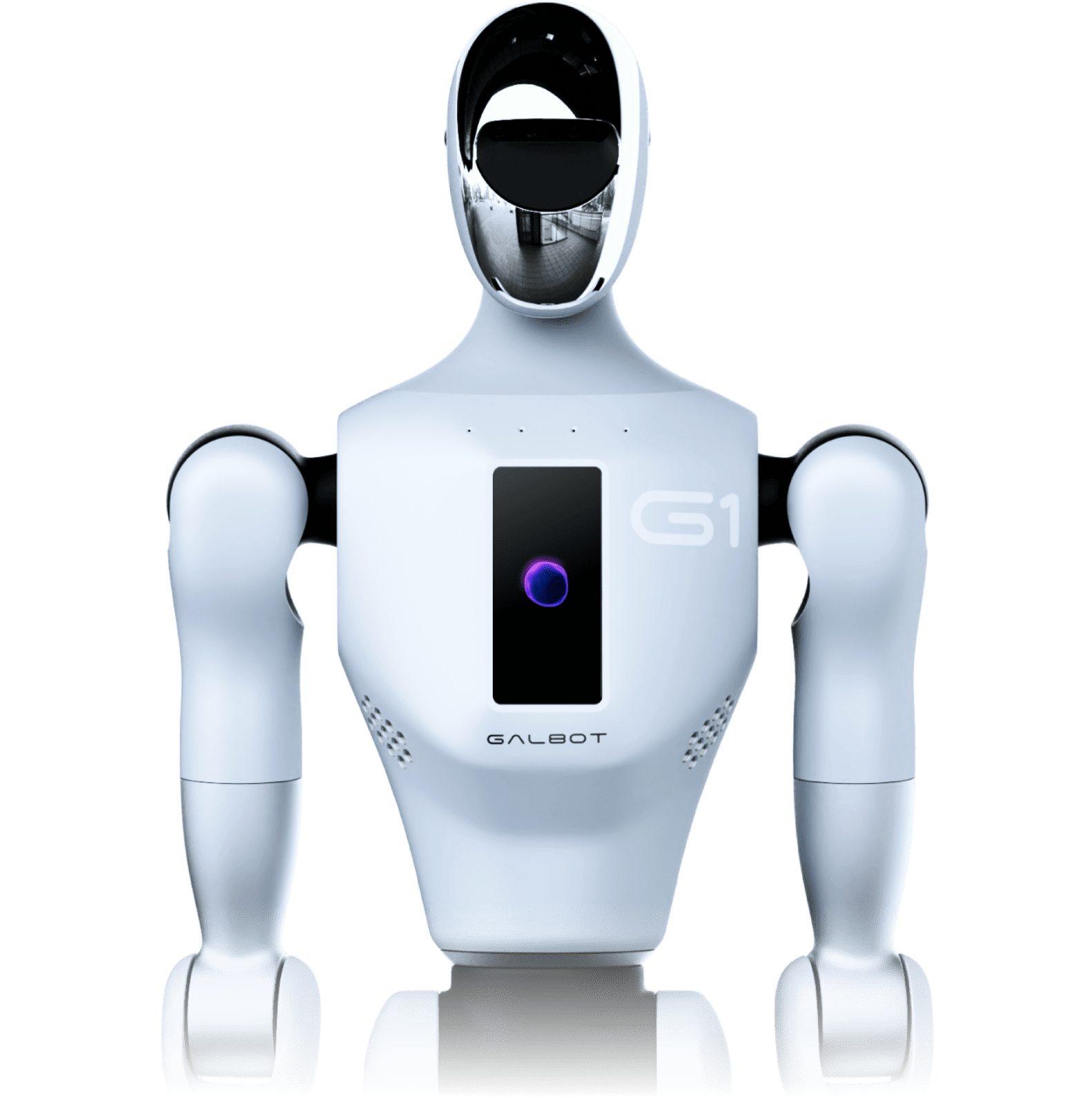
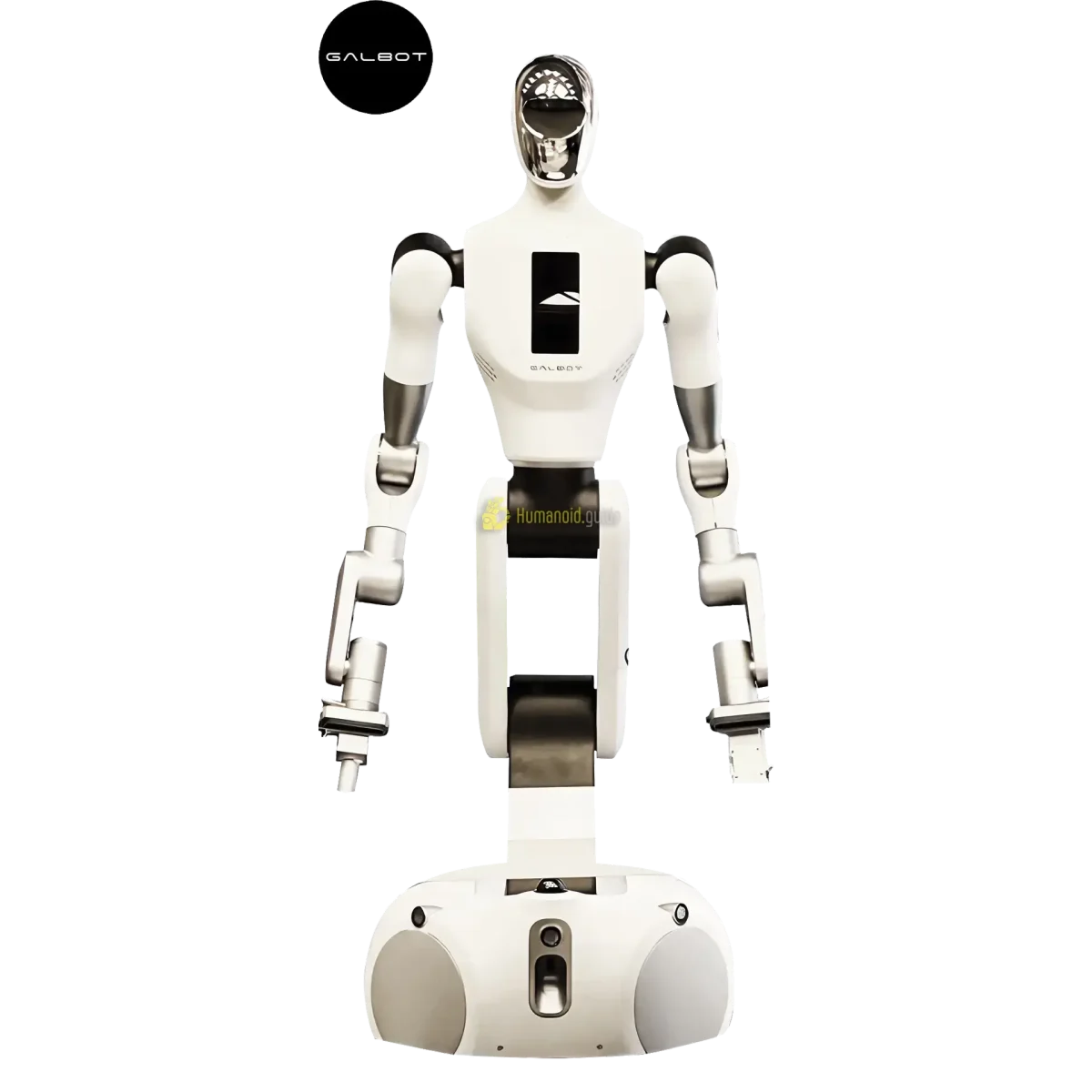
The Galbot is a general-purpose humanoid robot developed by Beijing Galbot AI Co., Ltd., founded in 2022 and headquartered in Shenzhen, China. Designed for healthcare, service, education, and elderly care, it features electric actuation, 40 degrees of freedom (including 12-DOF hands), a 3D vision system with LiDAR and depth cameras, and runs on ROS. Standing 165 cm tall and weighing 55 kg, Galbot can walk at up to 4.32 km/h, carry 10 kg, and work for up to 2.5 hours on a charge. First shown as a prototype in 2023, it represents a new wave of affordable humanoids from China, targeting roles as a companion, assistant, and educator.
Specifications
Here are the full technical specifications.
| Spec | Value |
|---|---|
| Height | 165 cm |
| Weight | 55 kg |
| Degrees of freedom | 40 (12 in hands) |
| Battery life | 2.5 hours |
| Max speed | 4.32 km/h |
| Payload | 10 kg |
| Price (new) | Undisclosed (contact manufacturer) |
| Price (used range) | N/A (pre-commercial) |
Price & Value
New MSRP: Undisclosed (contact manufacturer)
Used range: N/A (pre-commercial)
Galbot has not published an official retail price. Early media reports have circulated an estimated figure around $55,000, but this is unconfirmed and likely placeholder. If eventually priced in that range, it would undercut higher-spec rivals like the Unitree H1 and Tesla Optimus, positioning itself as a cost-effective solution for lightweight service tasks. Its value would hinge on build quality, software maturity, and aftermarket support, all of which are unknown at this stage. As a prototype, depreciation and total cost of ownership are purely speculative, though its relatively low weight and simple electric actuators may point to lower long-term maintenance than heavier industrial humanoids. Buyers should contact the manufacturer directly for pricing and volume availability.
Who Is It For?
Best for: - Healthcare and elderly care providers seeking a lightweight, non-threatening companion robot for basic assistance and monitoring (40 DOF enables expressive gestures and smooth, safe interaction) - Education and research institutions investigating humanoid locomotion, manipulation, and HRI on a budget (ROS-based open architecture, with 2.5-hour runtime sufficient for classroom demos and student projects) - Early adopters in service robotics testing simple fetch-and-carry or front-desk roles where 10 kg payload and 4.32 km/h speed are acceptable
Not for: - Heavy industrial or warehouse applications (payload limited to 10 kg, no protection against dust or moisture) - Buyers needing a ready-to-deploy commercial product — Galbot remains in prototype phase with no proven reliability data or CE/FCC certifications - Outdoor logistics or patrol that requires extended battery life (2.5 hours is insufficient for all-day autonomy)
Alternatives & Comparison
As a pre-commercial humanoid targeting service roles, Galbot competes in a field of faster, stronger, or more established alternatives. Here’s how it stacks up against key rivals in the same general-purpose humanoid category.
| Model | Price | Available | Key Difference |
|---|---|---|---|
| Unitree H1 | Undisclosed | yes | Higher payload and speed; already commercially available. |
| Fourier GR-3 | Undisclosed | no | 40+ DOF, advanced dexterity; research-oriented. |
| Tesla Optimus | Undisclosed | no | General-purpose industrial humanoid; massive backing. |
Verdict: For buyers who can wait, Galbot’s potential $55k price point and 40-DOF design could make it a compelling entry-level humanoid for service and education — if the company delivers on reliability. Today, the Unitree H1 is the only real commercial alternative, but it’s heavier and lacks fine manipulation. Tesla Optimus remains a distant promise; Fourier GR-3 excels in dexterous research but likewise isn’t shipping. If you need a robot right now for light service tasks, look to wheeled AMRs until Galbot finally debuts.
Use Cases & Capabilities
Elderly Care Companion
Galbot’s gentle appearance, lightweight build, and 40 DOF (including expressive hands) make it suitable for social interaction with seniors in assisted living. It can remind residents to take medication, lead simple seated exercises, and provide a calming presence during downtime. The 10 kg payload is enough to carry a water bottle or small meal tray. Its quiet electric actuators and 2.5-hour battery allow it to operate for a full care shift with a midday recharge. However, fall detection and emergency response capabilities are not yet verified.
Education and University Research
With a standard ROS environment and 40 controlled joints, Galbot offers an affordable platform for teaching humanoid robotics, manipulation, and navigation. Labs can program locomotion gaits, visual servoing, and basic pick-and-place tasks using the onboard 3D vision and LiDAR. The 2.5-hour runtime supports semester projects without constant charging interruptions. At a projected price around $55k, it could become a favorite for human-robot interaction studies, though the lack of public documentation and commercial support may slow initial adoption.
Retail and Hospitality Greeter
At 165 cm and 55 kg, Galbot is unobtrusive enough to stand at a store entrance, restaurant counter, or hotel lobby. It can greet guests, answer simple voice queries via an LLM interface (if enabled), and gesture toward displays. Walking speed of 4.32 km/h enables it to escort a visitor to a specific aisle without feeling sluggish. The integrated depth cameras and LiDAR ensure safe navigation around shoppers. Still, without weather resistance or all-day battery, it would be limited to indoor, shift-based deployments, and no real-world commercial pilots have been announced yet.
Home Service Assistant
Galbot is marketed for home use — cleaning, organizing, fetching items, and handling packages. Its anthropomorphic design allows it to navigate typical home layouts, reach countertops, and use standard tools with 12-DOF hands. The 10 kg arm payload can manage groceries, laundry baskets, or a vacuum. For package handling, it would rely on front-facing 3D vision to recognize boxes. Realistically, the current prototype is far from consumer-ready; autonomous operation, robust object recognition, and safety in cluttered homes need significant software development.
History & Background
Beijing Galbot AI Co., Ltd. was founded in 2022 in Shenzhen, China, focusing on affordable humanoid robots. The company debuted the Galbot prototype in 2023, showcasing a 40-DOF, electrically actuated platform targeting service and care markets. Early demos highlighted basic locomotion, object grasping, and potential for home assistance, education, and elderly companionship. As of 2026, only one generation has been shown, and the robot remains a pre-commercial prototype. No acquisitions, joint ventures, or government certifications have been publicly disclosed. The company’s website lists application scenarios but no shipping dates. Galbot is under active research and development, with the goal of becoming a low-cost competitor to better-funded humanoid projects from Unitree, Fourier Intelligence, and Tesla.
Buying Used — What to Check
Verify payload and battery endurance Payload and runtime are critical for service tasks; early prototypes may have lower real-world performance than advertised.
Inspect actuator noise and sensor accuracy Loose joints or miscalibrated LiDAR can hinder navigation and manipulation tests.
Confirm software version and ROS compatibility Low-level control and API stability may vary between pre-production units.