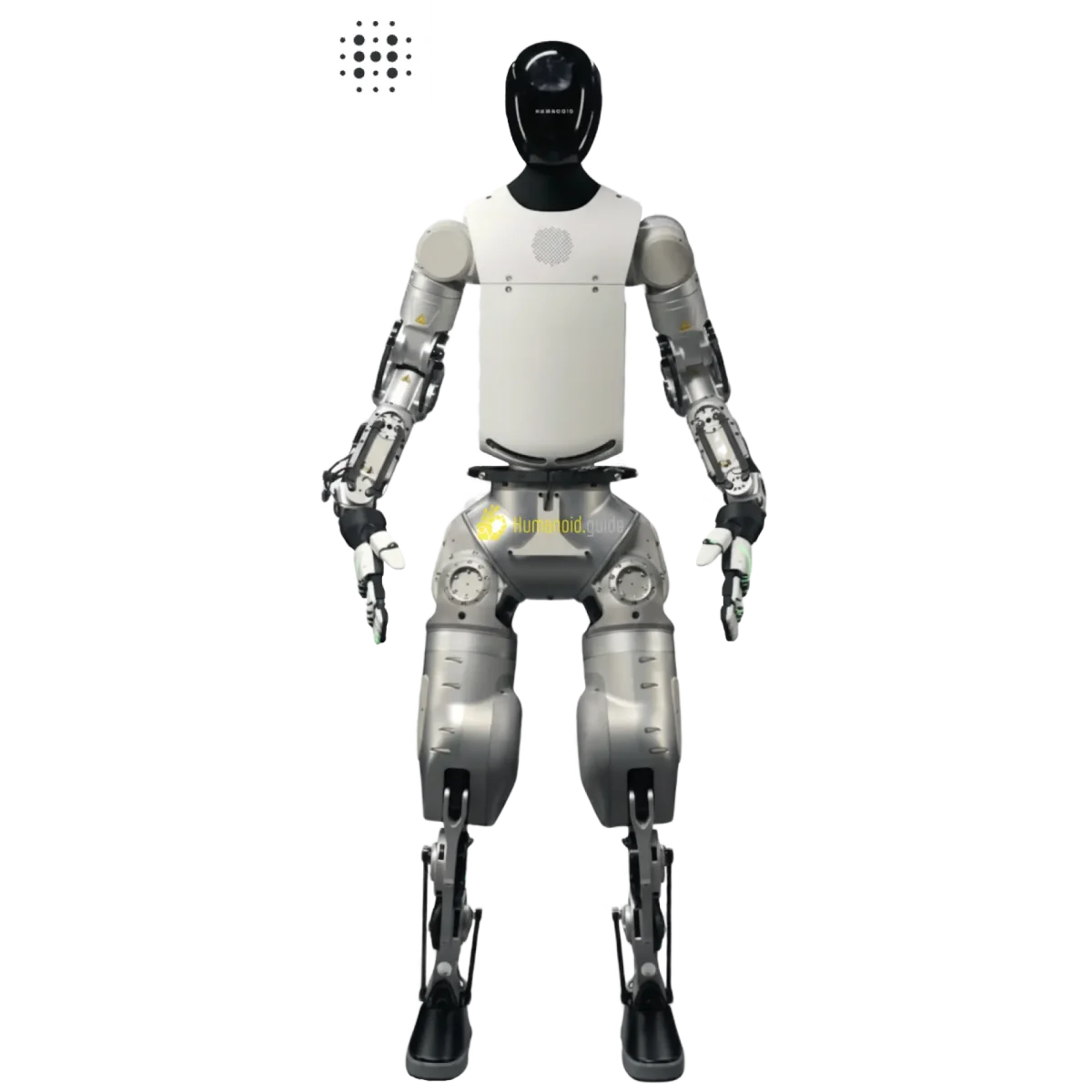
What is the Hmnd 01 Alpha Bipedal?
The HMND-01 Alpha is a full-size bipedal humanoid robot developed by Humanoid.ai (SKL Robotics), headquartered in London, United Kingdom. Designed for industrial applications including warehousing, manufacturing, and logistics, it combines a human-like form factor with advanced dexterity and mobility. The Alpha variant represents the company’s first complete bipedal platform, featuring 41 total degrees of freedom (12 per hand), a standing payload of 15 kg, and a 4-hour battery runtime. Equipped with RGB cameras, depth sensors, and powered by an NVIDIA Jetson Orin AGX alongside Intel i9 processing, the robot runs a VLM/VLA-based KinetIQ operating framework for autonomous task execution. It is currently a pre-production prototype demonstrated in material handling and pick-and-place tasks.
Specifications
Here are the full technical specifications.
| Spec | Value |
|---|---|
| Height | 175 cm |
| Weight | 70 kg |
| Degrees of freedom | 41 |
| Hand degrees of freedom | 12 per hand |
| Battery life | 4 hours |
| Max speed | 5.4 km/h |
| Payload | 15 kg |
| Price (new) | Undisclosed |
| Price (used range) | N/A |
Price & Value
New MSRP: Undisclosed
Used range: N/A
Pricing for the HMND-01 Alpha has not been publicly disclosed by Humanoid.ai; as a pre‑production prototype, orders are not yet open. Industry observers estimate that if commercialized, the price could fall in the $100,000–$250,000 range typical of full‑size industrial humanoids. Compared to competitors like Digit and Apollo, which have announced pricing, the HMND‑01’s value will hinge on its dexterity (41 DOF) and adaptability for logistics tasks. Potential buyers should anticipate a premium due to the advanced hand design and AI‑driven control infrastructure, including the NVIDIA Jetson plus Intel i9 compute stack. Without a public price, financial comparison is speculative; however, enterprises evaluating this robot should budget for ongoing software licensing, actuator maintenance, and end‑effector replacements. Used units are not expected until 2027 at the earliest, so the total cost of ownership will be entirely upfront, with no depreciation data available yet.
Who Is It For?
Best for: - Logistics and warehousing operators seeking a dexterous humanoid for pick‑and‑place and material handling (41 DOF including 12-DOF hands enable fine manipulation). - Manufacturers exploring human‑scale automation to augment labor in assembly lines where dual‑arm manipulation is required.
Not for: - Applications needing ultra‑high speed (max 5.4 km/h is slower than wheeled AMRs and insufficient for rapid sortation) - Outdoor rugged environments (no IP rating disclosed, likely not weather‑sealed and may be sensitive to dust/moisture)
Alternatives & Comparison
The HMND-01 Alpha competes with other bipedal humanoids targeting industrial logistics, such as Digit, Apollo, Atlas, Figure 01, and Optimus. While many are still pre‑commercial, the HMND‑01 differentiates through its advanced hand dexterity and UK‑based development.
| Model | Price | Available | Key Difference |
|---|---|---|---|
| Digit | $250,000 | yes | Proven warehouse deployments with ostrich‑like legs. |
| Apollo | $75,000 | preorder | Lower price point targeting general‑purpose safe collaboration. |
| Atlas | Undisclosed | no | Unmatched dynamic mobility for research. |
| Figure 01 | Undisclosed | no | AI‑driven autonomy and dexterous hands for manufacturing. |
| Optimus | Undisclosed (target <$20k) | no | Tesla’s ambitious mass‑market target price. |
Verdict: For buyers prioritizing proven deployment and North American support, Digit or Apollo are better choices today. However, if 41 DOF and highly dexterous 12‑DOF hands are critical for complex picking, the HMND‑01 Alpha offers a compelling option once it becomes commercially available—it strikes a balance between the high agility of Atlas and the cost focus of Optimus.
Use Cases & Capabilities
Automotive Parts Assembly
In automotive manufacturing, the HMND‑01 Alpha can handle small to medium-sized components such as sensors, wiring harnesses, and interior trim pieces. Its 12‑DOF hands allow for delicate gripping and insertion into tight fixtures. The robot’s humanoid form factor lets it work alongside human operators on existing assembly stations without major infrastructure changes. However, the 15 kg payload limits it to lighter sub‑assemblies, not engine or chassis components. Integration with plant MES systems via Ethernet and Wi‑Fi connectivity would enable real‑time quality checks.
E‑commerce Order Fulfillment
This robot can pick individual items from shelves or totes and place them into shipping cartons, handling a wide variety of shapes and textures thanks to its dexterous hands. Its 4‑hour battery life suits half‑shift operations, after which it can be swapped or recharged during breaks. The VLM/VLA‑based KinetIQ framework enables learning new SKU handling patterns without explicit reprogramming. Limitations include slower walking speed (5.4 km/h) compared to autonomous mobile robots, making it better suited to stationary workstation tasks than long‑range travel.
Third‑Party Logistics (3PL) Sorting
In a 3PL sortation center, the HMND‑01 Alpha can walk to a conveyor, grasp parcels, and place them onto pallets or outbound containers based on barcode information. Its RGB‑D sensors allow reliable identification even in low‑light conditions. The robot’s push‑recovery capability helps maintain uptime in cluttered environments. A fleet of these robots could be supervised by one operator, reducing labor costs. The main limitation is the 4‑hour runtime; without hot‑swappable batteries, extended shifts require multiple units or mid‑shift charging.
Manufacturing Line Tending
The HMND‑01 Alpha can load and unload CNC machines, injection molders, or press brakes, using its 15 kg payload capacity for raw material and finished parts. Its integrated vision system verifies part orientation and tool status before each cycle. Because it is bipedal, it can move between machines on a shop floor without dedicated rails or automation carts. The dual‑arm configuration enables one arm to load while the other unloads, increasing throughput. Its maximum reach and vertical stroke are not yet published, so it may require precise cell layout adjustments.
History & Background
Humanoid.ai was founded in 2023 in London, UK, emerging stealthily to develop a full‑size bipedal humanoid robot for industrial use. The company publicly revealed the HMND‑01 Alpha prototype in 2024, showcasing early demonstrations of full‑body motion, push recovery, and basic pick‑and‑place tasks at industry events. The Alpha is the first generation of the HMND series, built to target warehousing and manufacturing workflows. In early demos, the robot operated using a VLM/VLA‑based KinetIQ framework running on NVIDIA Jetson Orin AGX and Intel i9 hardware. As of 2026, the robot remains in pre‑production refinement, with no publicly announced pilot deployments or production versions. Humanoid.ai continues to iterate on the platform, aiming to achieve parity with other industrial humanoids before finalizing a commercial release date.
Buying Used — What to Check
Verify hardware revision Early demonstration units may not reflect final production components; ask for a build‑sheet to confirm it matches the latest iteration.
Assess demonstration wear Units that have toured trade shows often incur joint wear; check actuator logs and physical joint play before purchase.
Confirm software support As a pre‑production platform, firmware updates and developer support may be limited; validate whether the unit comes with access to the KinetIQ SDK and VLM/VLA updates.