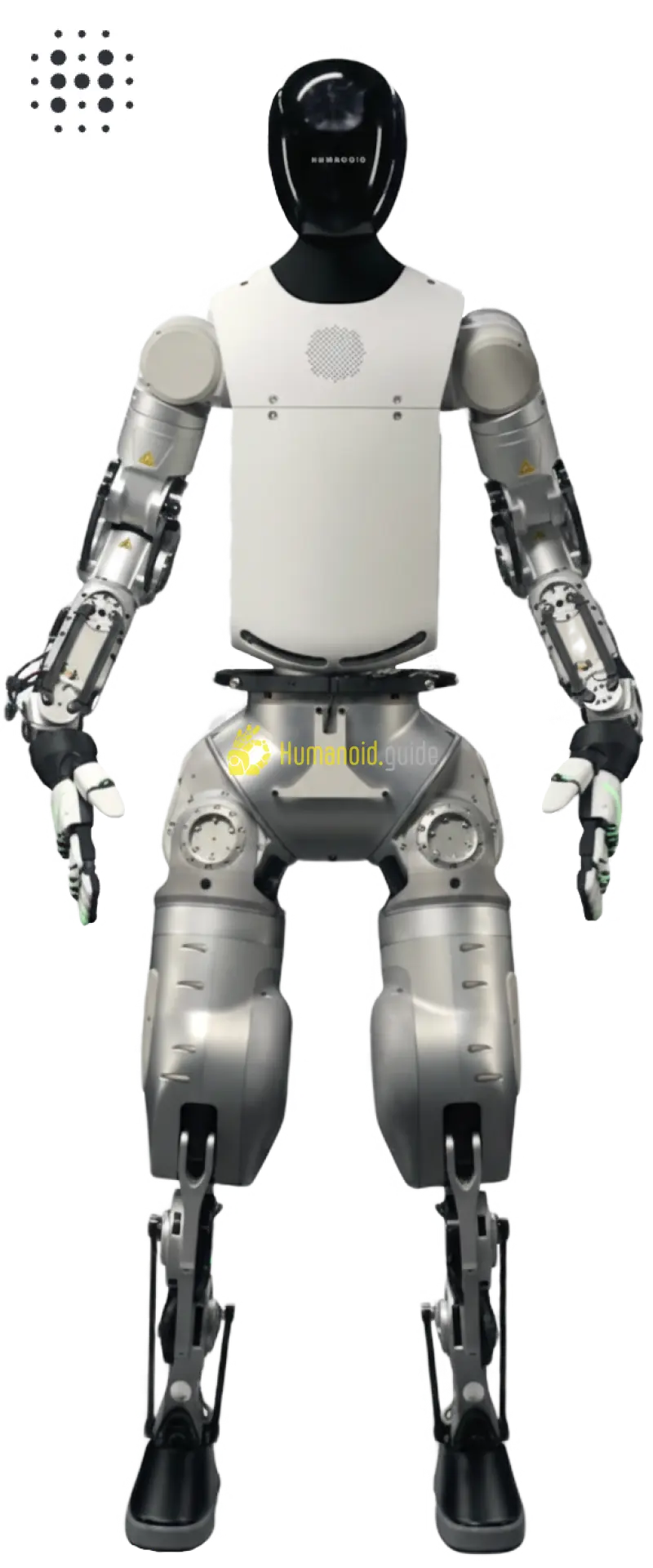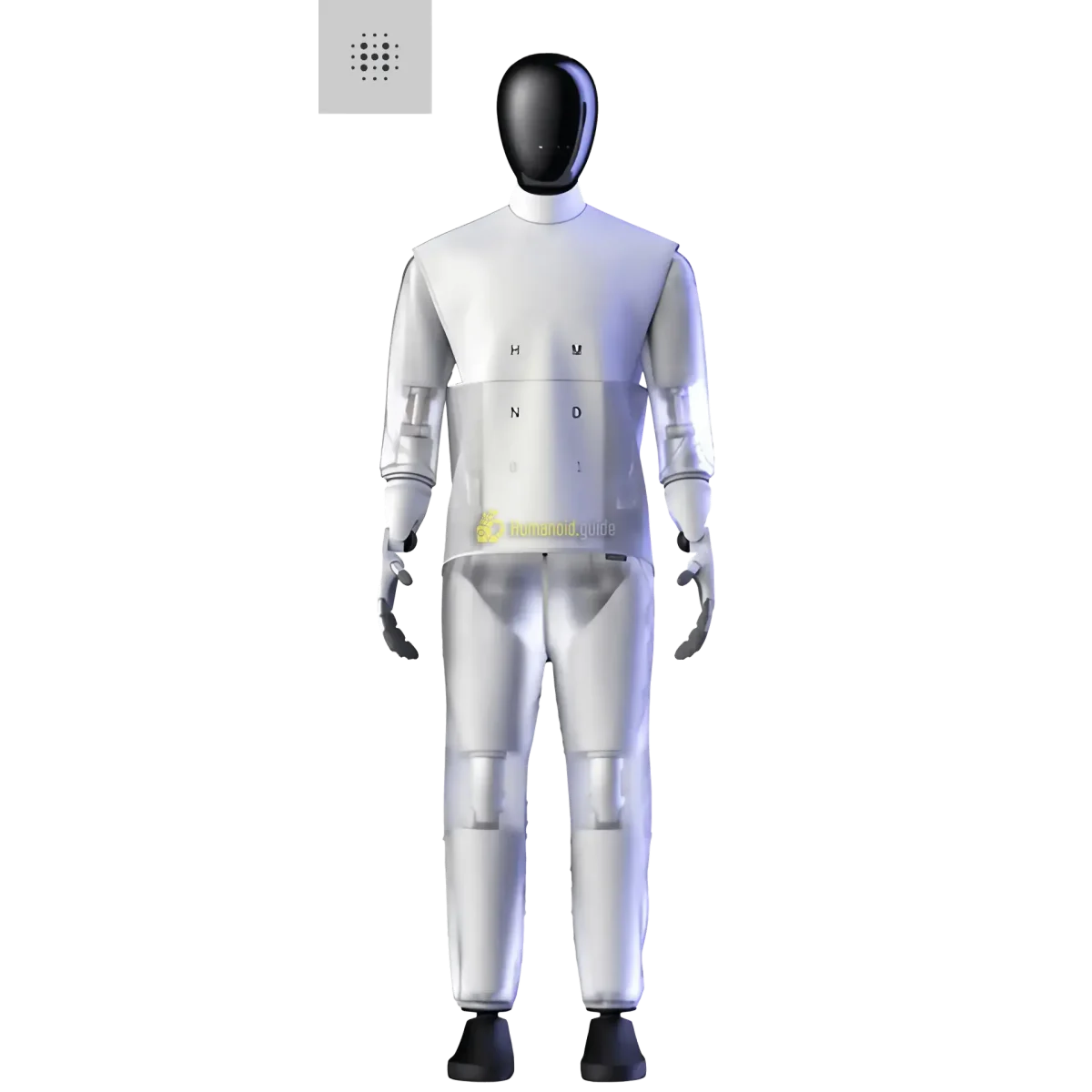
What is the Hmnd 01?
The HMND-01 is a human-scale humanoid robot developed by Humanoid.ai, a London-based startup founded in 2024. Designed to automate physically demanding and repetitive tasks in environments built for people, it stands 1.75 m tall, weighs 70 kg, and features 41 degrees of freedom including 5-fingered dexterous hands. With a 15 kg payload capacity and up to 4 hours of battery life, it targets material handling, picking and packing, and palletizing operations in logistics, manufacturing, and retail. Its sensor suite includes stereo cameras, lidar, and force/torque sensors, powered by an NVIDIA Jetson AGX Orin edge computer running Ubuntu and ROS 2. The robot is currently in pre-production, with initial units expected in 2025, and is offered through direct enterprise sales.
Specifications
Here are the full technical specifications.
| Spec | Value |
|---|---|
| Height | 1.75 m |
| Weight | 70 kg |
| Degrees of freedom | 41 |
| Battery life | 4 hours |
| Max speed | 1.5 m/s |
| Payload | 15 kg |
| Price (new) | Undisclosed (enterprise sales) |
| Price (used range) | N/A (pre-commercial) |
Price & Value
New MSRP: Undisclosed (contact manufacturer)
Used range: N/A
As a pre-production model, no official pricing has been released, but the HMND-01 is sold through direct enterprise sales channels, indicating a likely high cost typical of early-stage humanoid robots. Given its advanced dexterity (41 DOF, 12-DOF hands) and compute capabilities (NVIDIA Jetson AGX Orin), its price point is expected to be higher than simpler logistics platforms but may undercut Tesla’s Optimus if that robot is priced lower. Until commercial availability is established, depreciation and TCO remain speculative; however, buyers should factor in integration, training, and ongoing software support costs. Compared to alternatives like the Figure 02 (also pre-commercial) and the 1X NEO (which targets safer operation), the HMND-01 offers a balance of speed and payload that may justify a premium in industrial settings.
Who Is It For?
Best for: - Logistics companies trialing humanoid picking and packing in medium-duty environments (15 kg payload) - Manufacturers seeking a versatile humanoid for material handling and palletizing tasks - Retail distribution centers looking to automate repetitive sorting and placement
Not for: - Operations requiring heavy lifting (payload limited to 15 kg) - Facilities that need rugged, weatherized robots (IP rating not specified) - Businesses expecting turnkey deployment (requires integration and programming expertise)
Alternatives & Comparison
The HMND-01 competes in the emerging full-size humanoid market against Tesla Optimus, Figure 02, and 1X NEO. All are pre-commercial, but differ in design philosophy, target applications, and predicted pricing.
| Model | Price | Available | Key Difference |
|---|---|---|---|
| Tesla Optimus Gen 2 | Undisclosed (expected <$20,000 if mass-produced) | preorder | Tesla's AI-driven manufacturing integration and in-house battery technology |
| Figure 02 | Undisclosed | preorder | Advanced dexterous hands, partnership with OpenAI for language models |
| 1X NEO | Undisclosed | preorder | Soft, safe design for both home and workplace environments |
Verdict: For industrial logistics and manufacturing applications where speed and payload matter, the HMND-01 currently leads with its 1.5 m/s walking speed and 15 kg payload, though it remains to be seen how real-world performance stacks against Optimus' AI integration. Figure 02 may appeal more to research environments needing advanced language interaction, while 1X NEO's safety-first design suits collaborative spaces. Buyers should pilot-test all three if budgets allow.
Use Cases & Capabilities
Material Handling in Warehouses
The HMND-01 moves boxes, bins, and totes in human-centric warehouse aisles, using its 15 kg payload and 1.5 m/s walking speed to keep pace with manual workflow. Stereo cameras and lidar allow it to navigate dynamic environments, avoiding obstacles and recognizing shelf locations. Its dexterous hands can grasp a variety of shapes, from cuboid cartons to irregularly shaped bags, though suction-based end effectors might be added for smoother pick rates. Battery life of 4 hours supports a half-shift before needing a swap or recharge, fitting into break schedules. Early integration with warehouse management software will be critical for route optimization and task assignment.
Picking and Packing in E-commerce Fulfillment
In e-commerce order fulfillment, the HMND-01 picks items from inventory bins and places them into shipping cartons, leveraging its 41 DOF for precise positioning. The 12 DOF per hand and force/torque sensors enable it to handle fragile products like electronics or glassware without damage. Vision systems identify SKUs and verify order accuracy on the fly. Limited payload means heavy items still require human assistance, but for most consumer goods, the robot can work alongside human packers. Its ROS 2 compatibility facilitates integration with proprietary pick-and-pack software and existing automated conveyor systems.
Palletizing in Manufacturing
At the end of a production line, the HMND-01 stacks products onto pallets, using its full-body coordination to maintain balance even with offset loads. The 15 kg payload allows it to lift boxes or machine parts within that limit, building stable pallet layers through repeatable arm trajectories. Inline sensors detect pallet position and adjust stack patterns in real time. While speed is sufficient for moderate throughput lines, high-speed packaging operations may outpace a single robot. The open ROS 2 environment lets integrators program custom pallet profiles and integrate with enterprise resource planning systems for just-in-time scheduling.
Retail Stocking and Replenishment
In retail backrooms and store aisles, the HMND-01 restocks shelves by picking product cases from pallets and placing them at point of sale. Its bipedal locomotion works on smooth retail flooring, and sensor fusion avoids collisions with customers and staff if deployed after hours. The robot can work through a full overnight shift on a single charge if it does not need continuous maximum speed movement. Safety is a concern—without an IP rating, it cannot operate in wet or dusty stockrooms without additional protection. As voice interaction is not currently emphasized, tasks are pre-programmed or remotely supervised.
History & Background
Humanoid.ai was founded in 2024 in London, UK, with the goal of building human-scale robots for real-world work. The HMND-01 was first unveiled in late 2024 through demo videos and press coverage, showcasing bipedal locomotion and dexterous manipulation capabilities. As of early 2025, the robot remains in pre-production, with an expected release to early enterprise partners in 2025. No subsequent variants have been announced, and the company continues to refine its software and hardware stack. Humanoid.ai positions itself as a competitor to Tesla and Figure in the emerging humanoid market, emphasizing practical deployment in logistics and manufacturing.
Buying Used — What to Check
Verify payload rating Payload and runtime are critical for logistics tasks and may degrade with early prototype wear.
Inspect battery health Battery runtime of 4 hours is essential for shift work; used units may have degraded cells.
Check software update history Software stability is key; early units may lack the latest firmware for safety and features.