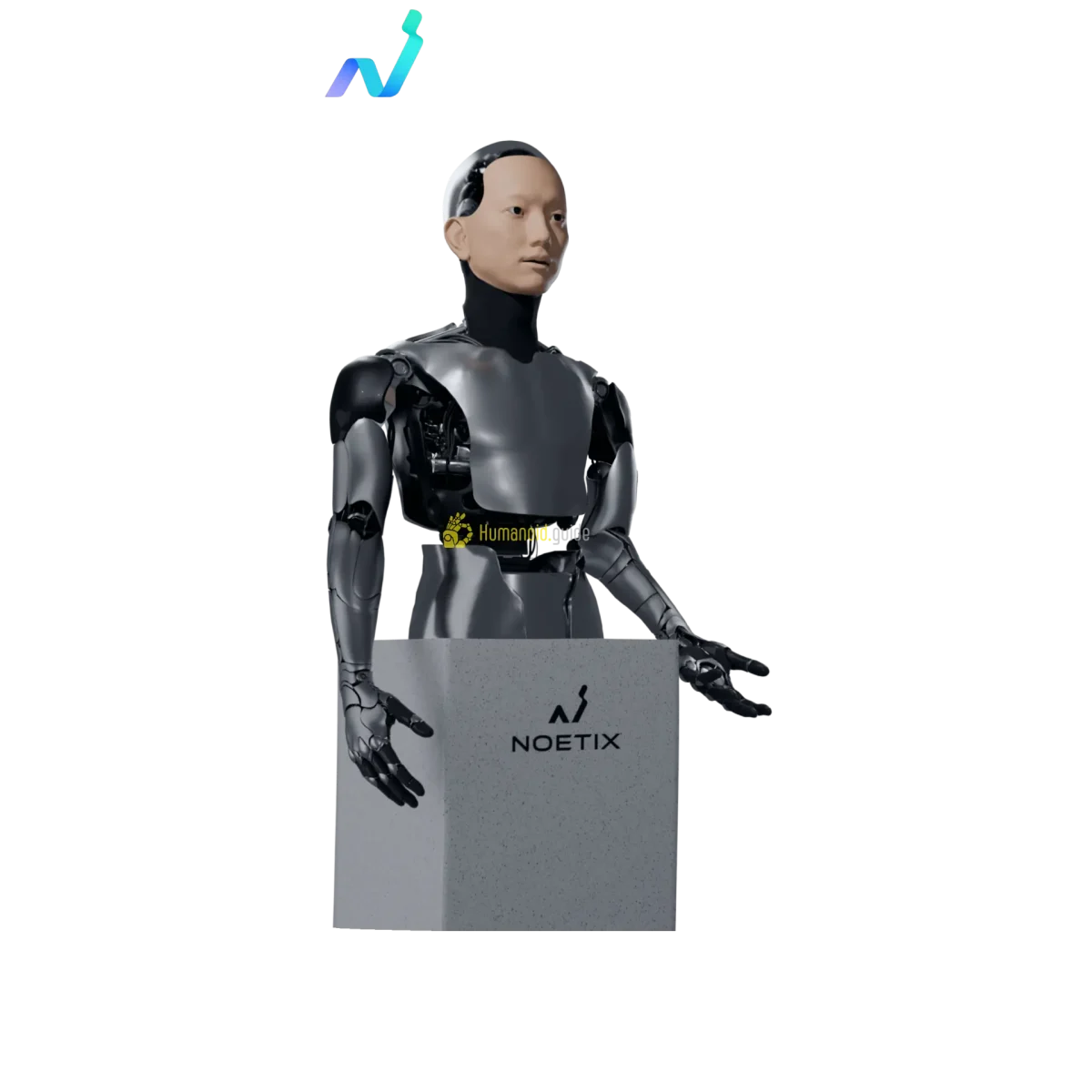
What is the Hobbs Paxini?
The Noetix Hobbs is a full-body humanoid robot developed by Noetix Robotics in China, designed primarily for research and education, as well as service demonstration applications. Standing up to 140 cm and weighing around 50 kg, it offers 20 degrees of freedom across its body and five-fingered hands. Its standout feature is a modular torso that allows researchers to swap out hardware configurations quickly, enabling fast prototyping and iterative development. Constructed from aluminum alloys and plastics, the Hobbs runs on an embedded x86 or ARM Linux system and supports Ethernet and Wi‑Fi connectivity. RGB cameras provide visual input, and its electric servo actuators deliver smooth motion, though walking speed is not specified, indicating a focus on manipulation and interaction rather than locomotion dynamics.
Specifications
Here are the full technical specifications.
| Spec | Value |
|---|---|
| Height | 140 cm |
| Weight | 50 kg |
| Degrees of freedom | 20 |
| Battery life | Not specified |
| Max speed | Not specified |
| Payload | 6 kg |
| Price (new) | Undisclosed |
| Price (used range) | N/A (no established secondary market) |
Price & Value
New MSRP: Undisclosed
Used range: N/A (no used listings)
Noetix Robotics has not published a list price for the Hobbs, and no third-party reseller quotes are available, making it difficult to assess value directly. Given its target market of academic and research institutions, pricing is likely negotiated on a per-unit or batch basis, comparable to other Chinese research humanoids that often fall in the $50,000–$150,000 range. The Hobbs’ modular design offers a unique advantage for labs needing to test different actuators, end-effectors, or sensor suites without purchasing entirely new platforms, potentially lowering long-term research costs. Without a transparent MSRP, however, buyers should expect significant total cost of ownership including software development, maintenance, and custom integration. As a newly released platform (2024), the used market is nonexistent, and depreciation patterns cannot yet be established.
Who Is It For?
Best for: - University robotics labs needing a modular humanoid for rapid hardware iteration and algorithm testing (20 DOF full body with interchangeable torso)
Not for: - Industrial deployment or heavy payload tasks (payload limited to 6 kg, no published reliability data) - Buyers requiring a turnkey commercial solution with clear pricing, support SLA, or proven field performance
Alternatives & Comparison
The Noetix Hobbs competes in the space of mid-size research humanoids. While precise pricing is unavailable for all models, the following alternatives serve similar academic and service demonstration needs.
| Model | Price | Available | Key Difference |
|---|---|---|---|
| UBTECH Walker S | Undisclosed | enterprise-only | Walk-capable humanoid with industrial payload and sensor suite |
| Fourier GR-2 | Undisclosed | preorder | Focus on dynamic walking and force-controlled manipulation |
| Engineered Arts Ameca | ~$133,000 (est.) | yes | Premiers expressive AI-driven face; no lower-body mobility |
Verdict: For research groups that prioritize hardware flexibility and modularity, the Hobbs is the clear choice—its swappable torso enables rapid reconfiguration that no other humanoid in this class offers. However, if walking dynamics or a commercially supported, pre-integrated system is more important, the UBTECH Walker S or Fourier GR-2 provide more polished locomotion stacks, albeit with likely higher cost and less customization. The Ameca is an unsuitable comparator unless the project only requires a head and face.
Use Cases & Capabilities
Academic Research & Prototyping
The Hobbs serves as a versatile platform for humanoid robotics research, allowing labs to explore whole-body control, manipulation algorithms, and human-robot interaction. Its modular torso lets researchers quickly swap out arm configurations, add custom sensors, or test new actuator designs without redesigning the entire robot. The Linux-based open architecture and standard communication interfaces (Ethernet, Wi‑Fi) simplify integration with external AI frameworks or custom vision pipelines. While the modest 6 kg payload limits heavy object manipulation, it is sufficient for most bench-top experiments and service demos.
Service Demonstration & Education
Event organizers and educational institutions can use the Hobbs as an interactive greeting or information robot. Its 140‑cm stature and human-like hand design make it approachable for public engagement, while RGB cameras enable person detection and simple gesture recognition. The modular nature allows a quick change of appearance or add-ons (e.g., a tablet holder) between events. Lacking autonomous navigation and with unspecified walking speed, the robot is best deployed in static or semi-static settings such as booths, classrooms, or museums where it can gesture and converse via an integrated speaker and external LLM integration.
History & Background
Noetix Robotics, a relatively new entrant from China, introduced the Hobbs humanoid in 2024 as a research-oriented platform emphasizing modularity. The company’s website (en.noetixrobotics.com) suggests a focus on accessible, customizable hardware for academia and service sectors. The Hobbs’ generation history is unclear, but the 2024 launch appears to be the first generation, with no known variants or successors announced as of early 2026. The robot’s production status is listed as ‘In production,’ indicating an ongoing manufacturing and sales effort, though no large-scale deployments have been publicly documented. Ownership of Noetix Robotics has not changed, and the company remains privately held with no disclosed partnerships or acquisitions.
Buying Used — What to Check
Verify actual payload rating The 6 kg payload figure appears only on humanoid.guide; no official spec sheet confirms it. Ensure the used unit can handle your intended task.
Inspect modular torso connections The Hobbs’ key innovation is its swappable torso. Check for wear or damage to the mounting interface and verify that additional torso modules (if any) are included.
Test battery health and charging system Battery runtime is not specified, making it crucial to measure actual performance and confirm the charger is functional before finalizing a used purchase.