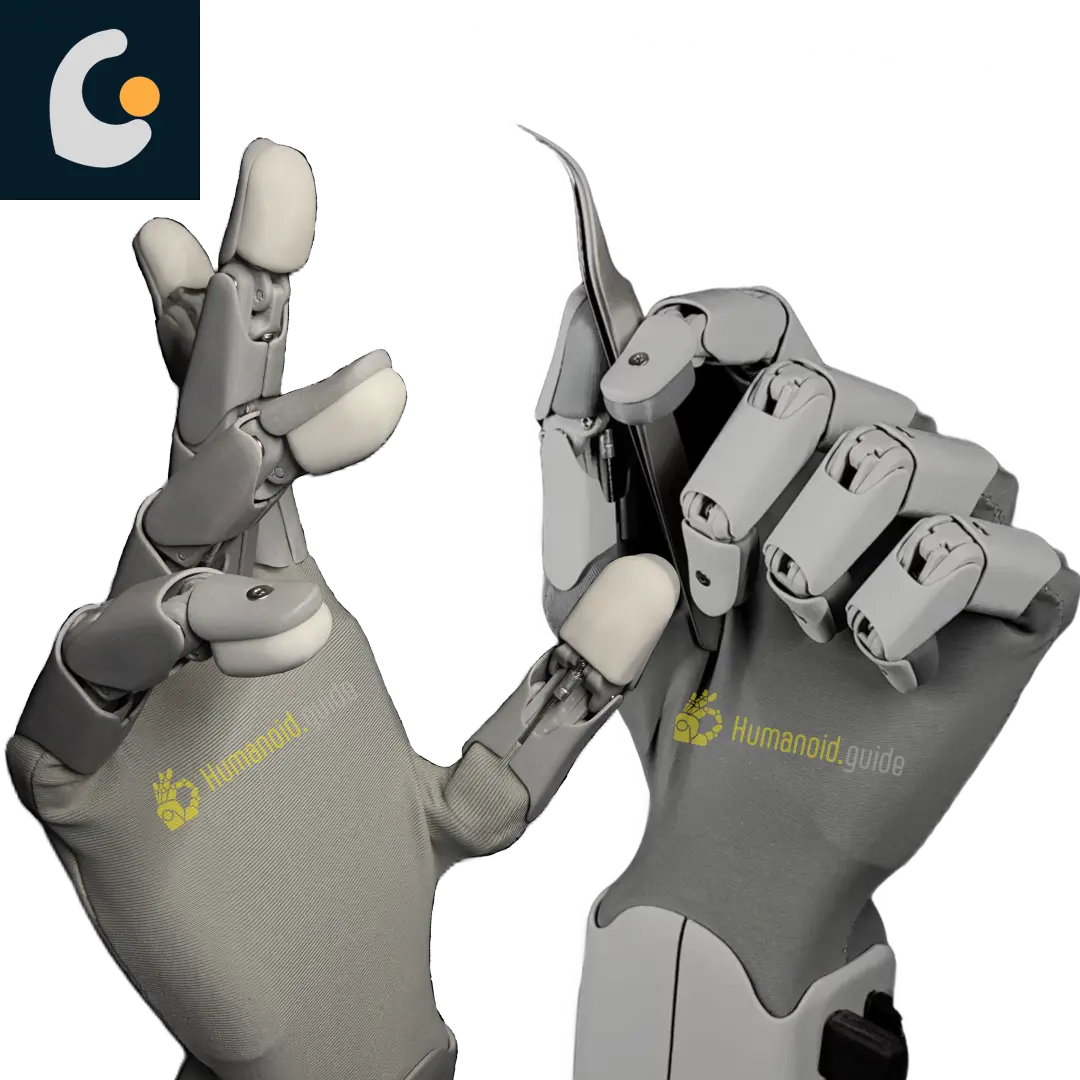
What is the Hw1?
The Gesture Platforms HW1 is a lightweight, five-fingered robotic hand and wrist designed for research, teleoperation, automation, and creative projects. Manufactured in Canada by Gesture Platforms, it weighs only 0.475 kg and offers 10 degrees of freedom across 19 joints. The hand uses a combination of direct-drive and tendon-driven actuation to deliver precise, human-like dexterity. It includes tactile and force sensors for feedback and is constructed from 3D-printed composite and metal hardware. The HW1’s open, customizable software and hardware allow researchers and developers to adapt it to a wide range of tasks, from grasping delicate objects to remote manipulation. Priced at $1,399, it is an accessible platform for exploring robotic manipulation.
Specifications
Here are the full technical specifications.
| Spec | Value |
|---|---|
| Height | Not specified |
| Weight | 0.475 kg |
| Degrees of freedom | 10 |
| Battery life | Wired (no battery) |
| Max speed | N/A |
| Payload | 3 kg (gripping strength) |
| Price (new) | $1,399 |
| Price (used range) | N/A (pre-order) |
Price & Value
New MSRP: $1,399
Used range: N/A
At $1,399, the HW1 is competitively priced among research-grade robotic hands, which can cost $5,000–$50,000. This makes it an affordable entry point for academic labs, makers, and tinkerers. As a pre-order prototype, depreciation is uncertain, but given the niche market, used units may hold value well if the platform gains adoption. Total cost of ownership is low due to its simple wired power and standard materials.
Who Is It For?
Best for: - Academic robotics labs needing an affordable, customizable hand for dexterous manipulation research (10 DOF, 3 kg grip strength) - Teleoperation and remote handling projects requiring lightweight, sensor-equipped end-effectors - Hobbyists and makers experimenting with robotic hands under $2,000
Not for: - Heavy industrial gripping tasks (3 kg grip strength insufficient for heavy loads) - Mobile humanoid applications needing integrated battery and onboard computing (wired, no battery) - High-speed pick-and-place operations (designed for dexterity, not speed)
Alternatives & Comparison
The HW1 competes with other low-cost robotic hands such as the Haddington Dynamics Dexter and the Yale OpenHand, though each serves different dexterity needs.
| Model | Price | Available | Key Difference |
|---|---|---|---|
| Haddington Dynamics Dexter Hand | ~$1,500 | yes | Fully assembled, proven in NASA and research labs. |
| Yale OpenHand Model T | ~$800 | yes | Open-source, 4 DOF, simpler design. |
| Shadow Dexterous Hand Lite | ~$120,000 | yes | 24 DOF for advanced dexterity research. |
Verdict: For labs and developers on a budget under $2,000, the Gesture Platforms HW1 offers an excellent balance of dexterity (10 DOF), weight, and customizability. The Haddington Dynamics Dexter is a close rival with similar pricing and a track record, but the HW1’s tendon-driven design may yield more natural motion. The Yale OpenHand is even cheaper but offers far fewer degrees of freedom, making the HW1 the better choice for complex manipulation tasks. If you need industrial payloads or battery operation, neither fits.
Use Cases & Capabilities
Research and Education
University labs can use the HW1 to teach robotic manipulation and conduct experiments in dexterous grasping. Its 10 DOF and tactile sensors provide a realistic platform for studying force control and object interaction. The hand’s lightweight design permits mounting on small arms or custom gantries. At $1,399, it is affordable enough for multiple units, enabling classroom or multi-student projects.
Teleoperation and Remote Handling
The HW1 is ideal for teleoperation setups where a human operator controls a remote hand. Its low weight (0.475 kg) reduces inertia on slave arms, improving response. Force sensors give operators haptic feedback, which is critical for delicate tasks like circuit board handling or medical training. The customizable hardware allows integration with glove controllers or motion tracking systems.
Maker and Hobbyist Projects
Tinkerers can incorporate the HW1 into personal robotics, animatronics, or art pieces. Gesture Platforms emphasizes user-friendly software, so programming basic grasping sequences requires minimal coding. The 3D-printed composite body can be modified or replaced with custom parts. Its direct-drive and tendon architecture provides a rewarding challenge for those who enjoy reverse engineering and customization.
Creative Robotics & Art Installations
Artists and designers can use the HW1 to create interactive sculptures that respond to touch or movement. The five-fingered hand with natural articulation adds a human-like element to installations. With open software, creators can synchronize hand motions with lighting, sound, or video. The relatively low cost means artists can dedicate budget to other installation components while still having a sophisticated robotic element.
History & Background
Gesture Platforms is a Canadian company founded to develop accessible robotic manipulation solutions. The HW1 hand was announced as a lightweight, customizable platform aimed at bridging the gap between expensive research hands (often over $10,000) and low-function hobby systems. The hand’s 19 joints and 10 DOF are realized through a hybrid actuation system combining direct-drive for strength and tendons for compliance. While specific founding dates and earlier iterations are not publicly documented as of 2026, the HW1 has been positioned as a pre-order prototype with an emphasis on open hardware and software. The company encourages users to modify and share designs, aiming to build a community around the platform. Early adoption is expected in academic and teleoperation projects, with commercial shipments anticipated to begin in the coming months.
Buying Used — What to Check
Verify assembly and tendon condition Tendon-driven hands can wear over time; ensure all joints move smoothly and there is no cord fraying.
Check for software and firmware updates Early prototypes may have bugs; updated firmware ensures compatibility with your control stack.
Confirm compatibility with your intended gripper software The HW1’s open platform may need specific integration work with ROS, custom drivers, or teleoperation interfaces.