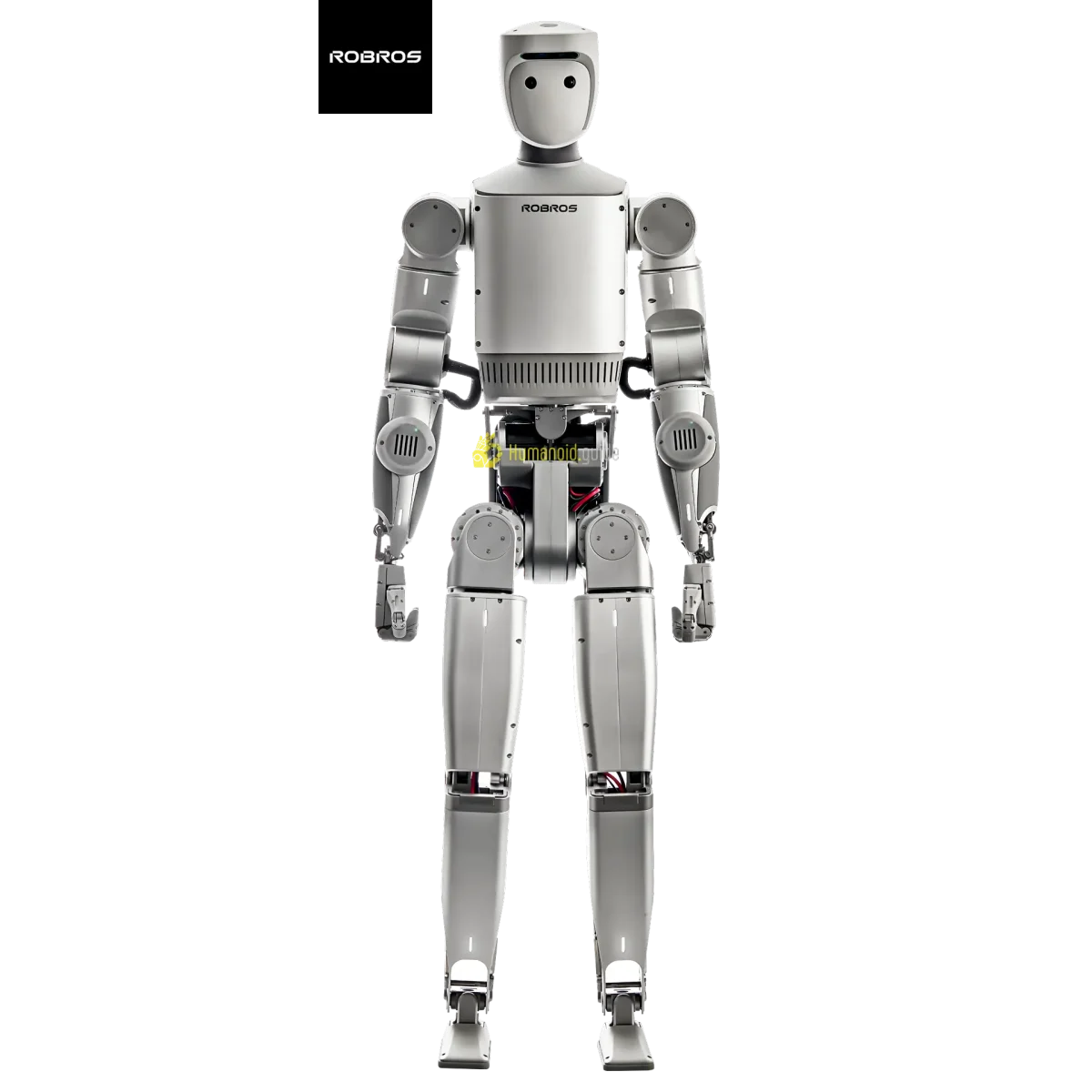
What is the Igris C?
The IGRIS-C is a commercial humanoid robot from South Korean manufacturer Robros, purpose-built for internal logistics and stock replenishment in industrial environments. Standing at 154 cm and weighing 56 kg, it features 43 degrees of freedom, including 6 per hand, enabling precise manipulation. A NUC i7/Nvidia Jetson Nano combination powers onboard perception and control, running on a Linux OS. The robot is rated for interaction near humans, with an aluminium structure and a 6 kg payload capacity. It walks at up to 2.1 km/h and reaches a top speed of 3.6 km/h, offering a 2-hour battery runtime per charge. As a dedicated logistics variant of the broader IGRIS platform, it targets manufacturing facilities requiring autonomous replenishment of parts and materials.
Specifications
Here are the full technical specifications.
| Spec | Value |
|---|---|
| Height | 154 cm |
| Weight | 56 kg |
| Degrees of freedom | 43 |
| Battery life | 2 hours |
| Max speed | 3.6 km/h |
| Payload | 6 kg |
| Price (new) | $110,000 |
| Price (used range) | N/A (no used market data yet) |
Price & Value
New MSRP: $110,000
Used range: Uncertain – few second-hand units exist
At $110,000, the IGRIS-C occupies a competitive niche among industrial humanoids, significantly undercutting the UBTECH Walker S (~$150,000). This price point makes it accessible for mid-tier manufacturers looking to automate internal logistics without the premium of top-tier, more dexterous robots. The value proposition is strongest in repetitive, structured tasks where its 6 kg payload and 2-hour runtime suffice. Depreciation is likely moderate given the early stage of the market, but as more humanoids enter service, residual values may dip to an estimated $80,000–$100,000 after a few years. Total cost of ownership must account for periodic maintenance, potential battery swaps, and software updates, but Robros has not publicly disclosed service plans. Compared to leasing a comparable robot hourly, outright purchase could break even within 18–24 months in high-utilization scenarios.
Who Is It For?
Best for: - Factory warehouses needing autonomous bin-to-line part delivery (6 kg payload covers many small-component logistics) - Manufacturers wanting a humanoid form factor to navigate existing human-centric aisles without infrastructure changes
Not for: - Heavy palletizing or machinery tending (payload limited to 6 kg, far below industrial cobot arms) - 24/7 operations without charging infrastructure (only 2 hours of runtime, non-swappable battery as far as known)
Alternatives & Comparison
The IGRIS-C squares off against other commercially available humanoids in the $100–200k range, balancing cost against advanced capabilities.
| Model | Price | Available | Key Difference |
|---|---|---|---|
| UBTECH Walker S | ~$150,000 | enterprise-only | Higher payload (8 kg per arm) and more advanced dual-arm manipulation |
| Fourier GR-2 | ~$120,000 (est.) | preorder | Better battery life (up to 4 hours) and integrated force torque sensors for delicate handling |
Verdict: If your primary need is cost-effective internal logistics with a bipedal form, the IGRIS-C wins decisively on price. For heavier payload tasks or longer shifts, the Walker S or GR-2 justify their premiums. Buyers focused purely on moving parts should opt for the IGRIS-C; those needing versatile manipulation or extended runtimes will be better served by alternatives.
Use Cases & Capabilities
Factory Internal Logistics
The IGRIS-C navigates factory floors to transport components between inventory racks, assembly stations, and packing areas. Its 6 kg payload is sufficient for most small parts, fasteners, and sub-assemblies. Bipedal locomotion allows it to use the same pathways as human workers, avoiding the need for dedicated automated guided vehicle (AGV) lanes. The robot’s 2-hour shift aligns well with typical break patterns, enabling recharge during operator rests. However, without external vision sensors, it may struggle in environments with heavy forklift traffic or dynamic obstacles.
Stock Replenishment in Retail Warehouses
In e-commerce fulfillment centers, the IGRIS-C can autonomously restock shelves from bulk storage, picking items up to 6 kg. Its humanoid dexterity (43 DOF) allows it to handle irregularly shaped goods that wheeled robots often drop. The robot’s compact height of 154 cm lets it operate in mezzanine levels designed for human pickers. Battery life may limit it to short bursts of activity, making it ideal for peak-time supplement work rather than continuous duty. Integration with warehouse management systems via Linux and standard APIs streamlines deployment.
Assembly Line Kitting
On mixed-model assembly lines, the IGRIS-C can pre-assemble kits of parts and deliver them to line-side stations. Its hands, each with 6 DOF, can grasp a variety of shapes reliably. The robot’s aluminium structure and safe-interaction design allow it to work within arm’s reach of human assemblers. Payload limitations mean it won’t carry heavy castings, but it excels with electronic components, brackets, and small hardware. Walking speed of 2.1 km/h keeps pace with slow-moving conveyor lines, ensuring just-in-time delivery.
History & Background
Robros, the South Korean developer, introduced the IGRIS platform as a research-oriented humanoid and later commercialized it as the IGRIS-C variant in 2024. The company, likely founded in the late 2010s or early 2020s, focuses on bipedal robotics for logistics. The IGRIS-C was first built in 2024, targeting the gap between high-cost, full-featured humanoids and lower-cost warehouse automation. No ownership changes have been reported, and as of 2026 the robot remains in active production. Public documentation remains sparse, but early demonstrators showed autonomous walking, object grasping, and rudimentary navigation. Unlike some competitors that are still in pilot phases, Robros asserts the IGRIS-C is commercially available, though direct purchase channels appear enterprise-oriented.
Buying Used — What to Check
Verify battery capacity The 2-hour runtime is critical for logistics tasks; degraded cells could halve operation time and force early replacement.
Inspect joint play 43 DOF means many moving parts; excessive lash or noise in knees, hips, or wrists indicates wear from heavy loads or poor maintenance.
Confirm payload calibration Assure that the robot still handles 6 kg without safety stops, as sensor drift can limit usable payload or cause false failsafes.