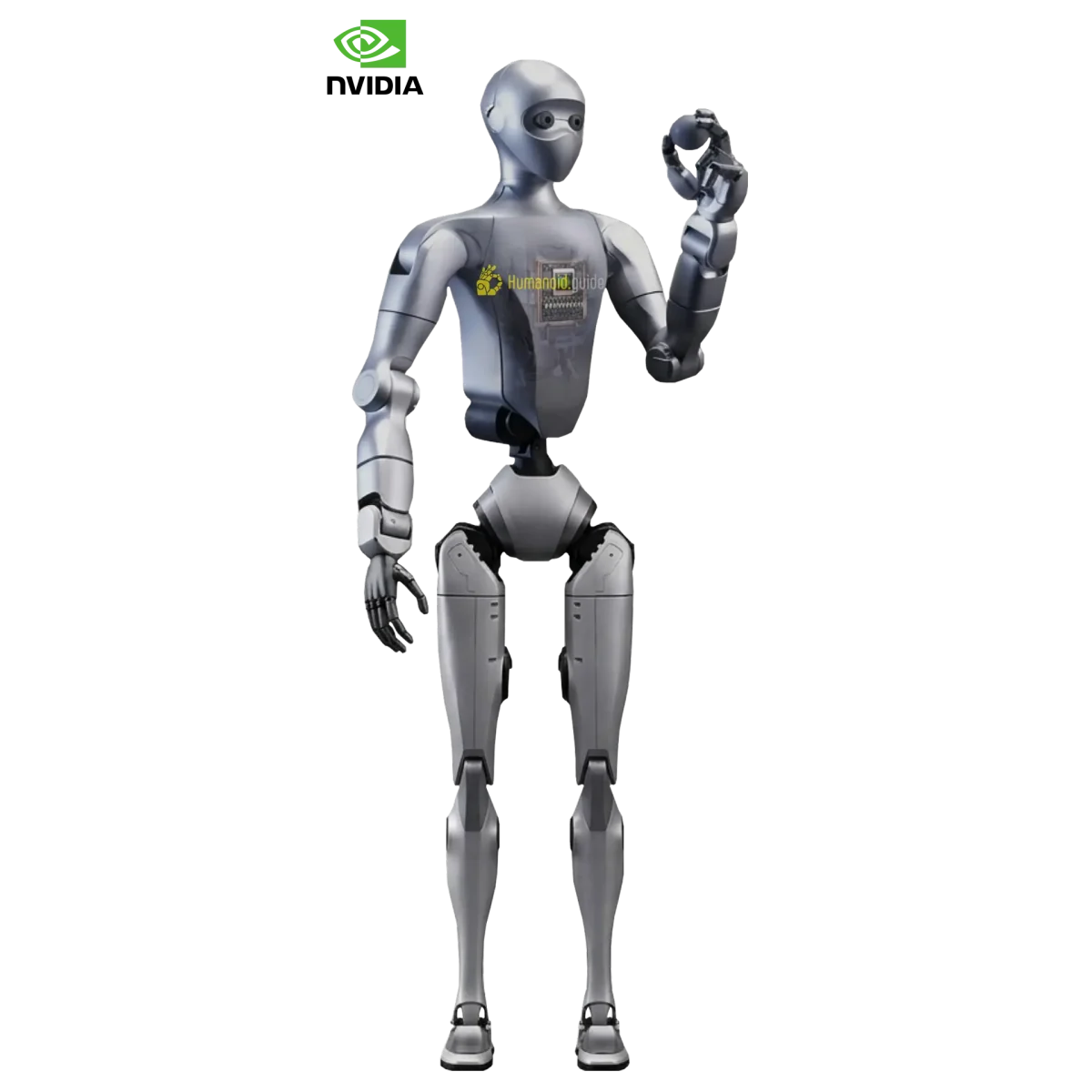
What is the Isaac Gr00t?
The NVIDIA Isaac GR00T is a foundation model and reference design platform for humanoid robots, unveiled by NVIDIA in March 2024. Based in Santa Clara, California, it provides a full-stack solution combining the Jetson Thor system-on-module (2,070 FP4 TFLOPS) with Isaac Sim simulation environment and ROS 2 Humble middleware. The platform includes a Vision-Language-Action (VLA) model family, GR00T N1, enabling robots to reason, understand language, and execute dexterous tasks. NVIDIA positions GR00T as an open ecosystem to accelerate humanoid robot development by offering a reference hardware design with 17 degrees of freedom, stereo vision, and force-torque sensing, ready for reality-to-simulation transfer. The project aims to standardize robot learning across industries.
Specifications
Here are the full technical specifications.
| Spec | Value |
|---|---|
| Height | 170 cm |
| Weight | 68 kg |
| Degrees of freedom | 17 |
| Battery life | Not specified |
| Max speed | Not specified |
| Payload | 14 kg (standing) |
| Price (new) | Undisclosed (contact manufacturer) |
| Price (used range) | N/A |
Price & Value
New MSRP: Undisclosed (contact manufacturer)
Used range: N/A
No official retail price exists for the Isaac GR00T platform, as NVIDIA sells it as a software stack plus engineering support, not a finished robot. Third-party estimates place a reference hardware kit around $8,000, but that figure is based on comparable Unitree robot costs and not confirmed. For enterprise customers, annual licensing and support could range from $10,000 to over $100,000 depending on scale. Compared to building a custom humanoid and training a foundation model from scratch—which may cost millions—GR00T offers massive cost savings if development teams can integrate the reference hardware. The platform’s value lies in shrinking the sim-to-real gap and leveraging NVIDIA’s cutting-edge transformer models, but buyers must accept uncertain long-term support for a still-evolving product. Used units do not exist yet, making total cost of ownership purely an internal R&D investment.
Who Is It For?
Best for: - University robotics labs researching manipulation with limited budget for full custom hardware (17 DOF reference design accelerates sim-to-real) - Startups building service humanoids that need a pretrained VLA model to jump-start learning
Not for: - Industrial deployment in heavy manufacturing (no IP rating, limited payload to 14 kg) - Consumers looking for a ready-to-use home robot (no commercial product exists)
Alternatives & Comparison
The Isaac GR00T competes in the emerging humanoid foundation model space against other software platforms and full-robot solutions.
| Model | Price | Available | Key Difference |
|---|---|---|---|
| Google DeepMind RT-2 | Undisclosed | no | Google’s vision-language-action model not tied to a specific robot hardware reference |
| OpenAI Embodied Foundation Model | Undisclosed | no | No dedicated humanoid reference design; limited public release |
| Sanctuary AI Carbon | Undisclosed (no public price) | preorder | Full humanoid robot with proprietary foundation model; hardware available for pilot programs |
Verdict: For organizations that already have a robot and need a smart brain, GR00T or RT-2 offer strong choice. But if you need a complete, working humanoid, Sanctuary AI Carbon delivers hardware today, albeit at unclear pricing. GR00T’s reference design reduces integration guesswork for those who want a NVIDIA-supported path.
Use Cases & Capabilities
Humanoid Robot Foundation Model Training
The GR00T platform provides pretrained VLA models for dexterous manipulation, locomotion, and tool use. Researchers can fine-tune on their own robot via Isaac Sim simulations, reducing real-world data needs. The 17-DOF reference design is sufficient for basic whole-body tasks, but multi-fingered hand control requires integrating aftermarket end-effectors. NVIDIA’s Jetson Thor onboard compute delivers 2,070 FP4 TFLOPS, enough to run large transformer models in real time. Early adopters report significant speed-up in learning complex behaviors like dual-arm coordination.
Sim-to-Real Transfer Research
Using the Isaac Sim environment, developers can test policies in high-fidelity virtual worlds before deploying on physical reference hardware. The platform supports domain randomization and sensor simulation for robust model training. Transfer to real robots requires careful calibration, but NVIDIA provides ROS 2 packages to streamline the pipeline. Compared to open-source alternatives, GR00T users see a smaller sim-to-real gap thanks to photorealistic rendering and tight hardware-in-the-loop support. This makes it ideal for academic labs studying transfer learning for humanoids.
Logistics Pilot Deployments
The reference design’s 14 kg standing payload and basic mobility suit light material handling in warehouses. However, the lack of an IP rating and unconfirmed battery runtime limit 24/7 operation. Developers can integrate the foundation model into custom logistics robots, leveraging NVIDIA’s perception stack for object detection and grasping. Pilot deployments in controlled environments are ongoing, with early results showing consistent box stacking and bin picking under supervision. Widespread adoption awaits a more robust hardware specification and certified safety features.
Healthcare Assistance R&D
GR00T’s language understanding and gentle manipulation abilities make it a candidate for assistive care research. The platform can interpret verbal commands and perform tasks like fetching items, but safety in human-occupied spaces remains unproven. Researchers can use the reference hardware to prototype patient interaction flows, though additional compliance and certifications would be needed for real hospitals. The low payload and uncertain runtime restrict it to lightweight tasks such as delivering medication trays in a controlled ward.
History & Background
NVIDIA Corporation, founded in 1993 and headquartered in Santa Clara, California, entered humanoid robotics with Project GR00T (Generalist Robot 00 Technology) in 2023. CEO Jensen Huang announced the Isaac GR00T platform at GTC 2024 on March 18, 2024, revealing the Jetson Thor compute module and the GR00T foundation model initiative. The platform builds on NVIDIA’s existing Isaac robotics ecosystem, including Isaac Sim (formerly Isaac Gym) and the Nova Orin sensor suite. In early 2025, NVIDIA released GR00T N1, the first open VLA model for humanoids, targeting simple grasping and walking. A larger model, GR00T N1.6, followed in January 2026 with improved multi-step reasoning. The reference hardware design draws from NVIDIA’s collaboration with Unitree Robotics, likely based on the H-series, though no branded “GR00T robot” is sold. As of 2026, the platform remains in active development, with limited pilot programs and no set commercial launch date.
Buying Used — What to Check
Verify compute module revision Jetson Thor firmware updates may affect compatibility with the latest GR00T foundation models.
Confirm sensor suite integrity Reference hardware relies on stereo cameras and IMU; any damage can degrade sim-to-real performance.
Check NVIDIA licensing transferability Foundation models may be tied to subscription accounts, limiting their use on second-hand hardware.