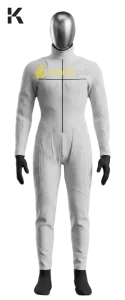
What is the Kai Kinetix?
The KAI is a mid-sized humanoid robot designed by Kinetix AI, a Shenzhen-based startup founded in 2022. It targets research, education, and light service applications, featuring elastomeric finger joints for compliant, human-like grasping. The base model has 26 degrees of freedom, a 172 cm height, and weighs 52 kg. It walks at 3.6 km/h, lifts 10 kg, and runs for 2 hours on a charge. Compute is handled by an NVIDIA Jetson Orin, with Ubuntu 22.04 and ROS 2. An Intel RealSense depth camera provides perception. An optional dexterous hand variant (72 DOF per hand) boosts total DOF to 115 for advanced manipulation research. The robot is open-platform and competitively priced at $35,000, making humanoid technology accessible to more labs and startups.
Specifications
Here are the full technical specifications.
| Spec | Value |
|---|---|
| Height | 172 cm |
| Weight | 52 kg |
| Degrees of freedom | 26 |
| Battery life | 2 hours |
| Max speed | 3.6 km/h |
| Payload | 10 kg |
| Price (new) | $35,000 (pre-order) |
| Price (used range) | N/A |
Price & Value
New MSRP: $35,000 (pre-order)
Used range: N/A (no used units yet)
At $35,000, the KAI is positioned as an affordable humanoid for research and education, significantly undercutting competitors like Unitree H1 ($90,000) or Boston Dynamics Atlas (enterprise-only). The pre-order pricing is subject to change, but initial deposits are around $5,000. For buyers, the total cost of ownership is modest due to electric servo actuators and standard ROS 2 software, reducing maintenance and integration costs. Resale value is uncertain as the market for used humanoids is nascent; early adopters may face depreciation if demand remains low. However, the optional dexterous hands (sold separately) could boost capability and resale value. Compared to a similarly sized but far less capable NAO robot, the KAI offers dramatically greater physical capability for only a few times the cost.
Who Is It For?
Best for: - University robotics labs seeking an affordable humanoid platform for locomotion and manipulation research (26 DOF, ROS 2, NVIDIA Jetson). - Light service and hospitality applications where human-like interaction and gentle object handling are needed (elastomeric fingers). - Teleoperation and R&D projects requiring easy integration with open-source software and standard sensors.
Not for: - Heavy industrial lifting tasks (10 kg arm payload is insufficient for moving heavy components). - Outdoor operation in rain or dust (no IP rating for ingress protection). - Budget-constrained hobbyist projects (minimum $35,000 entry price).
Alternatives & Comparison
The KAI enters the mid-range humanoid market alongside established and emerging players, each with different trade-offs.
| Model | Price | Available | Key Difference |
|---|---|---|---|
| Unitree H1 | $90,000 | pre-order | Higher payload (20 kg) and faster walk (5.4 km/h), but 2.5× the cost. |
| Fourier GR-1 | Undisclosed | enterprise-only | 44 DOF bipedal platform with larger form factor, but no public pricing limits adoption. |
| PAL Robotics REEM-C | ~$200,000 (est.) | available | Proven research platform with long support history, but outdated specs and far more expensive. |
Verdict: For cash-strapped labs and startups, the KAI offers the best cost-to-capability ratio among 1.7 m class humanoids. If heavy lifting or outdoor durability are priorities, the Unitree H1 justifies its higher price. The REEM-C remains the safest choice for funded institutions needing guaranteed support, but its cost is prohibitive for most buyers. Overall, the KAI is the smart buy for teleoperation and light service research in 2026.
Use Cases & Capabilities
Research and Education
The KAI’s 26-DOF base platform, combined with ROS 2 and NVIDIA Jetson Orin, enables rapid development of whole-body control and computer vision algorithms. Its elastomeric fingers allow grasping studies without delicate force sensors, and the $35,000 price puts it within reach of many university grants. However, the 2-hour battery limits continuous experimentation, requiring charging or swap stations in lab setups. Researchers can also upgrade to the dexterous hand option for advanced dexterity projects.
Teleoperation
With an Intel RealSense depth camera and Wi-Fi/Ethernet connectivity, the KAI is ideal for remote operation tasks in hazardous or distant environments. Its human-sized form and articulated arms provide an intuitive mapping for a teleoperator’s movements, and the 10 kg arm payload allows manipulation of tools and inspection devices. Latency remains a concern for precise tasks, as no glass‑to‑action figures have been published, so real‑world testing is advised before mission‑critical deployments.
Light Service and Hospitality
Standing at 172 cm, the KAI can navigate hallways and interact with humans at eye level, making it suitable for greeting guests or delivering items in hotels. The elastomeric finger joints provide a compliant, safe grip for handling fragile objects like glasses or documents. Its walk speed of 3.6 km/h is slower than a brisk walk, which may limit some service scenarios, but its integration with LLMs can enable natural language interactions, enhancing customer experiences. The open ROS 2 stack also allows customizing behaviors for specific venues.
Industrial Light Assembly
The KAI’s precision elastomeric joints and 10 kg payload enable it to pick and place components in light manufacturing lines. Its Intel RealSense camera allows part identification and quality inspection. However, the lack of an IP rating restricts deployment to clean, indoor factory areas, and integration with existing industrial systems requires custom ROS nodes. Despite these limitations, the open platform simplifies customization compared to more closed commercial robots.
History & Background
Kinetix AI was founded in 2022 in Shenzhen, China, by a team of robotics engineers from top Chinese universities. The company announced the KAI humanoid in 2023 as a pre-production prototype, debuting at the World Robot Conference with a 125 cm tall, 25 kg early model. By 2024, the design evolved to a 172 cm, 52 kg production model with improved specs: 26 DOF, 2-hour battery, and 10 kg payload. The robot gained attention for its elastomeric finger joints that mimic human grip compliance without complex force sensors. In 2025, Kinetix AI introduced an optional dexterous hand variant with 72 DOF hands, pushing total DOF to 115, while maintaining the same base platform. The company currently markets the KAI for research, education, and light service, aiming to undercut Western humanoids on price. As of 2026, the KAI remains in pre-order with shipments expected to begin later this year.
Buying Used — What to Check
Check firmware updates Early pre-order units may have software issues that require fixes only available from Kinetix AI; ensure the robot runs the latest ROS 2 packages.
Verify battery capacity Lithium-ion batteries in early batches could show degradation if rarely charged; ask for a runtime test to confirm remaining life.
Inspect elastomeric fingers The soft material may wear from heavy use; look for tears, permanent deformation, or loss of grip compliance.