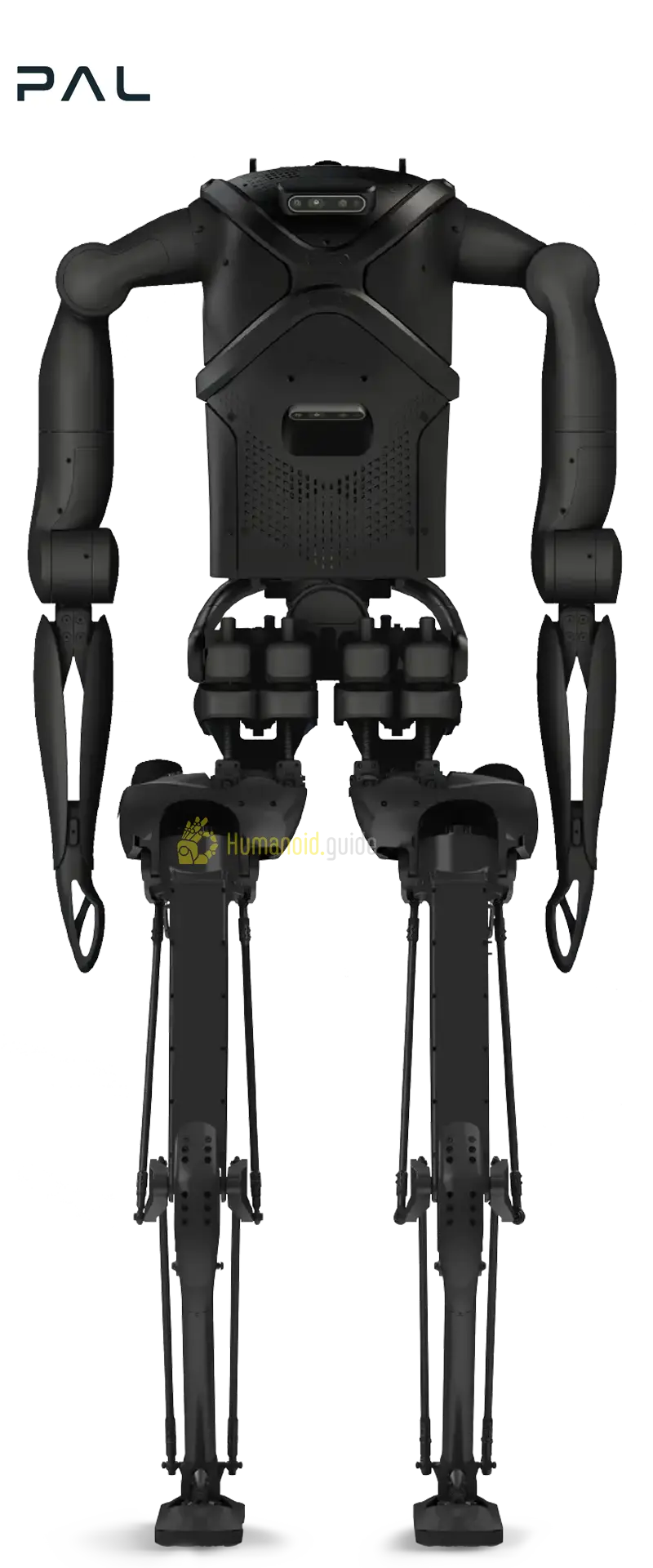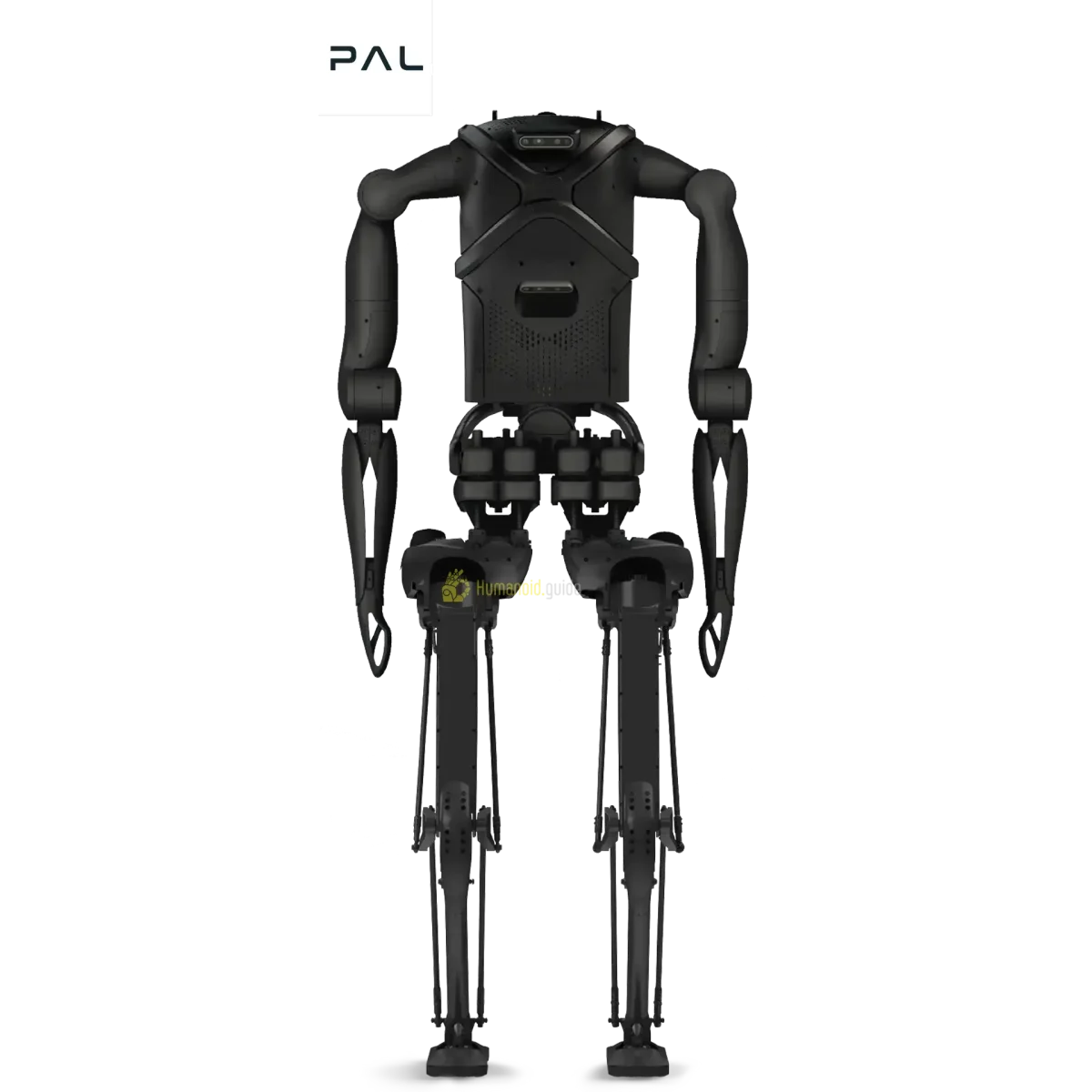
What is the Kangaroo?
The Kangaroo is a bipedal humanoid robot developed by PAL Robotics, a Spanish robotics company headquartered in Barcelona. Unveiled in 2024, it stands 160 cm tall and weighs 40 kg, making it one of the lighter full-scale humanoids. The robot features 28 degrees of freedom and a distinctive inverted knee joint design for dynamic locomotion and agile turning. It is built on an open-source software stack including Linux, Ubuntu, and ROS, targeting academic and applied research. The Kangaroo carries up to 20 kg and walks at a maximum speed of 4.5 km/h with a 6-hour battery life. As a pre-order prototype, it reflects PAL Robotics' accumulated experience from earlier platforms like REEM-C and TALOS, emphasizing mobility and programmability for laboratories and early-adopter industrial applications.
Specifications
Here are the full technical specifications.
| Spec | Value |
|---|---|
| Height | 160 cm |
| Weight | 40 kg |
| Degrees of freedom | 28 |
| Battery life | 6 hours |
| Max speed | 4.5 km/h |
| Payload | 20 kg |
| Price (new) | Undisclosed (contact manufacturer) |
| Price (used range) | N/A (no used units yet) |
Price & Value
New MSRP: Undisclosed (contact manufacturer)
Used range: N/A (pre-order only; no used units exist as of 2026)
PAL Robotics has not publicly disclosed a price for the Kangaroo, consistent with its early prototype stage. Pricing is expected to align with the company's previous humanoids: the REEM-C was offered at roughly €100,000, while the TALOS research platform exceeded €400,000. If the Kangaroo enters serial production at a volume similar to REEM-C, it could land in the low-six-figure range. Competitive pressure from Fourier's GR-2 and UBTECH's Walker S, which have begun shipping, may push PAL to offer aggressive pre-order incentives. Because no units have reached customers, depreciation and used-market dynamics are unknown; early adopters will likely treat Kangaroo as a long-term research investment. Total cost of ownership will hinge on maintenance contracts and on-site support availability through PAL's Barcelona hub.
Who Is It For?
Best for: - University robotics labs needing a lightweight bipedal platform with 28 DOF for dexterous manipulation and walking studies. - Researchers focusing on dynamic locomotion with an inverted knee design that enables rapid turning and stair climbing. - Industrial R&D teams evaluating humanoids for light material handling tasks up to 20 kg without heavy safety guarding.
Not for: - Heavy manufacturing or assembly lines requiring payloads above 20 kg — the Kangaroo is not rated for high-load carrying. - Organizations seeking an immediately available, off-the-shelf humanoid — Kangaroo is still a pre-order prototype with no field-proven deployment.
Alternatives & Comparison
In the early-stage bipedal humanoid market, the Kangaroo competes against other prototypes and newly commercial alternatives aiming to prove viability in research and light industry.
| Model | Price | Available | Key Difference |
|---|---|---|---|
| Fourier GR-2 | Undisclosed | preorder | Greater DOF (60) and higher payload, but heavier and less established ROS integration. |
| UBTECH Walker S | ~$150,000 (est.) | yes | Commercially shipping with proven industrial deployments and enterprise support. |
| Tesla Optimus | Undisclosed | preorder | Tesla's manufacturing scale ambition and AI-driven vision system, but no delivery timeline. |
Verdict: For researchers who value a lightweight body, strong ROS/Ubuntu ecosystem, and an innovative leg design, the Kangaroo is the most agile and open platform among pre-order humanoids. The UBTECH Walker S is the safest bet for organizations needing a shipping product with industrial track record, while Tesla's Optimus and Fourier's GR-2 offer higher payloads but remain speculative. Until PAL Robotics announces formal pricing and delivery dates, the Kangaroo is best suited for well-funded labs willing to co-develop with the manufacturer.
Use Cases & Capabilities
Academic Research and Education
The Kangaroo serves as a flexible platform for university labs studying full-body humanoid control. Its 28 DOF and ROS compatibility allow researchers to implement and test algorithms for walking, grasping, and human-robot interaction. The inverted knee design provides a unique testbed for comparing locomotion strategies. With a 6-hour battery, students can run extended experiments without frequent recharging. PAL's open-source toolchain lowers the barrier for curriculum integration.
Dynamic Locomotion Development
Engineers exploring agile bipedal movement will appreciate the Kangaroo's 4.5 km/h top speed and inverted knee joints that enable quick direction changes. The lightweight 40 kg body reduces inertia, making it safer to test dynamic maneuvers like jumping or rapid step recovery. PAL's simulation models and ROS-based control stack allow simulation-to-reality transfer. This use case targets labs advancing legged locomotion beyond traditional ZMP-based walking.
Light Industrial Material Handling
With a 20 kg payload, the Kangaroo can transport tools or components in warehouses and labs. Its bipedal form navigates spaces designed for humans, moving between workstations without floor modifications. The 6-hour runtime supports a full shift of intermittent tasks, and the Linux/ROS backbone enables integration with existing MES or WMS software. While not yet hardened for heavy industrial environments, it is suitable for small-batch logistics.
Human-Robot Interaction (HRI) Studies
The Kangaroo's humanoid shape and non-threatening height (160 cm) make it a natural candidate for HRI experiments. Researchers can program gestures and speech dialogues using ROS middleware, while the robot's 20 kg strength allows it to give physical demonstrations like object handovers. Its quiet operation and smooth motion (thanks to low gear backlash) improve participant comfort. PAL's previous social robots provide a strong software foundation for HRI applications.
SLAM and Navigation Testing
The Kangaroo can be equipped with LiDAR, depth cameras, and IMU sensors to perform simultaneous localization and mapping (SLAM) in indoor environments. Its 4.5 km/h walking speed enables rapid coverage of large areas, and the 6-hour battery supports long-duration mapping sessions. The ROS navigation stack simplifies customization, and the robust odometry from the leg kinematics enhances map accuracy. This use case appeals to labs developing navigation algorithms for bipedal platforms.
History & Background
PAL Robotics was founded in 2004 in Barcelona, Spain, initially focusing on service robots before moving into humanoids. Early bipeds included REEM (2008), REEM-C (2016), and the TALOS high-torque research platform (2017). The Kangaroo was first announced in 2024 as a next-generation agile biped, incorporating lessons from TALOS's joint actuation and REEM-C's lightweight frame. Its defining feature—inverted knee joints—was inspired by biomechanics to improve dynamic stability and energy efficiency. A prototype was demonstrated at robotics events in 2025, generating academic interest. As of 2026, the Kangaroo remains a pre-order product, with limited prototypes in early-access partner labs. PAL Robotics continues to refine its ROS-based software stack and expects to open general orders once reliability trials conclude. The company maintains all manufacturing and support from its Barcelona headquarters.
Buying Used — What to Check
Verify battery health Lithium-ion packs degrade over time; after 500+ cycles, runtime may fall below 5 hours.
Inspect joint backlash The inverted knee design relies on precise gearing; excessive play can cause walking instability.
Confirm ROS version and software updates Compatibility with the latest ROS 2 Long-Term Support releases is critical for ongoing research.