What is the Kapex Lg?
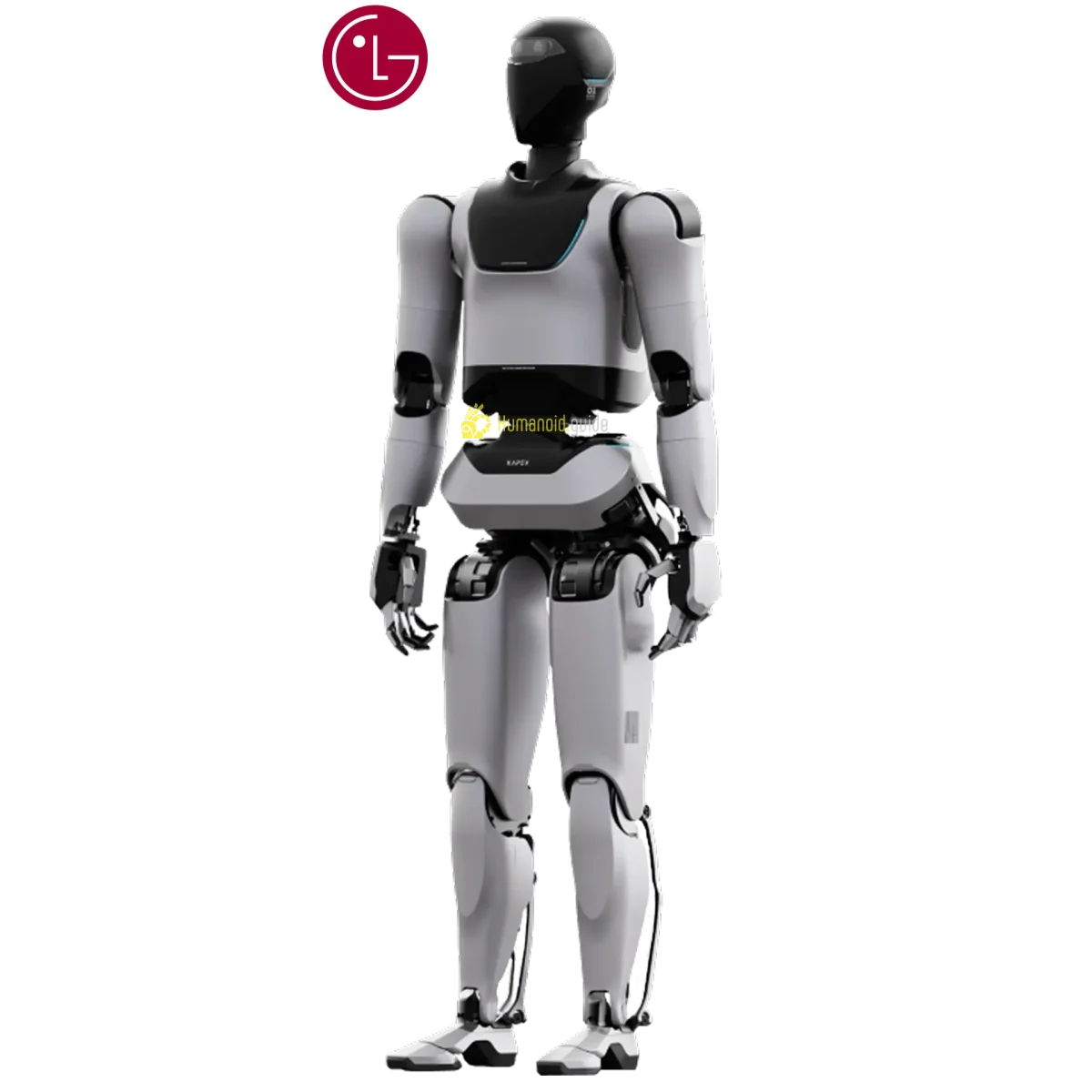
The LG Electronics KAPEX is an AI-powered humanoid robot prototype created jointly by South Korean conglomerate LG Electronics and the Korea Institute of Science and Technology (KIST). Standing 175 cm and weighing 65 kg, it combines up to 50 degrees of freedom — including 20-DOF dexterous hands — with LG’s EXAONE vision-language model (VLM) as its cognitive core. Designed for research in home assistance, logistics, manufacturing, and service robotics, KAPEX demonstrates autonomous navigation at 4.5 km/h, payload handling of 10 kg, and a 3-hour battery life. Uniquely, it integrates high-performance onboard AI compute with multi-modal sensor fusion (stereo RGB, depth, tactile) for real-time world interaction. Currently a research platform, it is not available for commercial purchase.
Specifications
Here are the full technical specifications.
| Spec | Value |
|---|---|
| Height | 175 cm |
| Weight | 65 kg |
| Degrees of freedom | 50 |
| Battery life | 3 hours |
| Max speed | 4.5 km/h |
| Payload | 10 kg |
| Price (new) | Not commercialized (research prototype) |
| Price (used range) | N/A |
Price & Value
New MSRP: Not commercialized
Used range: N/A
As a joint R&D prototype between LG Electronics and KIST, KAPEX has no retail price and no plans for immediate commercialization. Its value lies in its role as a testbed for next-generation AI-driven humanoids, showcasing LG’s EXAONE VLM and advanced actuator technology. Should it ever reach the market, its pricing would likely align with other enterprise humanoids (e.g., $50,000–$150,000), but no official estimates exist. For now, it serves as a benchmark for South Korean robotics capabilities rather than a product for purchase. Researchers and developers can monitor LG’s future announcements for any commercialization path.
Who Is It For?
Best for: - Robotics research labs exploring VLM-driven humanoid control (EXAONE integration offers state-of-the-art AI reasoning) - Collaborative R&D projects in industrial automation and service robotics (10 kg payload, 4.5 km/h mobility) - Universities needing a full-body humanoid for manipulation and navigation studies (50 DOF, tactile hands)
Not for: - Commercial deployment or production floors (prototype-only, no regulatory certifications, IP20 ingress) - Heavy payload tasks (10 kg arms unsuitable for heavy industrial lifting) - Budget-conscious buyers (no pricing exists, but development costs suggest a high six-figure R&D platform if ever sold)
Alternatives & Comparison
KAPEX competes in the research-humanoid space with other AI-driven prototypes. Here’s how it stacks up against notable counterparts that share similar development timelines.
| Model | Price | Available | Key Difference |
|---|---|---|---|
| Tesla Optimus (Gen 2) | ~$25,000 (est., not yet for sale) | no | Tesla’s manufacturing scale and direct integration with EV battery tech; Optimus is further along toward mass production. |
| Figure 02 | Undisclosed (enterprise partnerships only) | no | Figure 02 features OpenAI-powered conversation and has secured industrial pilot contracts, whereas KAPEX remains lab-focused. |
| Boston Dynamics Atlas | Undisclosed (research-exclusive) | no | Atlas offers unparalleled dynamic mobility (backflips, parkour), but lacks integrated VLM and is purely hydraulic; KAPEX emphasizes AI reasoning. |
Verdict: For researchers prioritizing vision-language AI integration and dexterous hands in a single platform, KAPEX is a compelling prototype — outpacing Atlas in AI but lagging in athleticism. Compared to Tesla Optimus or Figure 02, KAPEX faces a longer path to commercialization, but its EXAONE brain could give it an edge in tasks requiring reasoning. For now, it’s a precursor, not a competitor; labs that can collaborate with LG/KIST should pursue it, while those needing an off-the-shelf humanoid will have to wait or choose an alternative like NAO for smaller-scale research.
Use Cases & Capabilities
AI Research & Development
KAPEX serves as a hardware platform for advancing vision-language models in embodied agents. With EXAONE running onboard, researchers can test multimodal perception, task planning, and natural language interaction in real-world settings. Its 50 DOF allow complex manipulation studies, and the 10 kg payload enables handling of everyday objects. The prototype’s 3-hour battery life supports extended experiment runs, though the IP20 rating limits it to lab environments. This makes it ideal for publishing next-gen cognitive robotics papers.
Service Robotics Pilots
In hotel or office scenarios, KAPEX can autonomously navigate corridors (4.5 km/h max, 3.5 km/h walking) and deliver lightweight items (up to 10 kg). The EXAONE VLM enables it to identify guests, understand verbal instructions, and interact safely via visual and tactile sensors. While its 3-hour runtime and lack of commercial certifications prevent real customer-facing deployment, pilot studies can use KAPEX to evaluate human-robot interaction and logistics workflows. Integration with building Wi‑Fi and Ethernet supports remote monitoring.
Industrial Automation Testing
Manufacturers can trial KAPEX for material handling and inspection tasks on pilot lines. Its full-body dexterity and onboard AI allow it to pick, classify, and sort parts without external sensors. The 10 kg payload suits small-part handling in electronics or automotive assembly. However, the IP20 rating and 175 cm height may limit factory-floor compatibility, and the prototype status means no heavy-duty cycle ratings are available. Still, it offers a sandbox for LG’s actuator and gear technologies in production settings.
Logistics Demonstrations
KAPEX can perform last-meter delivery in warehouses or mailrooms, hauling packages up to 10 kg while avoiding obstacles using stereo vision. Its 4.5 km/h top speed and 3-hour endurance are sufficient for short-loop tasks. The EXAONE brain processes inventory labels, reads waypoints, and adapts to dynamic layouts. For logistics integrators, this prototype allows testing of full-body humanoid mobility versus wheeled AMRs, with the potential to handle stairs and uneven surfaces that carts cannot. Certification and durability improvements would be needed for real deployment.
Education & Outreach
Universities can leverage KAPEX as a flagship research platform to teach advanced robotics, AI, and human-robot interaction. The combination of 50 DOF, tactile hands, and a VLM offers students hands-on experience with state-of-the-art systems. LG’s involvement could lead to academic partnerships, providing access to proprietary software stacks. The 175 cm human-scale form factor makes demonstrations engaging for visitors and prospective students. However, the platform is not commercially available, so institutions would need direct collaboration agreements with LG/KIST to obtain a unit.
History & Background
LG Electronics, founded in 1958 and headquartered in Seoul, South Korea, has been expanding its robotics division since the mid-2010s with service robots like CLOi. In 2024, LG and the Korea Institute of Science and Technology (KIST) unveiled KAPEX as a joint research humanoid, first shown at CES 2024 and subsequent trade events. The robot integrates LG’s EXAONE large language model, marking a leap toward VLM-driven physical agents. As of 2026, KAPEX remains a prototype with no announced production timeline. It represents LG’s strategic move into general-purpose humanoids, competing with global tech giants’ robotics initiatives. The project feeds data into LG’s broader AI and actuator technologies for future commercial offerings.
Buying Used — What to Check
Verify hardware revision Prototypes may vary; ensure you receive the latest sensor suite and actuator configuration to match research needs.
Confirm battery health A used prototype’s 3-hour battery may have degraded; request cycle count and runtime test results.
Check calibration of dexterous hands The 20-DOF hands are complex; worn or miscalibrated fingers reduce manipulation accuracy.