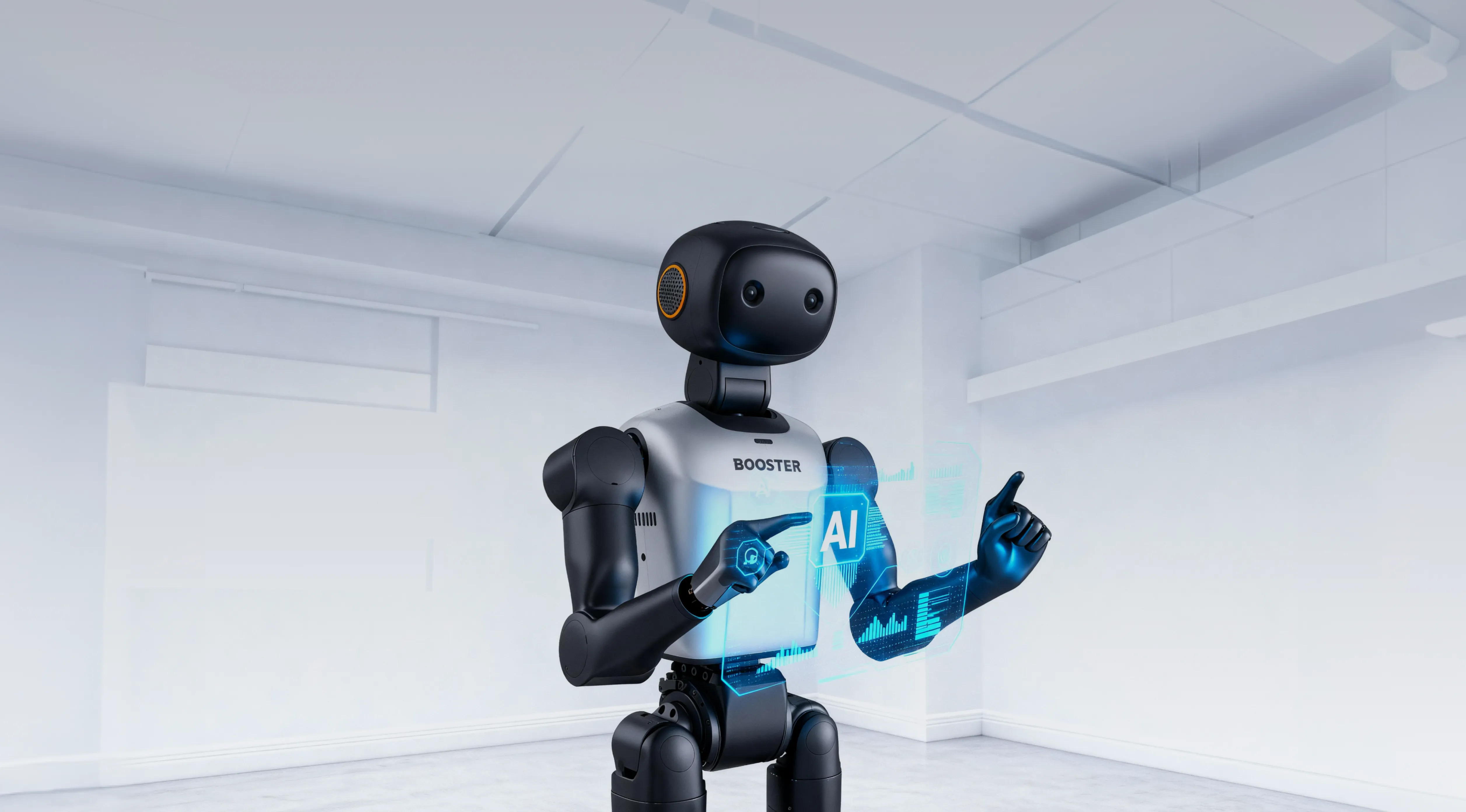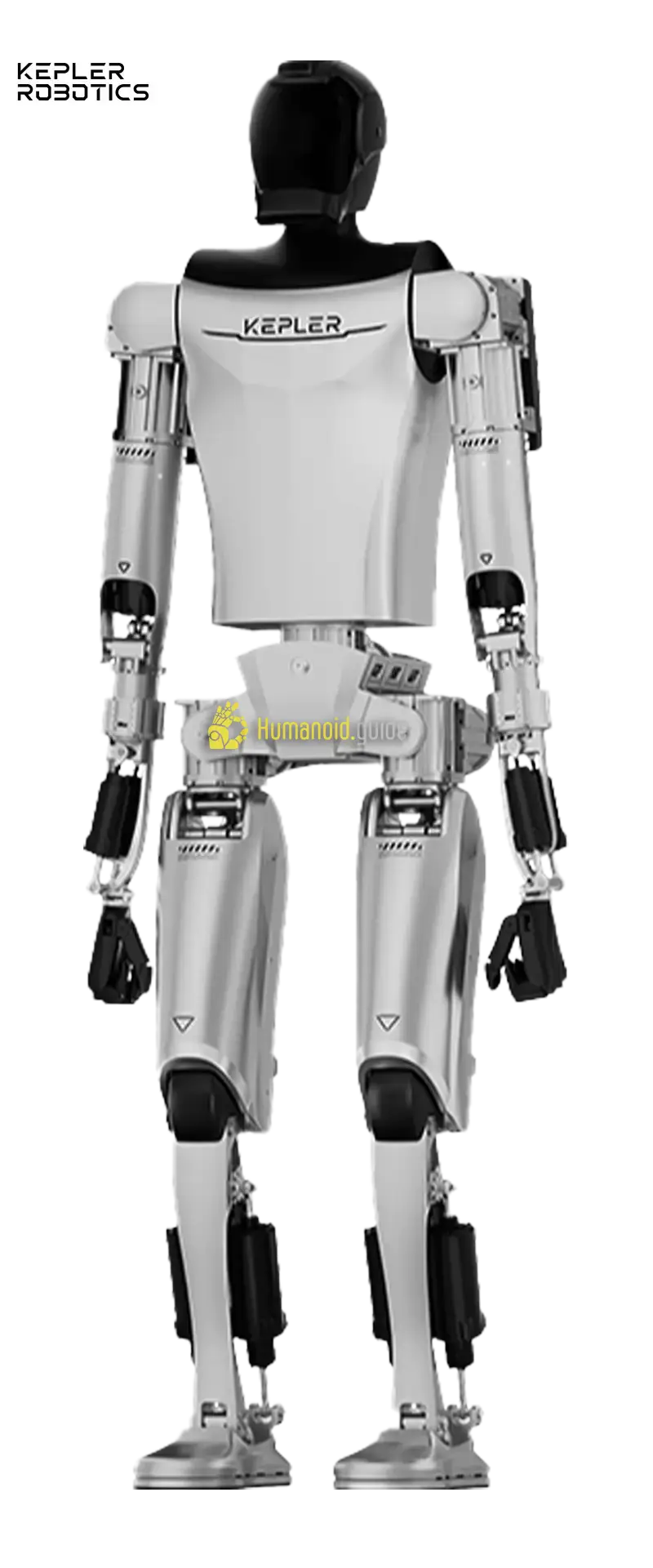
What is the Kepler K1?
The Kepler K1, manufactured by Booster Robotics in China, is a full-scale humanoid robot designed as an introductory embodied development platform. Revealed in 2023, it targets education, research, robotics competitions, and electronic manufacturing. It features 52 DOF for human-like movement, four-DOF arms for gesture tasks, and Doubao LLM integration. Running on a Linux-based robotics framework, it includes up to 200 TOPS compute and a stereo depth camera. With an aluminum alloy body, the K1 claims up to 8-hour battery life and offers a price range that lowers the barrier for academic and industrial humanoid development.
Specifications
Here are the full technical specifications.
| Spec | Value |
|---|---|
| Height | 178 cm |
| Weight | 85 kg |
| Degrees of freedom | 52 |
| Battery life | 8 hours (claimed, 5Ah pack) |
| Max speed | 1.4 km/h |
| Payload | 3 kg (per arm, interaction only) |
| Price (new) | $4,999–$12,500 |
| Price (used range) | $3,500–$10,000 (est.) |
Price & Value
New MSRP: $4,999–$12,500 (Geek to Edu/Pro tier)
Used range: ~$3,500–$10,000 (depreciated used market)
The Kepler K1 enters the market at a disruptive price point: the Geek edition at $4,999 makes it one of the most affordable full-size humanoid robots, while the Edu/Pro tier at $12,500 still undercuts competitors like the Unitree H1 ($90,000) and Fourier GR-1 ($100,000). Its value proposition lies in lower upfront cost for education and research institutions, although buyers should note that the Geek edition includes a smaller 2Ah battery (about 50–80 minutes runtime) compared to the 5Ah pack in higher tiers (up to 8 hours claimed). For teams requiring longer operation or more robust compute, stepping up to the Pro tier is advisable. Depreciation is likely steep in the first year as newer models emerge, but the used market may offer significant savings for budget-conscious labs. Total cost of ownership is low given its simple mechanical design and community support for ROS-based development.
Who Is It For?
Best for: - University robotics labs needing an affordable humanoid platform for manipulation research via 52 DOF - STEM education programs looking for a scalable, low-cost humanoid robot - RoboCup teams requiring a standard platform for humanoid soccer competitions
Not for: - Industrial heavy-payload tasks (no official payload rating, limited manipulation capability) - Outdoor or unstructured environments (no IP rating, limited speed and stability) - Manufacturing floors that require continuous operation beyond 2 hours without battery swap (runtime limited to 50–80 min on base battery)
Alternatives & Comparison
The Kepler K1 competes in the emerging sub-$15k humanoid segment, differentiating itself from higher-priced industrial humanoids by focusing on education and competition scenarios.
| Model | Price | Available | Key Difference |
|---|---|---|---|
| Unitree H1 | $90,000 | yes | Higher joint torque and dynamic running capability, but 18x more expensive, aimed at research and industrial mobility. |
| Fourier GR-1 | $100,000 | yes | Similar 54 DOF with dexterous hands, but far pricier and targeted at healthcare and service. |
| Xiaomi CyberOne | Prototype (not for sale) | no | Concept humanoid with emotional AI, not commercially available; K1 offers actual hardware for developers. |
Verdict: For budget-constrained academic labs, robotics competition teams, and educational institutions, the K1 is the clear winner—it delivers a humanoid platform at a fraction of the cost. However, labs needing high-performance dynamic locomotion or delicate dexterous manipulation should look to the Unitree H1 or Fourier GR-1 despite the higher price. Xiaomi CyberOne remains an aspirational research project with no purchase option.
Use Cases & Capabilities
Embodied AI Research
The K1's 52 DOF body and ROS compatibility make it an ideal testbed for developing and validating embodied AI algorithms. Researchers can explore full-body motion planning, reinforcement learning for locomotion, and human-robot interaction with the integrated Doubao LLM. Its stereo depth camera and up to 200 TOPS on-device compute enable real-time visual SLAM and object recognition experiments. The platform's open software architecture allows integration of custom neural networks, and the affordable price permits multi-unit deployments for comparative studies. However, the limited payload and slow walking speed confine research to controlled lab environments rather than real-world tasks.
Robotics Competition (RoboCup)
The Kepler K1 has been adopted as a standard platform for RoboCup humanoid soccer, where its 52 DOF enable human-like kicks, dribbles, and falls recovery. Teams benefit from a consistent hardware baseline, reducing mechanical variability and focusing development on AI and control strategies. The durable aluminum alloy construction survives the inevitable collisions, and the dual encoder motors provide precise joint feedback. The Geek edition's lower cost allows multiple backup robots for intensive tournament schedules. On the downside, the walking speed of 1.4 km/h is slower than many custom competition bots, requiring clever tactical programming to compensate.
STEM Education and Outreach
With a price starting at $4,999, the K1 breaks the barrier for high schools and community colleges wanting a humanoid robot for STEM curriculum. Students can program gestures, simple navigation, and voice interactions using Python and ROS, gaining hands-on experience with state-of-the-art robotics. The humanoid form factor creates immediate engagement, and the LLM integration opens discussions on AI ethics. Multiple battery configurations let educators choose between shorter, more affordable sessions and longer project hours. Though not suited for heavy payload tasks, the K1 effectively introduces key concepts in kinematics, sensor integration, and human-robot interaction.
History & Background
Booster Robotics, based in China, emerged as a developer of affordable humanoid platforms with the launch of the K1 in 2023. The robot was designed to bring humanoid robotics within reach of universities and competition teams, building on the company’s experience with the smaller Booster T1 robot. The K1 quickly gained attention as a standardized platform for RoboCup humanoid soccer, with a Geek edition priced at an aggressive $4,999 to foster adoption. In 2024, Booster expanded configurations with the Edu/Pro tier, adding larger batteries and enhanced compute. By 2026, the K1 remains in active production, sold directly through Booster Robotics and select distributors, with a growing community of academic and hobbyist users.
Buying Used — What to Check
Verify battery capacity Runtime plummets with degraded batteries; ensure the unit includes a 5Ah pack if long sessions are needed.
Check for missing accessories Kits may lack chargers or cables; replacement parts are sourced directly from Booster Robotics.
Confirm DOF and arm condition Ensure all 52 joints function and arms are not damaged, as repairs can be costly for a niche platform.