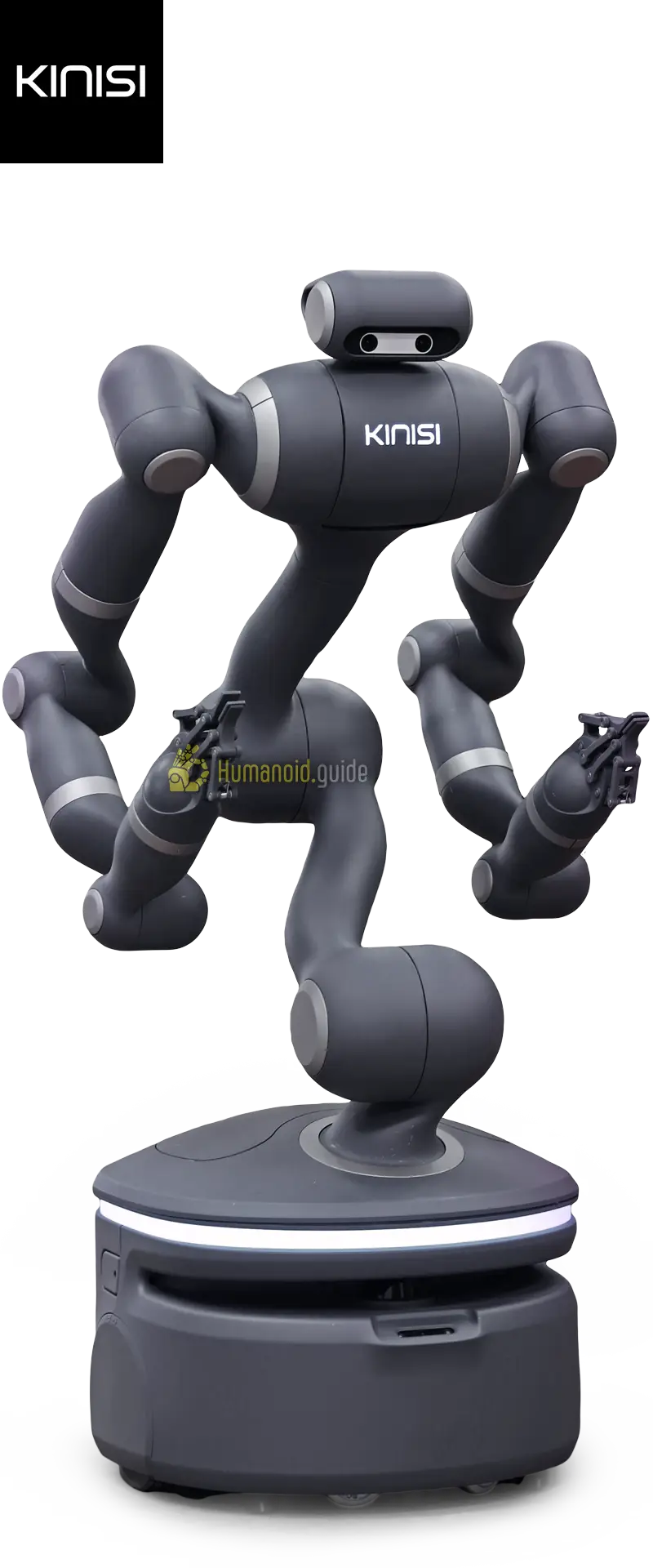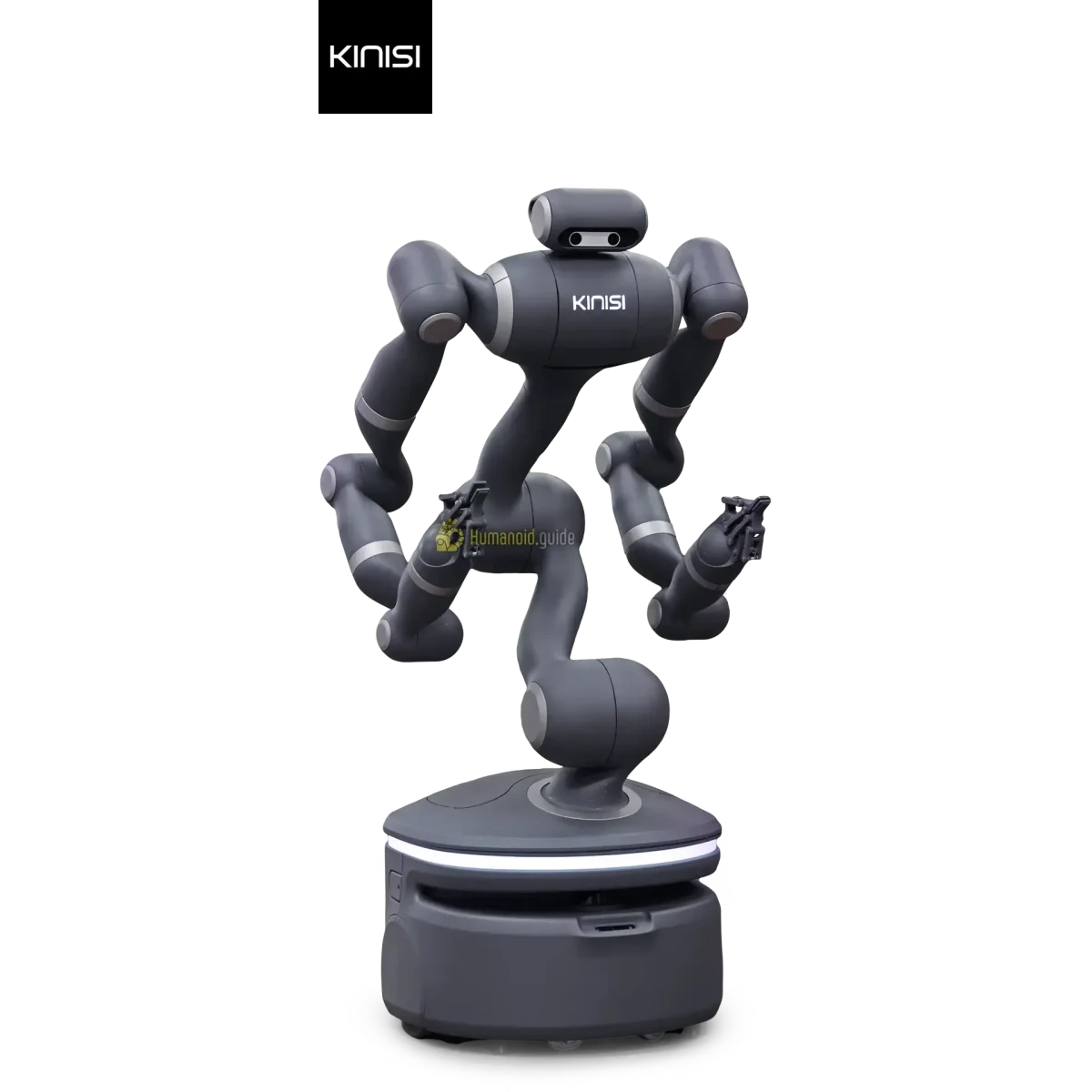
What is the Kinisi Kr1?
The Kinisi KR1 is a general-purpose humanoid robot built by Silicon Valley startup Kinisi Robotics (founded 2024). Designed for logistics and warehousing, it handles tasks from lifting boxes to fine assembly. Standing 162 cm and 100 kg, it has 21 degrees of freedom, 2 in the hands. The robot uses Nvidia Jetson computing, BLDC motors, strain wave gears, and IP65 ingress protection for dusty environments. It walks up to 14.4 km/h and lifts 20 kg, with an 8-hour battery. Currently in prototype phase, the KR1 is priced at $75,000 on pre-order.
Specifications
Here are the full technical specifications.
| Spec | Value |
|---|---|
| Height | 162 cm |
| Weight | 100 kg |
| Degrees of freedom | 21 |
| Battery life | 8 hours |
| Max speed | 14.4 km/h |
| Payload | 20 kg |
| Price (new) | $75,000 |
| Price (used range) | N/A (pre-commercial) |
Price & Value
New MSRP: $75,000
Used range: N/A
At $75,000, the Kinisi KR1 sits in a competitive price bracket for pre-commercial humanoid robots aimed at logistics. It undercuts high-end platforms like the UBTECH Walker S (~$150,000) and Sanctuary AI Phoenix ($200,000+), while being more expensive than the mass-market target of Tesla Optimus ($20,000–$30,000). For warehouses willing to invest early, the IP65 rating and 8-hour battery could justify the cost over lighter-duty alternatives. However, as a prototype, this price excludes potential software licenses, maintenance contracts, and training, which will add to total cost of ownership. Depreciation is likely steep once production units ship with improved reliability, so pre-order buyers should negotiate service guarantees. Overall, the KR1 offers a balance of capability and price, but value ultimately depends on it maturing into a production-ready robot with confirmed uptime and support.
Who Is It For?
Best for: - Logistics companies testing humanoid robotic workers in warehouses (IP65 rating survives dusty conditions and 8h battery covers a full shift). - Early adopters of general-purpose automation seeking a full-size walking robot for material handling tasks (20 kg payload capacity for boxes and parcels). - R&D labs focused on bipedal locomotion and whole-body control in industrial settings, given the 21 DOF and 14.4 km/h top speed.
Not for: - Operations requiring delicate precision assembly or fine manipulation (only 2 hand degrees of freedom and no tactile sensing specified). - Businesses needing high throughput 24/7 automation (unproven reliability and lack of fleet management tools). - Cost-sensitive facilities that can serve their needs with fixed automation or cobots (the $75,000 price and unknown maintenance costs make it a risky investment).
Alternatives & Comparison
The Kinisi KR1 enters a crowded logistics humanoid market dominated by Agility Digit and the emerging low-cost Tesla Optimus.
| Model | Price | Available | Key Difference |
|---|---|---|---|
| Agility Robotics Digit | ~$150,000 (est.) | preorder | Proven warehouse leg design but limited upper-body manipulation vs. full humanoid form. |
| Fourier GR-2 | ~$50,000 (est.) | preorder | 53 DOF offers far greater dexterity, but lacks IP rating and is slower (7.2 km/h). |
| Tesla Optimus | $20,000–$30,000 (target) | preorder | Radically lower price if production targets hold, but early units lack industrial ruggedness. |
Verdict: For early adopters with dusty, fast-paced warehouses, the KR1's IP65 rating and 14.4 km/h speed give it an edge over Digit and Optimus. However, the unproven arm payload and lack of production track record are red flags. If your priority is proven fleet management, Digit's mature ecosystem is a safer bet; if you want maximum dexterity at a low price, Fourier GR-2 offers 53 DOF for around $50,000. The KR1 wins only on paper speed and ruggedness until Kinisi ships working units.
Use Cases & Capabilities
Warehouse Box Handling
The KR1 can navigate warehouse aisles, pick up cardboard boxes of varying sizes, and place them onto conveyor belts or pallets. Its 20 kg payload capacity supports typical e-commerce parcels, and the IP65 rating allows operation in dusty loading docks. The 8-hour battery life matches a standard shift, but rapid recharging or battery swapping would be needed for continuous use. Early prototypes have shown the ability to stand up after falls, which is critical for reliability on uneven floors. Integration with existing warehouse management systems is expected via Wi‑Fi connectivity and Linux-based software.
Palletizing and Depalletizing
In distribution centers, the KR1 can lift boxes or totes onto pallets or remove them for sorting. Its full-size humanoid form provides the reach and mobility to work at standard pallet heights without a fixed arm. The 14.4 km/h top speed allows it to cover long walks between loading bays faster than many wheeled AMRs. However, the current prototype's manipulation performance is rated as minimal (2 out of 5 by third-party listings), suggesting slow grasp cycles compared to dedicated palletizing robots. Real-world throughput will depend on final end-effector design and software optimization.
Light Assembly and Kitting
Kinisi promotes the KR1 for ‘precise assembly’ tasks, though only 2 hand DOF and no specified grip force limit its ability. The robot could position parts, operate simple fixtures, or use its body to lean into fastening tasks. The aluminum structure provides rigidity, but repeatability data is missing, making micron-level assembly unlikely. For kitting operations, the KR1 could gather items from bins and place them into kits using vision and low-latency sub-100ms response. This use case will require extensive custom grippers and software tuning absent off-the-shelf solutions.
Logistics Sorting
The KR1 can be deployed to sort parcels by destination using onboard computer vision and Wi‑Fi connectivity to a central system. With 14.4 km/h maximum speed and bipedal navigation, it can traverse multi-floor facilities via ramps (stairs remain a challenge for most humanoids). The IP65 rating protects against dust and occasional water spray in sorting hubs. The 8-hour runtime is sufficient for a full shift, but the lack of automatic charging infrastructure means a human must manage battery swaps. As of 2026, Kinisi has not published any sorting throughput benchmarks, so performance remains speculative.
History & Background
Kinisi Robotics was founded in 2024 in Silicon Valley, though details about its founders, funding, and team remain largely undisclosed. The company's first and only product, the KR1, aims to be a general-purpose humanoid robot tailored for logistics and warehouse operations. Prototypes were reportedly completed in 2024, featuring an aluminum frame, BLDC motors with strain wave gears, and an Nvidia Jetson computer. The design prioritizes industrial toughness with IP65 ingress protection and a walking speed of 14.4 km/h — among the faster humanoids announced. In late 2024 or early 2025, Kinisi began accepting pre-orders at $75,000, signaling intent to commercialize. However, as of 2026, no production units are known to have shipped, and the company has not announced a manufacturing partner or scale-up plan. The KR1 has been cataloged by third-party robotics marketplaces and databases but remains in the ‘prototype’ phase. The competitive pressure from Agility Robotics’ Digit, which is already deployed in some warehouses, and Tesla’s Optimus, with its aggressive price target, means Kinisi must move quickly to convert interest into tangible deliveries. The startup’s minimal public footprint (no media demos, no conference appearances) adds uncertainty about its long-term viability. Nonetheless, the KR1’s specification sheet suggests a capable machine if Kinisi can overcome the typical challenges of humanoid bipedal stability, battery endurance, and real-world reliability.
Buying Used — What to Check
Confirm arm payload rating The 20 kg standing payload may not reflect what the arms can actually manipulate; verify real lifting capability before purchase.
Test battery endurance under load The 8-hour runtime is unverified; actual life may degrade under heavy walking and manipulation cycles.
Inspect software stability As a prototype, the control stack may be immature; ask for documentation on teleoperation, autonomous modes, and failure recovery.