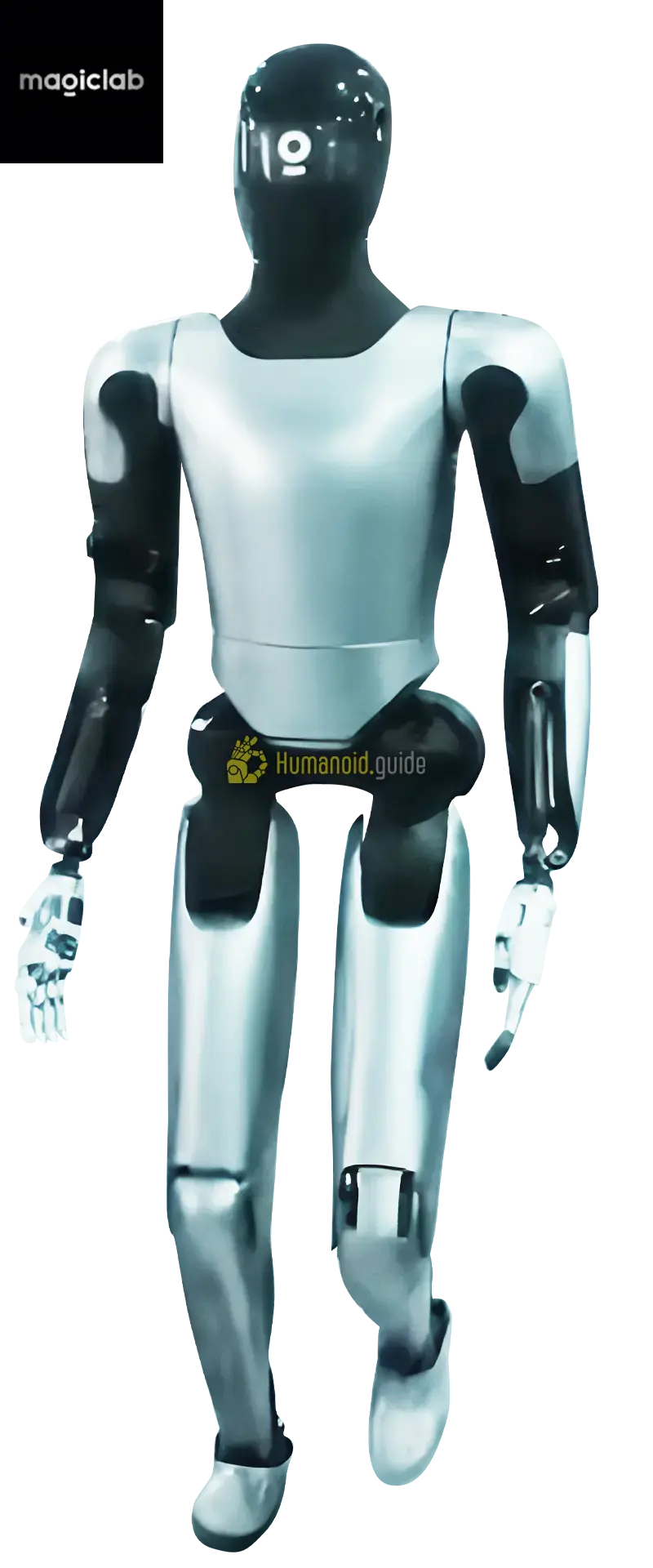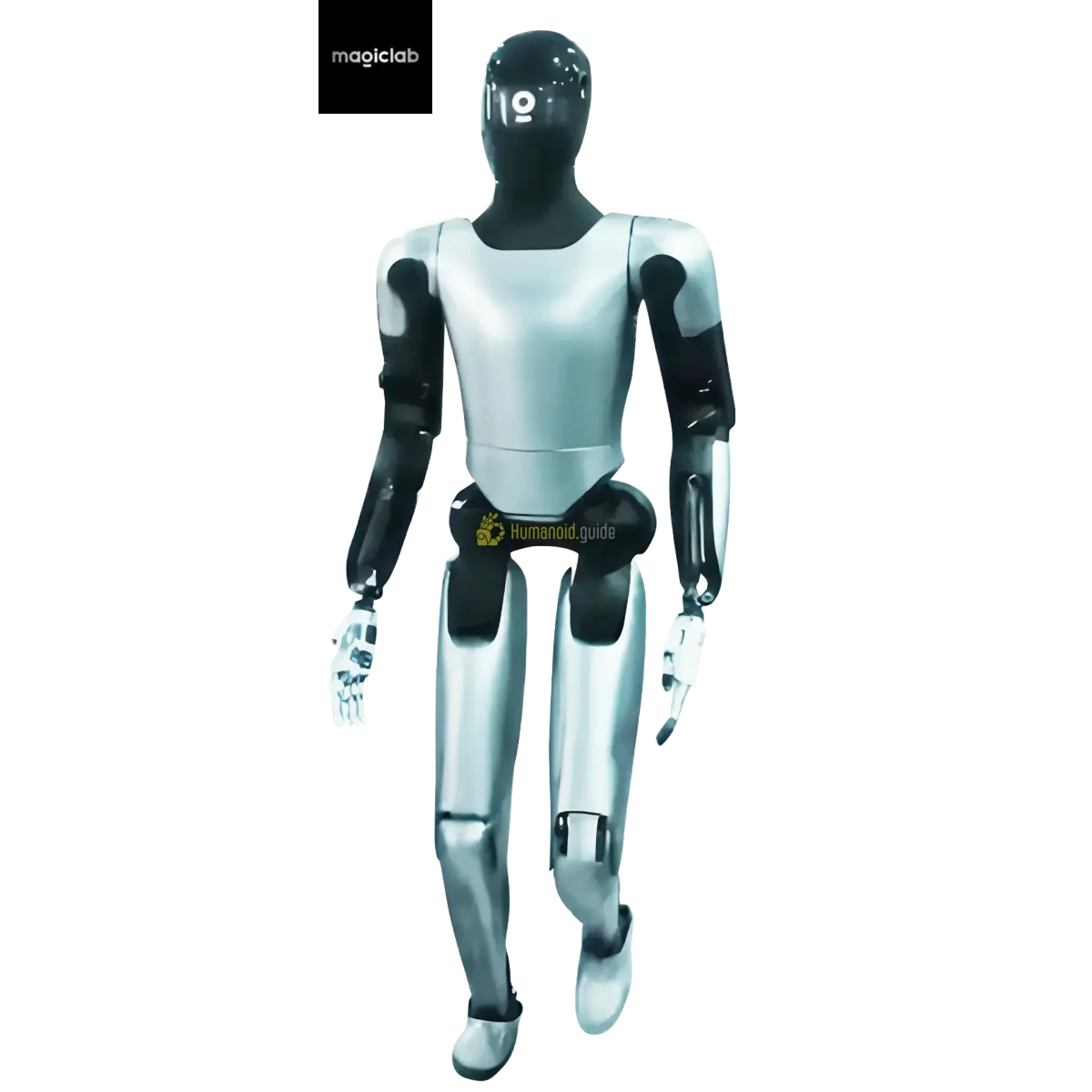
What is the Magicbot?
The MagicBot Z1 is a full-sized humanoid robot from MagicLab, a Chinese robotics startup. Standing 170 cm tall and weighing 55 kg, it features 49 degrees of freedom, high-performance smart joint actuators, and a sensor suite including stereo cameras, depth sensing, and 3-D LiDAR for navigation. Designed as a research platform for humanoid robotics and general-purpose automation, it can walk at up to 9 km/h and carry 10 kg of payload. MagicLab is developing MagicBot for education, service, and entertainment applications, though it remains in the prototype stage with no commercial release date.
Specifications
Here are the full technical specifications.
| Spec | Value |
|---|---|
| Height | 170 cm |
| Weight | 55 kg |
| Degrees of freedom | 49 |
| Battery life | ~4-5 hours |
| Max speed | 9 km/h |
| Payload | 10 kg (standing) |
| Price (new) | Undisclosed |
| Price (used range) | N/A (pre-commercial) |
Price & Value
New MSRP: Undisclosed (contact manufacturer)
Used range: N/A
The MagicBot Z1 is not yet on sale, so pricing is undisclosed. Prospective purchasers must contact MagicLab directly to inquire about research partnerships or early-access programs. In the broader humanoid robotics landscape, price points vary widely—from the $16,000 Unitree G1 to the anticipated $20,000 Tesla Optimus—giving a rough benchmark, but the Z1’s higher DOF and larger size suggest it could fall in a similar or slightly higher range if commercialized. Without a proven track record, its value remains speculative, and no used units exist to gauge depreciation. Total cost of ownership would also depend on support, software ecosystem, and spare parts availability, all currently undefined. Early adopters should also consider that many Chinese humanoid startups fail to reach production, so any investment in prototype partnership carries inherent financial risk.
Who Is It For?
Best for: - University and corporate robotics labs seeking a high-DOF humanoid research platform - Developers interested in bipedal locomotion and manipulation studies
Not for: - Companies needing a field-ready service robot (prototype only) - Buyers requiring a certified, commercially supported product
Alternatives & Comparison
The MagicBot Z1 enters a competitive landscape of Chinese humanoid prototypes. Below we compare it with two direct alternatives—Unitree G1 and Fourier GR-3—plus the internationally known Tesla Optimus.
| Model | Price | Available | Key Difference |
|---|---|---|---|
| Unitree G1 | $16,000 | preorder | Lighter, more affordable, proven locomotion |
| Fourier GR-3 | Undisclosed | preorder | High DOF dexterous hands, designed for manipulation |
| Tesla Optimus | $20,000 (projected) | preorder | Integrated into Tesla ecosystem, factory automation focus |
Verdict: For labs with limited budgets, the Unitree G1’s $16,000 price and proven locomotion make it the best buy. For dexterous manipulation research, the Fourier GR-3’s hands are more advanced. The MagicBot Z1 is intriguing for its high DOF and speed, but until it moves beyond the prototype phase with confirmed pricing and support, it remains a higher-risk choice for early adopters.
Use Cases & Capabilities
Humanoid Robotics Research
The MagicBot Z1’s 49 DOF and stereo camera/LiDAR stack make it an ideal platform for studying bipedal locomotion, whole-body motion planning, and sensor fusion. Its 9 km/h maximum speed provides a challenging baseline for control algorithms. Researchers can prototype autonomous navigation and object manipulation in lab environments without the constraints of a smaller robot. The open-frame design (based on early demo videos) suggests flexibility for custom sensor integration. However, the lack of publicly available software libraries and an established user community means early adopters must build much of the software stack from scratch. Nevertheless, for well-funded labs, the MagicBot Z1 offers a high-performance hardware testbed that could accelerate research into dynamic walking and manipulation.
General-Purpose Task Automation
MagicLab envisions the Z1 eventually performing tasks like sorting, assembling, and delivering items in unstructured environments. Its 10 kg standing payload is modest but sufficient for light industrial or household chores. The humanoid form factor allows it to use human tools and navigate spaces designed for people. In prototype demos, it has shown basic walking and turning capabilities, but full task execution—like picking up objects and placing them—has not been publicly demonstrated in detail. For now, this use case remains aspirational until the robot gains reliable manipulation and a robust software ecosystem. If MagicLab releases a reliable software development kit, the Z1 could become competitive for university and corporate automation projects.
Education and STEM Outreach
Universities and science museums could deploy the MagicBot Z1 as an eye-catching platform to teach robotics principles. Its human-like appearance and movement can captivate students and the public, making STEM concepts tangible. With 49 DOF, students can study kinematics and dynamics on a full-scale humanoid. However, as a prototype with no official educational curriculum or support materials, instructors would need to develop their own coursework and handle any hardware reliability issues independently. The high complexity and unknown maintenance costs make it suitable only for institutions with strong technical support staff.
Entertainment and Hospitality
As a humanoid, the MagicBot Z1 could serve as a greeter or performer in theme parks, hotels, or events, using its 49 DOF and 9 km/h walking speed to interact dynamically with guests. Its size and speed allow it to navigate human spaces with presence, while the sensor suite supports safe operation around people. In prototype demos, it has demonstrated basic walking, but expressive gestures and speech interaction have not been shown. The lack of safety certifications and reliability data currently prohibits real-world deployment in public settings. However, if developed further, the Z1 could become a cost-effective alternative to larger entertainment humanoids like Engineered Arts' robots.
History & Background
MagicLab is a Chinese robotics company believed to have been founded in the early 2020s, concentrating on humanoid robot development. The first known MagicBot prototype appeared around 2024, with a 42-DOF version standing 138 cm tall and weighing 54 kg, often referred to as MagicBot G1 on reseller sites. In 2025, the upgraded MagicBot Z1 was unveiled, featuring 49 degrees of freedom, a taller 170 cm frame, and a refined sensor suite with stereo cameras and 3-D LiDAR. Both variants use self-developed high-performance smart joint modules and variable-ratio transmission technology. MagicLab operates from China and has shared only limited demonstration footage on its website magiclab.top. As of 2026, the MagicBot Z1 remains a research prototype, with no mass production timeline, pricing, or commercial partnership announcements. Reports suggest a battery pack of 25 Ah (~1.35 kWh) delivering 4–5 hours of operation, though official specs are still preliminary. The company has not publicly disclosed its founding date or team size, and the robot has not been certified for any safety standards.
Buying Used — What to Check
Verify payload capacity 10 kg is only standing payload; arm/payload rating for manipulation is unpublished and may affect suitability for tasks.
Confirm battery runtime under load The 4-5 hour figure is an estimate based on a 25 Ah pack; real-world endurance during dynamic walking or computation-heavy tasks may be significantly less.
Inspect sensor calibration Prototype sensor stacks can drift; ensure LiDAR and stereo cameras are correctly calibrated for reliable navigation and object detection.