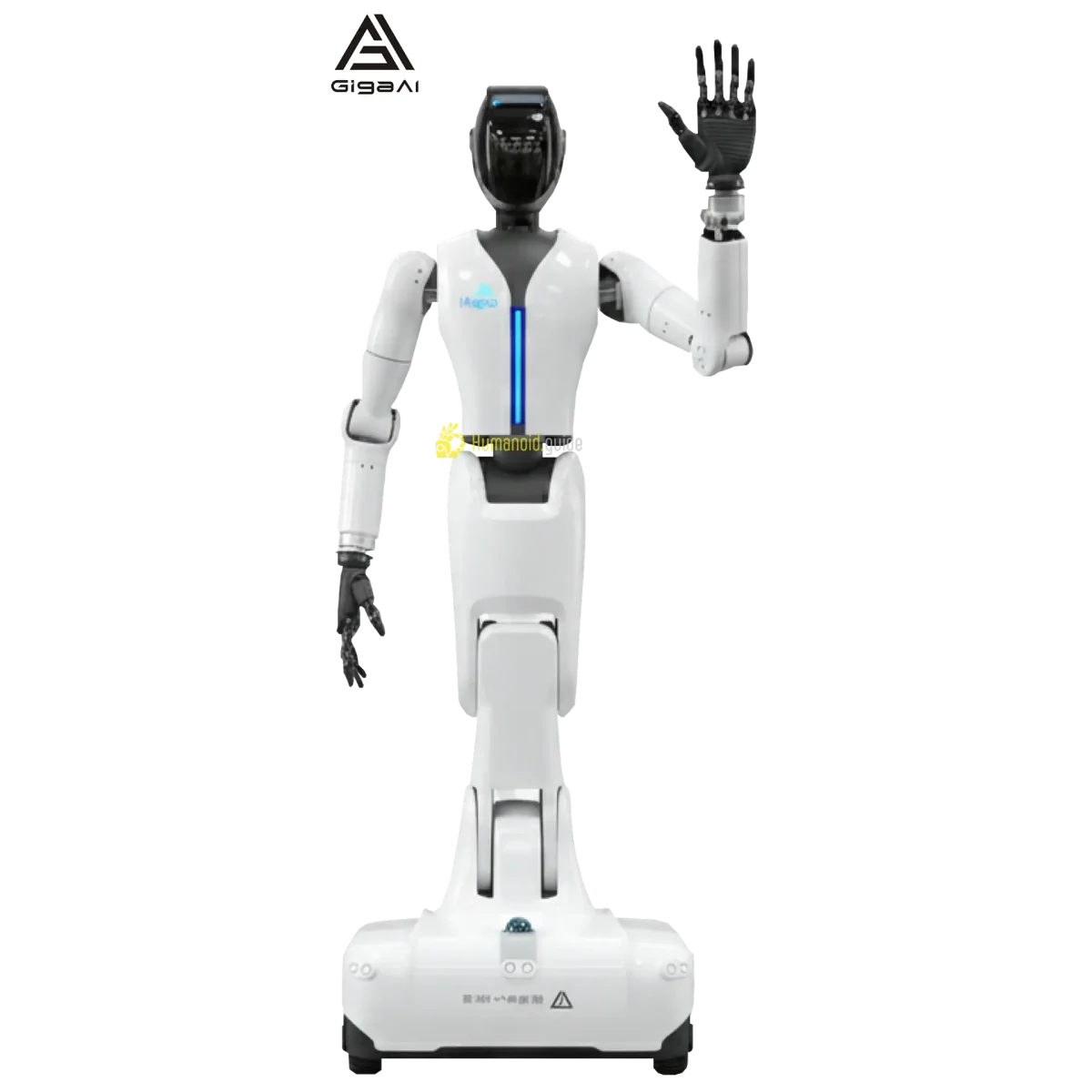
What is the Maker H01 Gigaai?
The GigaAI Maker H01 is a wheeled humanoid robot developed by the Chinese company GigaAI, first revealed in 2024. Designed primarily for service applications in home, hospitality, and light logistics, it features a 28-degree-of-freedom upper body with two five-fingered hands (14 DOF in hands) and a wheeled base for efficient indoor navigation. A unique selling point is its maker-friendly architecture: the robot runs on a Raspberry Pi brain and includes structural elements that can be 3D-printed, making it appealing to the hobbyist and educational robotics communities. While the manufacturer has not disclosed official pricing or mass production timelines, pre-orders are reported by third-party distributors, suggesting limited availability.
Specifications
Here are the full technical specifications.
| Spec | Value |
|---|---|
| Height | 1600 mm |
| Weight | 64 kg |
| Degrees of freedom | 28 |
| Battery life | 4 hours |
| Max speed | 8 km/h |
| Payload | 8 kg |
| Price (new) | Undisclosed |
| Price (used range) | N/A |
Price & Value
New MSRP: Undisclosed
Used range: N/A
GigaAI has not released an official price for the Maker H01, consistent with its status as a pre-commercial product. Distributor listings caution that all pricing remains unconfirmed, and interested buyers should contact the manufacturer directly. Given its maker-oriented design with standard components like a Raspberry Pi and 3D-printable parts, the bill of materials is likely low—potentially in the $2,000–$5,000 range for a basic kit—but any commercial markup is unknown. As a new platform, resale value will depend heavily on adoption and whether GigaAI establishes a community support ecosystem. Until official support, warranty, and spare parts information is provided, total cost of ownership is impossible to estimate accurately. Prospective buyers should budget for a Raspberry Pi 4 or 5, 3D-printing materials, and possibly custom fabrication of missing parts.
Who Is It For?
Best for: - Makers and educators seeking a wheeled humanoid platform with open-source modifiability and low hardware cost - Hospitality venues needing a mobile receptionist robot with expressive arms - Research labs exploring dual-arm mobile manipulation with a maker-friendly controller
Not for: - Heavy industrial tasks (limited to 8 kg payload) - Bipedal locomotion research (the Maker H01 is wheeled) - Outdoor deployment (IP20 ingress protection)
Alternatives & Comparison
The Maker H01 occupies a niche among affordable, maker-focused humanoids, competing with open-source platforms like InMoov and the Poppy Humanoid.
| Model | Price | Available | Key Difference |
|---|---|---|---|
| InMoov | ~$3,000 (est.) | yes | Fully 3D-printable but does not offer a wheeled base and lacks a standard Raspberry Pi controller. |
| Poppy Humanoid | ~$8,000 (est.) | yes | Bipedal, more complex, and uses a Dynamixel-based skeleton, making it less accessible for beginners. |
Verdict: For makers who value mobility and a lower barrier to entry, the Maker H01's wheeled base and Raspberry Pi brain make it simpler than bipedal equivalents like Poppy. However, InMoov offers a larger community and proven design at a similar price point. The Maker H01's value will ultimately be determined by official pricing and community support.
Use Cases & Capabilities
Home Service and Assistance
The Maker H01 can perform simple fetch-and-carry tasks in a home environment, using its wheeled base to navigate between rooms and its 14-DOF hands to manipulate objects up to 8 kg. With 4-hour battery life and a height of 160 cm, it can access kitchen counters and shelves. Its IP20 rating means it should avoid wet areas, and the 3D-printable structure allows customization for specific household tasks. The Raspberry Pi control system supports voice interaction and integration with smart home devices, though latency (250–450 ms) may limit real-time conversation.
Hospitality and Reception
Deployed in a hotel lobby or office reception, the Maker H01 can greet visitors, provide directions, and deliver lightweight items like documents or beverages. Its wheeled design enables smooth movement on flat floors, while the upper body can gesture and present a friendly interface. The robot's aluminum alloy and ABS shells are durable for public spaces, but the lack of certified safety features means it should be used under supervision. Custom 3D-printed skins or logos can adapt its appearance to a brand.
Education and Research
For universities and robotics clubs, the Maker H01 serves as a platform to study mobile manipulation, human-robot interaction, and ROS integration without the complexity of bipedal balance. Its 28 DOF provide ample degrees of freedom for arm trajectory projects, and the Raspberry Pi compatibility allows students to code in Python and C++. The low cost assumption (unconfirmed) and 3D-printable replacement parts make repairs affordable, though the absence of an official curriculum or community forum currently limits its uptake.
Light Logistics and Workplace Assistance
In small warehouses or offices, the Maker H01 can act as a courier between workstations, carrying loads up to 8 kg on a tray or in its grippers. Its 8 km/h top speed is adequate for indoor distances, and the 4-hour battery enables a half-shift without recharging. However, its reliance on Wi-Fi and Bluetooth may be unreliable in steel-framed buildings. The robot is not designed for rugged environments, and the lack of a published MTBF makes it risky for continuous operation.
History & Background
GigaAI, a Chinese robotics startup, emerged around 2023, though the company's exact founding date is not publicly documented. The Maker H01 was first unveiled in 2024, targeting the maker and education markets with an open-architecture, wheeled humanoid design. The robot quickly gained attention from hobbyist forums and tech media for its use of a Raspberry Pi controller and 3D-printed structural components, reminiscent of the popular open-source humanoid InMoov but in a wheeled, service-oriented format. As of 2026, GigaAI has not announced mass production or a formal release date, and the Maker H01 remains in a pre-order/pre-commercial phase through third-party distributors like MERA Robotics. The company's current roadmap and funding status are unknown, leaving the platform's future uncertain but still generating interest among early-adopter makers.
Buying Used — What to Check
Verify payload rating The claimed 8 kg may differ from actual arm endurance after 3D-printed part wear.
Battery health 4 hours runtime is based on new cells; older packs may degrade, and replacement availability is unknown.
Raspberry Pi version The control architecture may depend on a specific Pi model; confirm compatibility and software support.